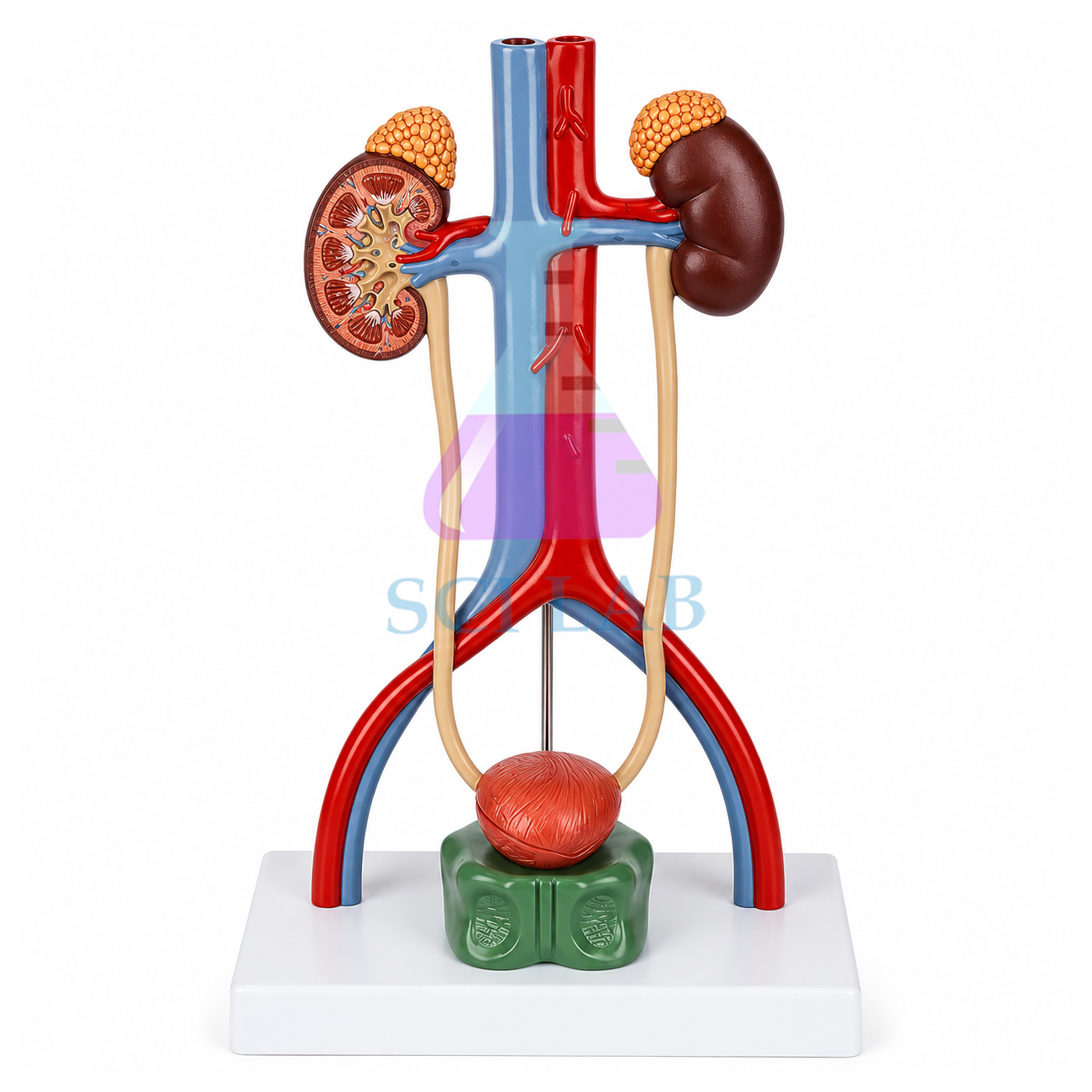
Human Urinary System Model, PVC
Product Code : SCL-BLE-11732
The Human Urinary System Model, PVC, is an enlarged three-dimensional model of the human urinary system for biology lessons. It is moulded in PVC and brightly coloured with non-toxic dyes, so students can follow how urine is made in the kidneys and carried away for storage and release.
Specifications of the Urinary System Model
| Specification | Value |
|---|---|
| Shows | Human urinary system |
| Scale | Enlarged |
| Material | PVC, brightly coloured with non-toxic dyes |
| Supplied by | Science Lab Supplies, Ambala, India |
Excretion Lessons with the Urinary System Model
Students trace urine from where it forms to where it leaves the body, naming each organ and its job as they go.
- Path of urine (Class 7 to 10): kidneys, ureters, bladder and urethra, in that order.
- Inside the kidney (Class 10 and 11): open the organ on the Kidney With Adrenal Model to see the cortex, medulla and renal pelvis, then study the capillary knot where filtration begins on the Glomerulus Model.
- Excretion beyond the kidneys: compare the jobs of the kidneys, lungs, skin and liver in removing wastes.
Common errors: drawing the urethra as the first tube after the kidney, and labelling the bladder as part of the kidney.
Frequently Asked Questions
Does the model show a male or a female urinary system?
No sex is stated and no inserts are listed. The kidneys, ureters and bladder are the same in both sexes; the urethra is the part that differs, being longer in males and passing through the prostate. One model therefore covers urine formation and the path of urine, and sex differences can be shown on a chart.
How does it differ from the urinary models with removable parts in the range?
Other urinary models in the range list a removable kidney or bladder and male and female inserts. This listing names none of these: it is an enlarged, brightly coloured PVC model for showing how the system works.
What is the difference between the ureter and the urethra?
Each kidney has its own ureter, a tube that carries urine down to the bladder. The single urethra carries urine from the bladder out of the body, so it is the last part of the system.
Where are the kidneys found in the body?
At the back of the abdomen, one on each side of the backbone, just below the ribcage. The right kidney usually sits a little lower than the left because the liver lies above it.
Are the kidneys the only organs that remove wastes?
No. The lungs remove carbon dioxide, sweat from the skin carries salts and a little urea, and the liver breaks down old red blood cells and other substances. The kidneys remove most nitrogen waste as urea.
Why is urine stored in the bladder rather than released all the time?
The kidneys make urine continuously. The stretchy muscular wall of the bladder holds it, and as it fills, stretch receptors send signals that create the urge to urinate.
Related Urinary and Kidney Models
- Human Urinary System Model: kidneys with ureters, adrenal glands and bladder with prostate, with removable kidney and bladder.
- Human Urinary System Deluxe Model: six-part model with male and female inserts, on a base with numbered key cards.
- Kidney Stone Model: calices, renal pelvis and ureter opened to show where stones form.
- Kidney Model, Approximately 3-4x Enlarged: PVC kidney with removable parts, enlarged 3 to 4 times.
- Human Kidney On Stand Model: kidney in two removable parts showing cortex, medulla and calices, on a stand.
Explore excretory and other organ-system models in Human System Model, or return to Biology Lab Equipment.
Destinations open for export of the urinary system model include the UAE, Saudi Arabia, Oman, the Philippines, Nepal and Bangladesh, under the Importer-Exporter Code of Science Lab Supplies. A quotation for this model may be requested on the contact page or by adding it to the enquiry cart.
Last updated: 15 November 2026
.jpg)