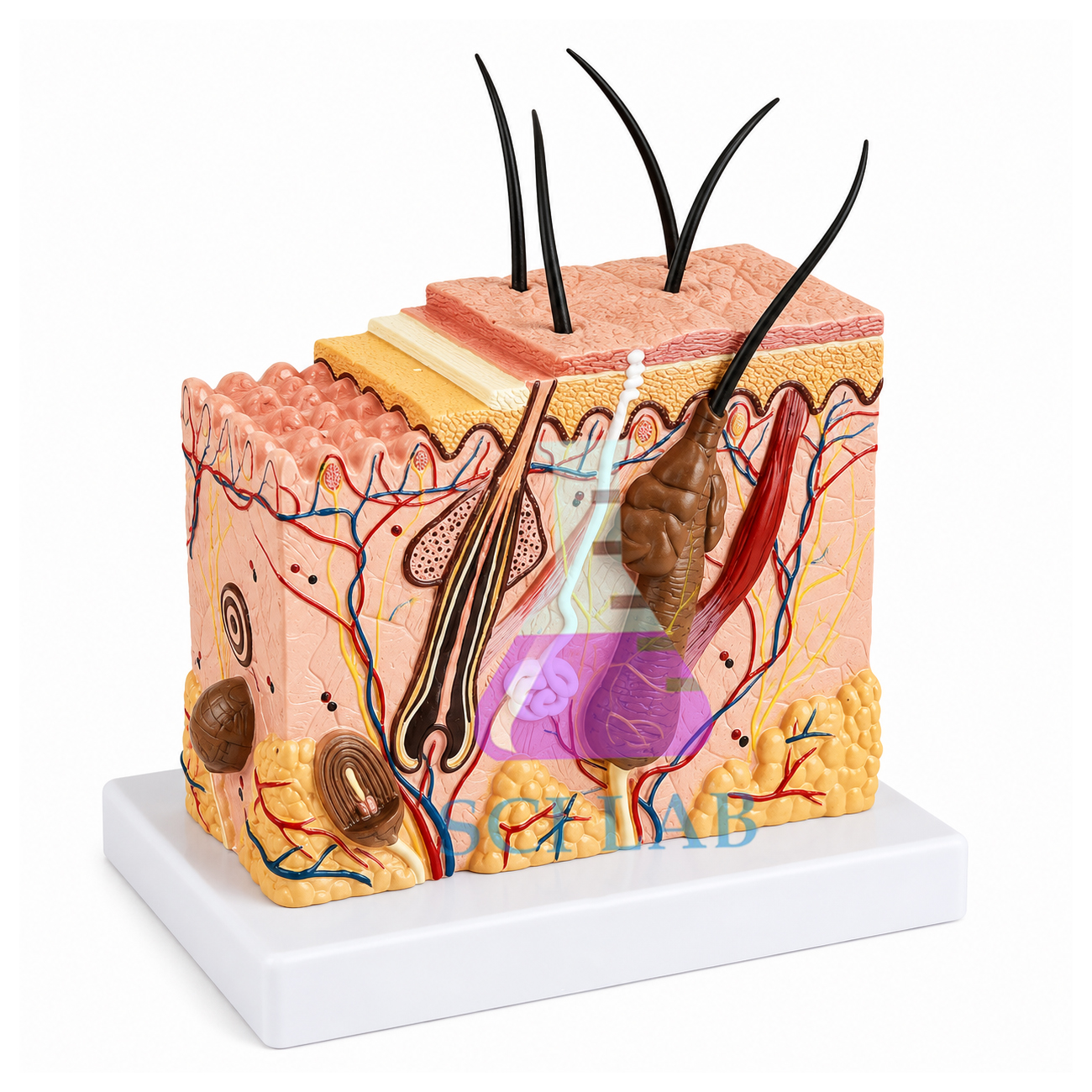
Human Skin Section Model, 70x Enlarged
Product Code : SCL-BLE-11731
The Human Skin Section Model is a three-dimensional desk relief model of human skin, enlarged 70 times. It compares scalp skin with hairless skin and shows the epidermis, hairs with their roots, sweat and sebaceous glands and Meissner's corpuscles. The PVC relief is coloured with non-toxic dyes and detailed on the front, side and back. It is a model to handle and point to, not a microscope slide.
Specifications of the Human Skin Section Model
| Specification | Value |
|---|---|
| Enlargement | 70 times |
| Skin types | Scalp skin and hairless skin |
| Structures | Epidermis, hairs and hair roots, sweat glands, sebaceous glands, Meissner's corpuscles |
| Views | Front, side and back |
| Form and material | Three-dimensional desk relief model in PVC with non-toxic dyes |
| Supplied by | Science Lab Supplies, Ambala, India |
Skin Structure Lessons with the Human Skin Section Model
Students name the skin layers from the surface down, then link each structure to a job: protection, cooling, touch or hair growth.
- Layers and glands (Class 9 and 10): epidermis and dermis, sweat glands and sebaceous glands, then find the same parts, far smaller, on the Human Skin with Hair Follicles and Glands, Transverse Section microscope slide.
- Microscope work: view the stained skin section on the Biological Microscope and draw it at low and high power.
- Touch test: find how close two blunt points can be and still be felt apart on a fingertip and on the forearm, and link the result to Meissner's corpuscles in hairless skin.
Common errors: drawing sebaceous glands opening straight onto the skin instead of into the hair follicle, and putting sweat glands only in the epidermis.
Frequently Asked Questions
Why does the model show both scalp and hairless skin?
The two skin types differ. Scalp skin has many hair roots with sebaceous glands, while hairless skin, as on the palm, has none of these but many Meissner's corpuscles for fine touch. Side by side, the contrast is easy to teach.
Which sense receptors are shown?
Meissner's corpuscles: the touch receptors that sit just below the epidermis of hairless skin, where fine touch is sharpest. For lessons on pressure, heat or pain endings, a skin structure chart can be used beside the model.
Which class levels is a 70 times skin model suited to?
Secondary biology lessons on skin structure and temperature control, and college anatomy practicals in which students compare scalp and hairless skin before studying stained sections.
Where does a sebaceous gland release its oil?
Into the hair follicle, beside the hair. The oil, called sebum, then spreads onto the hair and the skin surface and keeps them supple, which is why sebaceous glands sit beside hairs.
Is all of the hair inside the skin?
No. Only the root lies inside the skin, in the follicle, with the bulb at its base. The shaft is the part above the surface, made of dead cells filled with keratin.
Which skin has an extra clear layer in its epidermis?
Thick skin, such as that of the palms and soles. It has a stratum lucidum between the granular layer and the thick outer horny layer; thin hairy skin lacks it.
Related Skin and Nervous System Items
- Skin Section Model: three layers of head skin with hair follicles, sebaceous and sweat glands, receptors, nerves and vessels.
- Human Skin Model: 3-layer model of hair-covered head skin on a base, numbered with a key card.
- Neuron Model: schematic nerve cell with axon, medullary sheath and Schwann's sheath, on a base.
- Hand Magnifier, 2x, 50 mm Lens, Plastic Handle: 2x magnifier with a 50 mm lens and a plastic handle, 140 mm long overall.
Skin and organ models also appear under Human System Model, and the Biology Lab Equipment range lists the PVC series.
For skin models bound for Uganda, the UAE, Saudi Arabia, Oman, the Philippines or Nepal, Science Lab Supplies can arrange export under its Importer-Exporter Code. Quotations on the skin section are prepared on request from the contact page, and the enquiry cart can hold it alongside other models.
Last updated: 16 November 2026



.jpg)