Biological Microscope
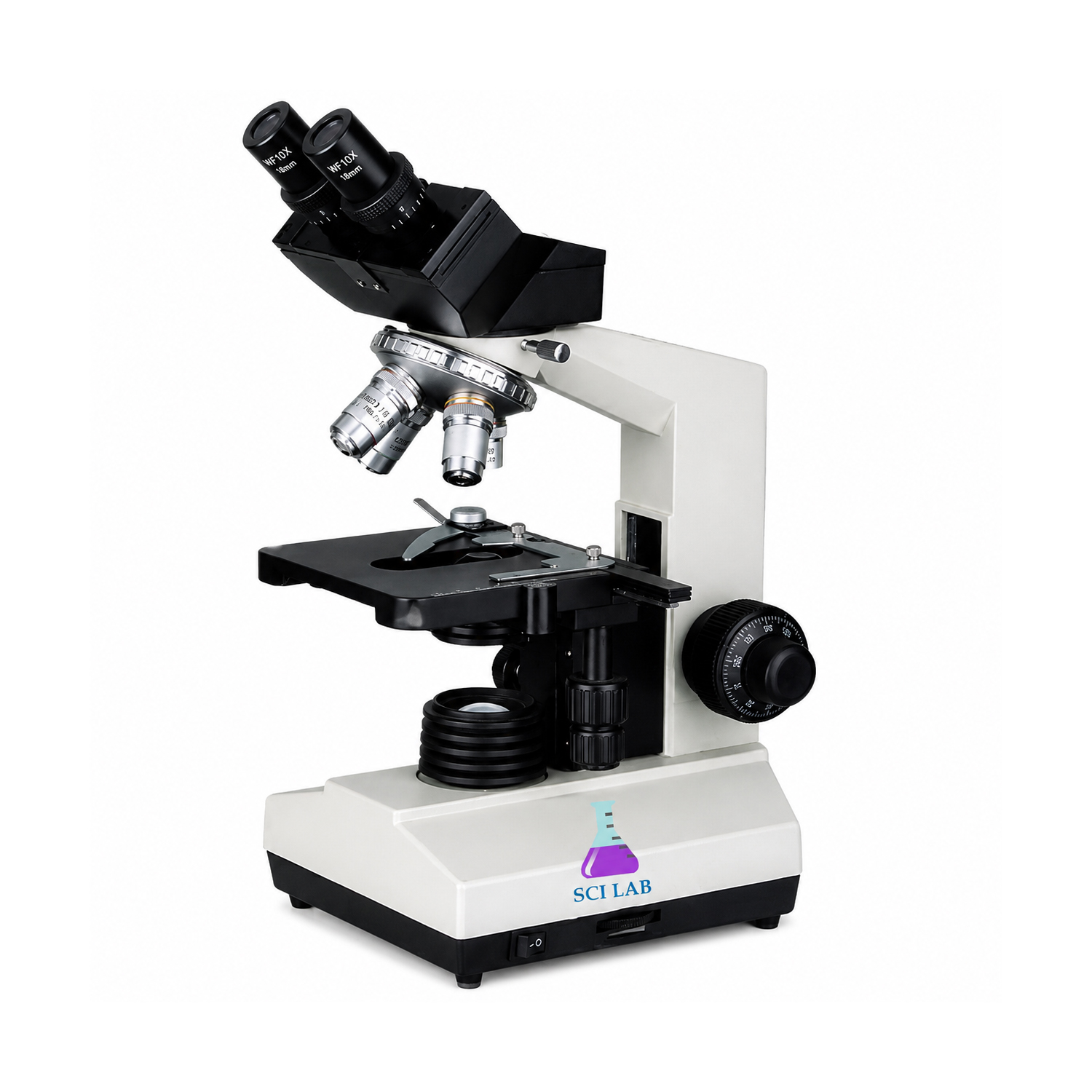
Product Code : SCL-BLE-11612
The Biological Microscope is a compound light microscope for viewing thin specimens on glass slides. It has a monocular head with a WF10x eyepiece and three plan achromatic objectives, 4x, 10x and 40x, which give 40x, 100x and 400x. Transmitted LED light passes through a condenser, and focusing is coarse and fine. Contrast is optimised for practical work by students, researchers and veterinarians.
Specifications of the Biological Microscope
| Specification | Value |
|---|---|
| Head | Monocular |
| Eyepiece | WF10x (wide field) |
| Objectives | Three plan achromatic objectives: 4x, 10x and 40x, all dry |
| Magnification | 40x, 100x and 400x |
| Illumination | Built-in transmitted LED |
| Condenser | Fitted |
| Focus | Coarse and fine |
| Image | Optimised contrast |
| Finish | Scratch-resistant |
| Supplied by | Science Lab Supplies, Ambala, India |
Slide Work with the Biological Microscope
Place the slide on the stage, switch on the LED and bring the image into view with the coarse focus and the 4x objective. Centre the part you want, then turn to a higher objective and sharpen the image with the fine focus only.
- Plant and animal cells: mount onion peel or cheek cells on Laboratory Microscope Glass Slides (Pack 50) under a Cover Glass, 22 x 22 mm, 0.17 mm.
- Staining: add a drop of methylene blue or Lugol's solution from the Stains and Reagents for Microscopy set to make nuclei or starch grains visible.
- Prepared slides: compare tissues such as stems, roots and blood at each objective and draw what is seen.
- Magnification records: note the objective used for every drawing and write the total beside it: 40x, 100x or 400x.
Carry the microscope with one hand under the base and one on the arm, and clean lenses only with lens tissue. All three objectives are dry lenses, so no immersion oil goes on the slide.
Frequently Asked Questions
Should a school order a compound or a stereo microscope?
This is a compound microscope, used for thin specimens on slides such as cells, tissues and microorganisms. Whole insects, flowers or rocks are looked at under a stereo microscope at lower magnification. Many labs keep both.
What is the difference between plan and ordinary achromatic objectives?
A plan objective is corrected for a flat field, so the whole view is sharp to the edge at one focus setting. With an ordinary achromatic objective the centre is sharp but the edge goes soft and needs a small refocus. The three objectives on this microscope, 4x, 10x and 40x, are plan achromats.
How is total magnification worked out?
Multiply the eyepiece power by the objective power. With the WF10x eyepiece, the 4x, 10x and 40x objectives of this microscope give 40x, 100x and 400x. Write the total beside every drawing.
Why is built-in illumination better than a mirror for class work?
The built-in LED shines up through the condenser and the slide, giving the same steady light at every bench, whatever the weather or the room. A mirror needs daylight or a desk lamp, and pupils must never angle a mirror towards the sun, which can damage the eye.
Why does the image move the opposite way when the slide is pushed?
The lenses form an image that is upside down and reversed left to right. Push the slide to the left and the image moves right; push it away and the image comes towards you. A letter e printed on paper and mounted on a slide is a quick way to practise before moving to cells.
Related Microscopes and Slide Supplies
- Digital Trinocular Microscope: built-in 3 MP camera with USB output to a 10.1 inch tablet, and a dimmable LED below the stage.
- Digital Binocular Microscope: built-in 3 MP camera, 10.1 inch tablet PC and plan objectives from 4x to 100x oil.
- Field Microscopy Kit: battery-powered LED monocular microscope, 40x to 400x, with 50 slides and 200 coverslips.
- Biological Prepared Slide Kit (10 Slides): ten ready-to-view slides for practical classes.
- Microscope Slide Box for 100 Slides: storage for standard 7.6 x 2.6 cm slides.
More slide and microscope items are in Biology Lab Equipment and the Microscope Lab Equipment range.
Laboratories in Malaysia, Peru, Egypt, Iraq, Nigeria and Kenya can be supplied by export: Science Lab Supplies holds an Importer-Exporter Code. Please use the contact page or the enquiry cart when asking for a quotation.
Last updated: 20 November 2026