Comparison of Limbs in Vertebrates
Product Code : SCL-BLE-11716
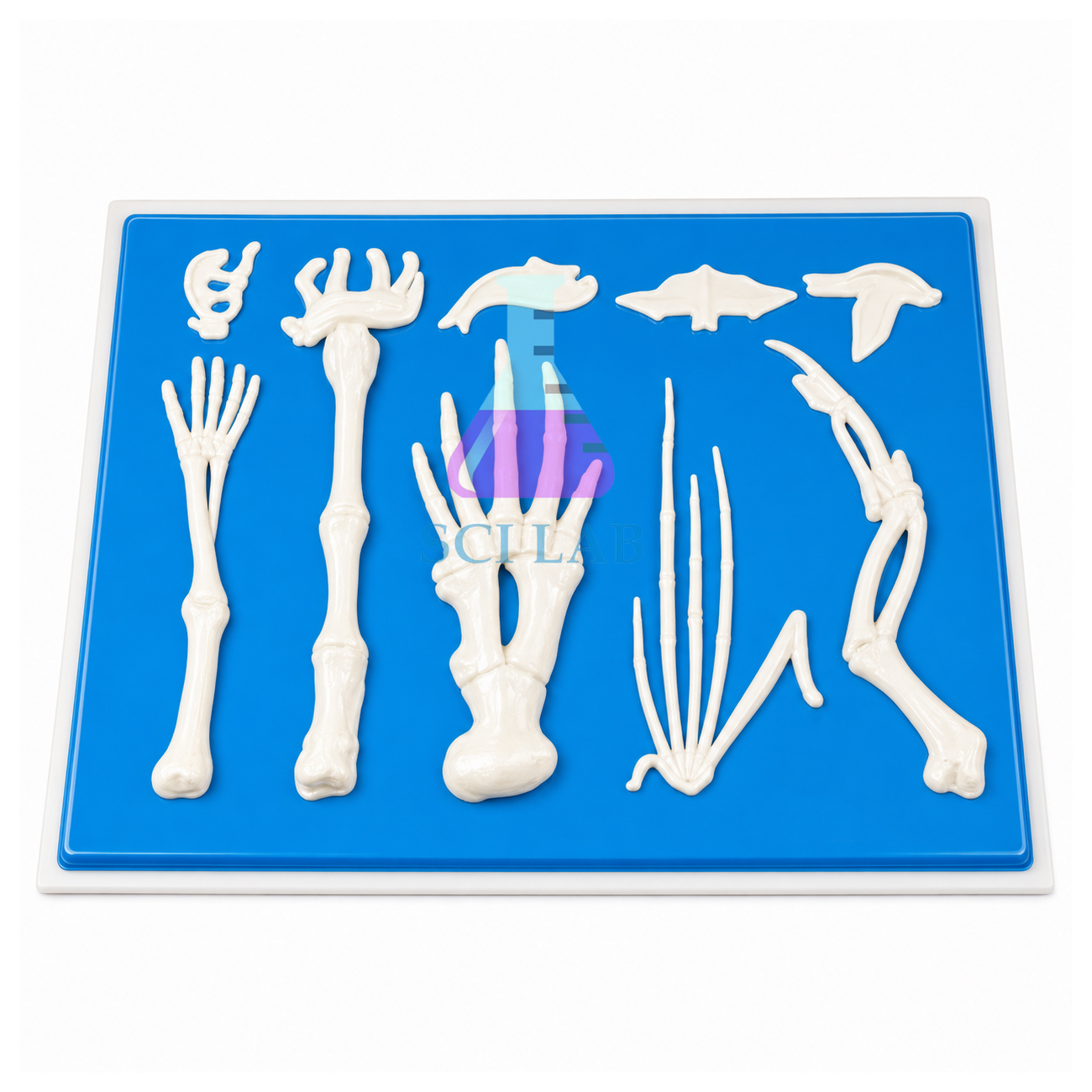
The Comparison of Limbs in Vertebrates is a three-dimensional model of five homologous forelimbs: a human arm, a cat foreleg, a whale flipper, a bat wing and a bird wing. The scaled replicas, in PVC with non-toxic dyes, sit on one board with a printed English key, and the humerus, radius and ulna, wrist and digits are marked wherever shown. A class compares how one bone plan serves different uses.
Specifications of the Vertebrate Limbs Model
| Specification | Value |
|---|---|
| Shows | Five homologous forelimbs: human arm, cat foreleg, whale flipper, bat wing, bird wing |
| Type | Three-dimensional scaled replicas, mounted on one board |
| Bones marked | Humerus, radius and ulna, wrist and digits, wherever shown |
| Key | Printed, in English |
| Material | PVC with non-toxic dyes |
| Supplied by | Science Lab Supplies, Ambala, India |
Evidence for Evolution with the Vertebrate Limb Model
Lay the board on the bench and give each group a blank outline of each of the five forelimbs. Students colour matching bones in the same colour on every outline, check them against the marks and the printed key, then discuss why the plan repeats.
- Bone matching (Class 10 to 12): colour the humerus, the radius and ulna, the wrist bones and the digits in the same colours wherever they appear.
- Use and shape: add a column for what each limb does (grasping, walking, swimming or flying) and note which bones are longer, shorter, fused or missing.
- Find it in a skeleton: locate the same bones on the arm of the Human Skeleton Model 45 cm, then look at the paired fins of the Fish Dissection as the older body plan.
Frequently Asked Questions
Which school topics can a distributor offer this limb model for?
Evolution units: homologous and analogous organs, divergent and convergent evolution, and comparative anatomy as evidence for common descent, usually in senior secondary biology. It also supports lessons on how limb shape suits walking, swimming, flying or grasping in vertebrate zoology courses.
Which animals does the limb board compare?
Five forelimbs: a human arm, a cat foreleg, a whale flipper, a bat wing and a bird wing. The humerus, radius and ulna, wrist and digits are marked wherever shown, and a printed English key names them, so pupils match one bone plan across grasping, walking, swimming and flying limbs.
Are the five limbs shown at their real sizes?
No. They are scaled replicas on one board. In life a bat wing is tiny beside a whale flipper, while true-to-life casts leave wrist and finger bones small. Bringing each limb to a comparable size lets a class see the same bones side by side from the bench.
Is a fish fin homologous to a human arm?
Partly. The paired front fins of fish and the arms of land vertebrates arose from the same paired appendage. In lobe-finned fish the fin base already has bones matching the upper arm and the two forearm bones, but fin rays are not the same as fingers, which formed later in early land vertebrates.
Do homologous limbs have to do the same job?
No. Homology is about shared origin and structure, not function. A human hand grasps, a bat wing flies and a whale flipper swims, yet all three are built on one bone plan. Assuming the same use is a common exam mistake.
How are homologous limbs different from analogous structures?
Analogous structures do a similar job but have a different origin and build. A bird wing and an insect wing both give flight, but one has bones and the other is a thin sheet of cuticle. They arise by convergent evolution.
Related Evolution and Skeleton Teaching Aids
- Evolution of the Animal World Chart, 70 x 100 cm: laminated wall chart, 70 x 100 cm.
- Human Skeleton Chart: laminated chart for wall mounting, 70 x 100 cm.
- Bone Structure Chart: laminated 70 x 100 cm chart for laboratories and classrooms.
- Lizard Dissection: formalin specimen sealed in a 200 x 70 x 40 mm glass container.
- Dissection of the Frog: dissected frog in formalin, in sealed glass.
See Biology Lab Equipment for further models, or the full School Lab Equipments range for other subjects.
Science Lab Supplies holds an Importer-Exporter Code, which allows it to ship to Zambia, Rwanda, South Africa, Qatar, Sri Lanka and Vietnam. Requests for a quotation go through the contact page or the enquiry cart.
Last updated: 19 November 2026