Comparative Vertebrate Heart Models
Product Code : SCL-BLE-11740
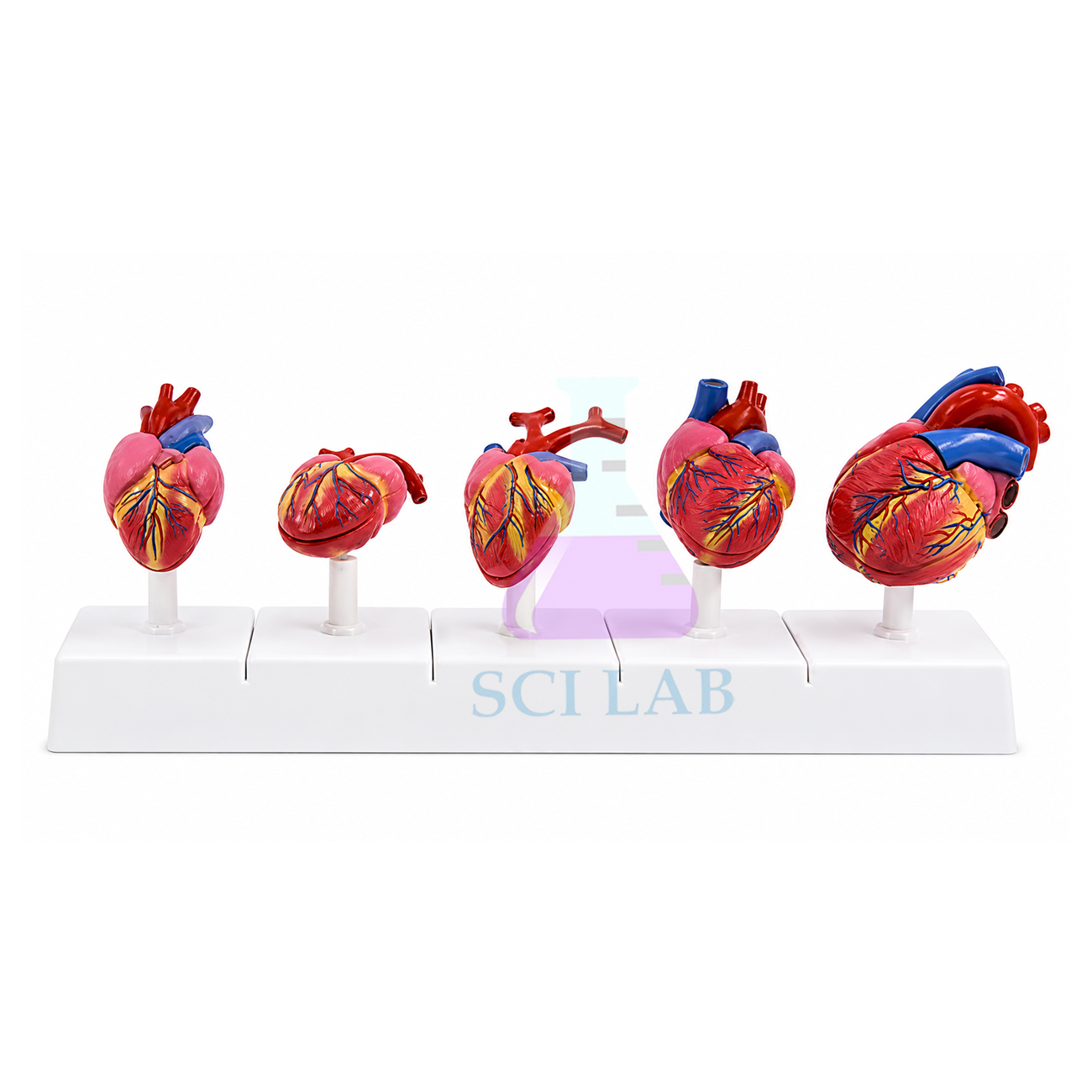
The Comparative Vertebrate Heart Models are a set of five moulded plastic hearts: a fish, a frog, a turtle, a bird and a human heart for the mammals. Each heart opens to show its chambers, has the direction of blood flow marked and sits on its own stand, with an English comparative key for the set. Students follow the change from two chambers to four.
Specifications of the Vertebrate Heart Models
| Specification | Value |
|---|---|
| Models | 5 hearts: fish, frog, turtle, bird and mammal (human heart) |
| Construction | Openable, showing the internal chambers |
| Circulation | Direction of blood flow marked on each heart |
| Model size | About 80 to 180 mm per model |
| Material | Moulded plastic |
| Mounting | Each model on its own stand |
| Key | English comparative key |
| Subject | Comparative anatomy of the vertebrate heart |
| Supplied by | Science Lab Supplies, Ambala, India |
Comparing Vertebrate Hearts in the Zoology Class
Students open one heart at a time, from the fish to the human heart, count the chambers and follow the marked flow direction to draw the route that blood takes from the body back to the body.
- Chamber count (Class 9 to 11): work through the five models: two main chambers in the fish, three in the frog, three with a partly divided ventricle in the turtle, and four in the bird and the human heart. Crocodilians are the reptile exception, with four chambers. Then study the four chambers in detail on the Human Heart Model, 3 Detachable Parts.
- Double circulation: trace the lung circuit and the body circuit on the Human Blood Circulation Chart and mark where each begins.
- Common plan: set the hearts beside the Comparison of Limbs in Vertebrates to discuss how one body plan is changed in each class.
Common errors: mixing up the vessels that carry blood to and from the gills, and reading the two amphibian atria as one chamber.
Frequently Asked Questions
Which vertebrate groups should a heart comparison cover?
A full comparison covers five classes: fish, amphibian, reptile, bird and mammal. This set covers them with a fish, a frog, a turtle, a bird and a human heart for the mammals. Crocodilians deserve a mention in class, because unlike the turtle their heart has four chambers, like a bird's.
What should a buyer check about how each heart is shown?
Check whether each heart opens to show its chambers, whether the direction of blood flow is marked, how each heart is mounted and what key comes with it. In this set each moulded plastic heart opens, has the flow direction marked and sits on its own stand, with an English comparative key; the models measure about 80 to 180 mm.
What happens to the sinus venosus in mammals?
It no longer forms a separate chamber. It becomes part of the wall of the right atrium, and the sinoatrial node, the heart's pacemaker, develops from it.
What is the conus arteriosus in a dogfish heart?
It is a muscular tube after the ventricle with valves inside. It evens out the pressure of each beat and stops blood flowing back before it moves on through the ventral aorta to the gills.
How many atria does an amphibian heart have?
Two, a left and a right, both opening into a single ventricle. Seen from above they can look like one chamber, so students should find the dividing wall before they count.
Which vessels carry blood to and from the gills of a fish?
Afferent branchial arteries take blood from the ventral aorta to the gills while it is still low in oxygen. Efferent branchial arteries carry the oxygen-rich blood away from the gills towards the dorsal aorta and the body.
Related Heart and Circulation Models
- Heart Model, Giant: extra-large human heart that separates into 4 parts, 280 x 230 x 330 mm, with English key card.
- Human Heart Jumbo Model: PVC, 4 times enlarged, dissectible into 3 parts, 25 x 23 x 23 cm.
- Heart Model with Hand Pump: a simple hand pump shows blood flow through the heart and lungs.
- Pumping Heart Model: shows how the heart pumps blood round the body, 320 x 250 x 65 mm, needs assembling.
- External View of the Heart Chart: laminated wall chart, 70 x 100 cm.
Comparative anatomy items belong to Biology Lab Equipment, while the whole school offer starts at School Lab Equipments.
Science Lab Supplies can add this heart comparison item to export shipments for South Africa, Qatar, Sri Lanka, Vietnam, Malaysia and Peru, using the Importer-Exporter Code registered in its name. Teachers and distributors may raise questions on the contact page, or save the item in the enquiry cart before asking for a quotation.
Last updated: 19 November 2026

.jpg)