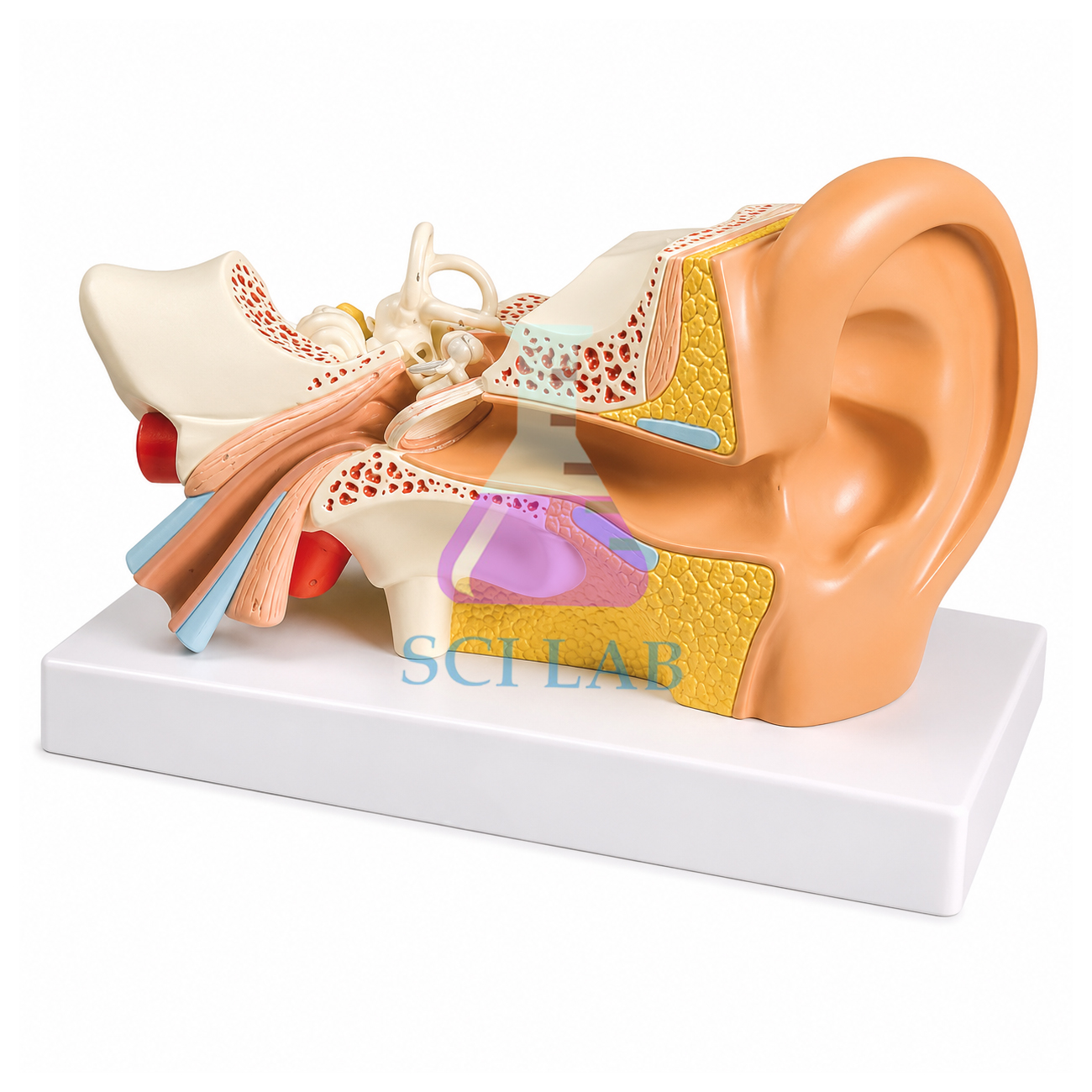
Human Ear Model, 6x Enlarged
Product Code : SCL-BLE-11726
The Human Ear Model, 6x Enlarged, is a three-dimensional model of the human ear shown six times life size. It shows the outer, middle and inner ear, including the auditory bones, the tube and the canals, so the path of sound can be followed from the outside to the inner ear. It is moulded in PVC and coloured with non-toxic dyes.
Specifications of the Human Ear Model
| Specification | Value |
|---|---|
| Shows | Outer, middle and inner ear, with the auditory bones, tube and canals |
| Enlargement | 6 times life size |
| Material | PVC, coloured with non-toxic dyes |
| Supplied by | Science Lab Supplies, Ambala, India |
Hearing and Balance Lessons with the Human Ear Model
Students follow a sound wave from the outer ear to the inner ear and name each part it passes, then turn to the parts that sense balance.
- Path of sound (Class 8 to 11): pinna, ear canal, eardrum, the three auditory bones, oval window and cochlea, then the nerve to the hearing area of the brain on the Human Brain Model, 2 Parts, on Stand.
- Pressure balance: find where the auditory tube opens into the throat on the Median Section of the Head Model and explain why ears pop on a hill road.
- Balance: name the semicircular canals and explain how fluid moving in them signals a turn of the head.
Common errors: giving the cochlea a part in balance, and calling the ear canal the Eustachian tube.
Frequently Asked Questions
Which other sense-organ models are usually ordered with an ear model?
Schools that teach the sense organs as one unit usually pair the ear with an eye model, then add models or charts of the tongue, nose and skin so that each sense has its own item. The ear model carries the hearing and balance lessons.
Why does sound need the three ear bones to reach the inner ear?
The inner ear is filled with fluid, and most sound energy in air would bounce off a fluid surface. The ossicles collect the vibration of the large eardrum and press it onto the much smaller oval window, and their lever action adds force, so enough energy passes into the cochlea.
Does it cover all three regions of the ear?
Yes. The outer, middle and inner ear are all modelled, so one item covers the full hearing pathway for school lessons on hearing and balance.
What happens if the Eustachian tube is blocked?
Air pressure on the two sides of the eardrum can no longer be equalised. The eardrum is pushed in or out, which gives a blocked feeling, discomfort and dull hearing, for example during a cold or a fast change in altitude.
Which parts of the ear control balance rather than hearing?
The vestibular parts of the inner ear: the three semicircular canals, which sense turning of the head, and the utricle and saccule, which sense tilt and straight-line movement. The cochlea is for hearing.
In what order are the ear ossicles arranged?
Malleus, incus, stapes. The malleus is attached to the eardrum, the incus links it to the stapes, and the footplate of the stapes sits in the oval window of the inner ear.
Related Ear Models
- Ear Model, Economy: enlarged about 4 times in 4 parts, with removable ossicles and labyrinth.
- Human Ear Model, 3 Parts: 4 to 5 times larger, with a removable eardrum carrying the malleus and incus.
- Human Ear Model 5 Parts: 5 to 6 times larger, dissectible into 5 parts, on a base with a key card.
- Human Ear Model, PVC, 6 Parts: PVC, dissectible into 6 parts, 33 x 15 x 23 cm.
Ear models in other sizes are grouped under Head and Facial Model; general teaching aids are in Biology Lab Equipment.
Schools in Nigeria, Kenya, Ghana, Ethiopia, Tanzania and Uganda are within reach for export of the ear model, as Science Lab Supplies holds an Importer-Exporter Code. Quotations for the ear model can be asked for on the contact page; the enquiry cart keeps several items together.
Last updated: 16 November 2026