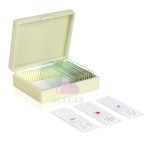
Root Pressure Demonstration Kit
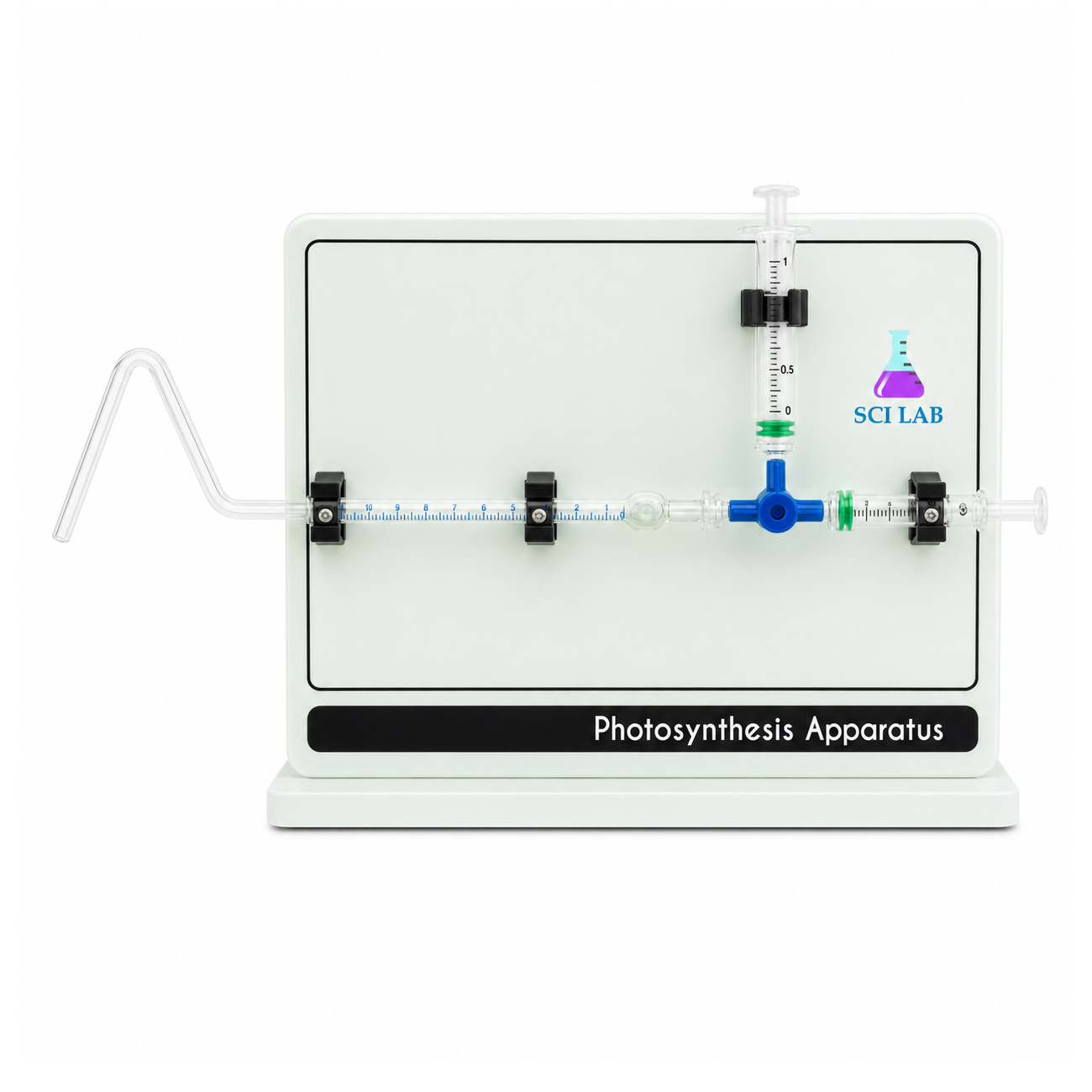
Product Code : SCL-BLE-11622
The Root Pressure Demonstration Kit is for showing root pressure: the positive pressure that the root system builds up, which pushes water up a cut stem with no pull from the leaves. A flexible sleeve seals stems of 4 to 8 mm to a tapered adaptor, and 200 mm of tubing leads to an open-ended 300 mm capillary tube with a scale, held on a 500 mm stand with clamp.
Specifications of the Root Pressure Kit
| Specification | Value |
|---|---|
| Type | Root pressure demonstration kit, supplied dry with its seals |
| Stem sleeve | Flexible, fits stems of 4 to 8 mm |
| Adaptor | Tapered, leak-tight |
| Tubing | Flexible, 200 mm long |
| Capillary (manometer) tube | Open-ended, 300 mm, with scale |
| Stand | 500 mm support stand with clamp |
| Needs | A fresh rooted plant stem and water, provided by the school |
| Manufacturer | Science Lab Supplies, Saha, Ambala, India |
Root Pressure Practical in the Plant Physiology Lab
Water a soft-stemmed potted plant the evening before. Next day, cut the stem a few centimetres above the soil, slide the flexible sleeve over the stump and fit the tapered adaptor. Run the 200 mm tubing to the capillary tube, clamp it upright on the 500 mm stand, and top up with water from a Plastic Wash Bottle 250ml until a level shows on the scale. Mark the starting level.
- Rise of sap: read the scale at set times, kept with a Digital Stopwatch. A steady rise over a few hours shows water being forced up from the roots.
- Morning and afternoon: compare the rise in the early morning with the rise later in the day, when the air is drier.
- Path of water: before the practical, trace water from the root hair to the xylem on the Root Tip Model.
- Guttation: cover young seedlings overnight and look for drops on the leaf edges at dawn.
Precautions: use a stem that fits the 4 to 8 mm sleeve so the joint stays watertight, shade the set-up from direct sun, and leave it undisturbed while readings are taken.
Frequently Asked Questions
How does a root pressure set-up differ from a potometer?
A potometer measures the water a cut leafy shoot takes up, which is driven mainly by loss from the leaves. A root pressure set-up uses the rooted stump with the shoot removed, so any rise comes from the roots pushing water up.
Which parts make up a working root pressure set-up?
This kit has a flexible stem sleeve for 4 to 8 mm stems, a tapered adaptor, 200 mm of tubing, an open-ended 300 mm capillary tube with a scale and a 500 mm stand with clamp. The school adds a well-watered rooted plant, cut a few centimetres above the soil, and water.
Which liquid should show the level in the tube?
Plain water with a drop of food colouring is enough, and it is easy to read against a white card. Old textbook set-ups used a mercury manometer, but mercury is toxic and is not needed for a class demonstration.
Why can root pressure not lift water to the top of a tall tree?
It is small and can push water up only a few metres. In tall trees most water is pulled up by transpiration from the leaves, with cohesion holding the water column together.
When is root pressure strongest?
At night and in the early morning, or in humid air, when the stomata are closed and transpiration is low. In the day the xylem is under tension and root pressure has little effect.
Do all plants show root pressure?
No. It is clear in many herbs and young plants, but it is weak or absent in conifers and many tall trees, which rely on transpiration pull instead.
Related Plant Water-Relations Kits
- Kit for Demonstration of Transpiration in Plants: tripod, 600 ml beaker, colouring liquid, clamp and a 200 mm borosilicate glass tube.
- Kit for the Demonstration of Absorption of Mineral Salts in Plants: two 250 ml Erlenmeyer flasks with five labelled nutrient sachets, one per litre of solution.
- Dutrochet's End Osmometer for Demonstrating Osmotic Pressure: 200 mm rise tube with 1 mm divisions, sucrose-retaining cellulose membrane and a 250 ml beaker.
- Potometer: 250 ml reservoir and a 100 mm graduated capillary for water uptake by a cut shoot.
- Monocotyledons and Dicotyledons, Roots, Cross Sections: coloured borosilicate glass slide, 25.4 x 76.2 mm, in a plastic box.
Plant physiology sets are grouped in Biology Lab Equipment, part of School Lab Equipments.
Buyers in the UAE, Saudi Arabia, Oman, the Philippines, Nepal and Bangladesh can order this kit for export, since Science Lab Supplies has an Importer-Exporter Code. Schools and distributors can ask for a quotation on the contact page or add the kit to the enquiry cart.
Last updated: 19 November 2026