Hour Glass
Product Code : SCL-BLE-11653
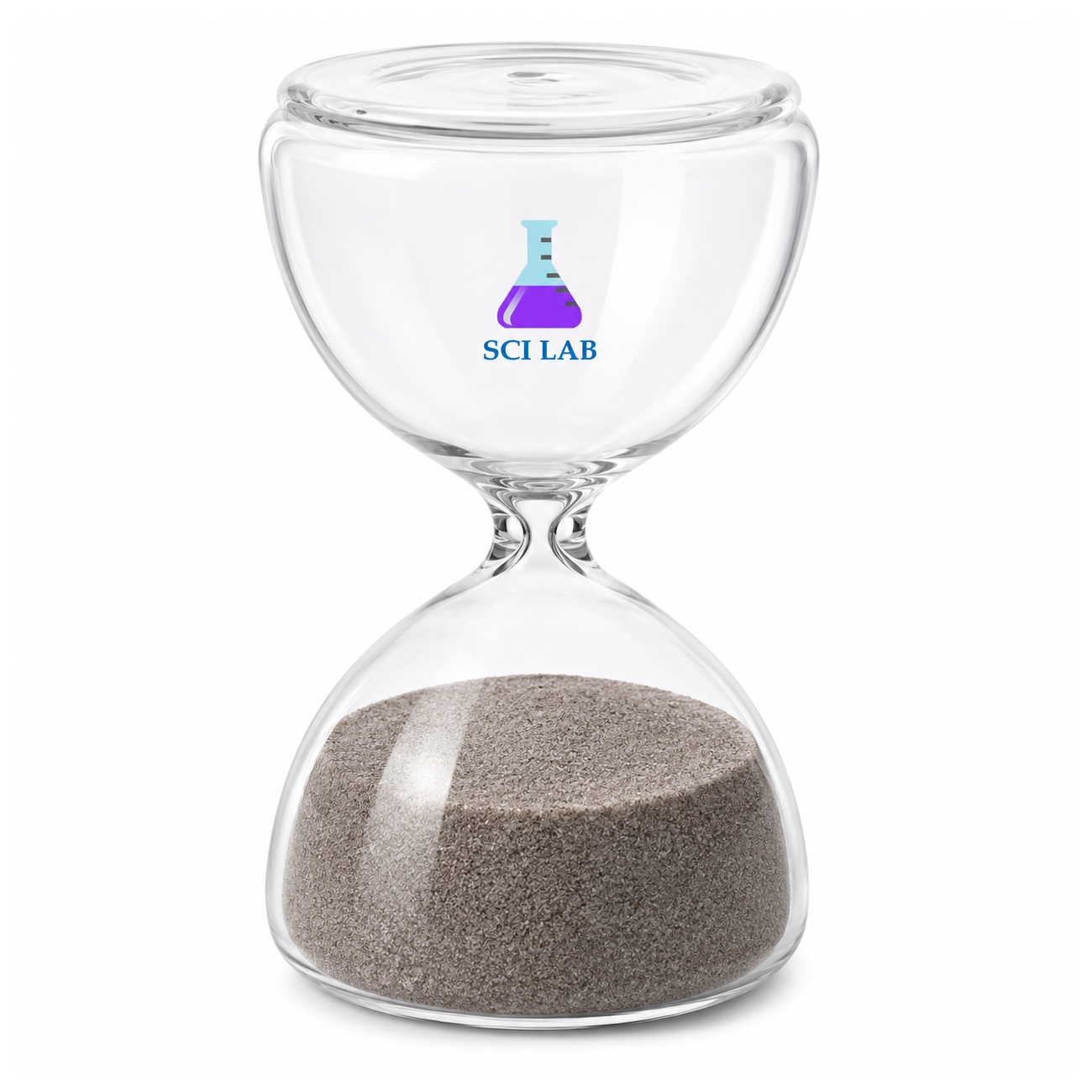
The Hour Glass is a handmade sand timer that runs for 5 minutes. Sand falls between two pear-shaped glass bulbs held in brass with an old-brass finish, and the piece carries an engraved motivational message. It stands about 13 to 14 cm high and serves on lab benches, study desks and office tables as a working timer and a display piece.
Specifications of the 5-Minute Hour Glass
| Specification | Value |
|---|---|
| Type | Handmade sand timer, nautical style |
| Running time | 5 minutes per turn |
| Construction | Brass with two pear-shaped glass bulbs |
| Finish | Old brass (antique look) |
| Engraving | Motivational message beginning "I will guide you" |
| Size | About 5 to 5.5 in high and 2.2 in wide (about 13 to 14 x 5.6 cm) |
| Weight | About 0.36 lb (about 163 g) |
| Supplied by | Science Lab Supplies, Ambala, India |
Timing Class Tasks with the Hour Glass
Turn the hour glass over and stand it on a flat, steady surface: the 5 minutes are up when the top bulb is empty. It needs no battery or winding, and a whole group can see at a glance how much time is left.
- Timed rounds: give each group one run for a spotting test at the microscope, a short quiz or a discussion, and turn the glass at the start of every round.
- Checking the timer: time five runs with a Digital Stopwatch, then five more with the other end up, and work out the mean and the spread of each set.
- Comparing timekeepers: count the swings of a bob on the Pendulum Set during one run, then shorten the cord and count again.
- Telling the time: during one run, move the minute hand of the Clock Face from one numeral to the next, to show that 5 minutes is one twelfth of an hour.
Handle it by the brass rather than the glass, never shake or tap it to hurry the sand, and keep it away from heat and damp.
Frequently Asked Questions
Is a sand timer exact enough for timed class tests?
It gives a steady, repeatable interval rather than an exact one, which suits timed group work, turn-taking and quiz rounds. A handmade timer can run a little long or short, so time one run against a stopwatch and use that real figure when a test needs it.
What care do sand timers need in transport and storage?
The glass bulbs are the fragile part. Each timer should travel padded so the bulbs cannot knock against anything, inside a rigid outer carton. On arrival, look at every bulb for cracks and for sand outside the glass, and keep stock in a dry place, as damp makes sand cling.
How is the old-brass finish kept looking right?
Dust it and wipe it with a soft, dry cloth. Avoid water, solvents and abrasive metal polish: polish strips the darkened antique look, and grit can scratch the glass bulbs. Keep it out of strong sun and away from radiators.
What decides how long the sand takes to run through?
The amount of sand, the width of the neck and the size and shape of the grains. More sand or a narrower neck gives a longer run. Unlike water draining from a vessel, sand flows at an almost steady rate whether the top bulb is full or nearly empty.
How can students test whether the timer is consistent?
Start a stopwatch the moment the glass is turned and stop it when the last grains fall. Repeat at least five times, then again with the other end up, as the two ends can differ slightly. Record the times in a table and compare the mean and the spread.
Related Timers and Clocks
- School Digital Stopwatches: 1/100 s resolution, powered by one LR44 battery, with lap and split times.
- Mechanical Timer 60min: spring-driven countdown timer graduated from 0 to 60 minutes, with a ring when time is up.
- Analog Timing Experiment Clock: spring-wound stopclock with a 60-minute outer dial and a 0.2 s least count.
- Analogue Wall Clock: white face numbered 1 to 12, with hour, minute and second hands.
- Reaction Timer: measures response time to light, sound and touch.
This sand timer is filed with the Biology Lab Equipment items, while stopwatches and other timing apparatus for practical work appear in the Physics Lab range.
Shipments of the hour glass can be arranged from Ambala to Qatar, Sri Lanka, Vietnam, Malaysia, Peru and Egypt, as Science Lab Supplies trades under an Importer-Exporter Code. Buyers wanting a quotation, for one piece or a class set, can write in via the contact page or list the hour glass in the enquiry cart.
Last updated: 16 November 2026

.jpg)