
Tilia (Linden Tree), 1-Year-Old Stem, Cross-Section
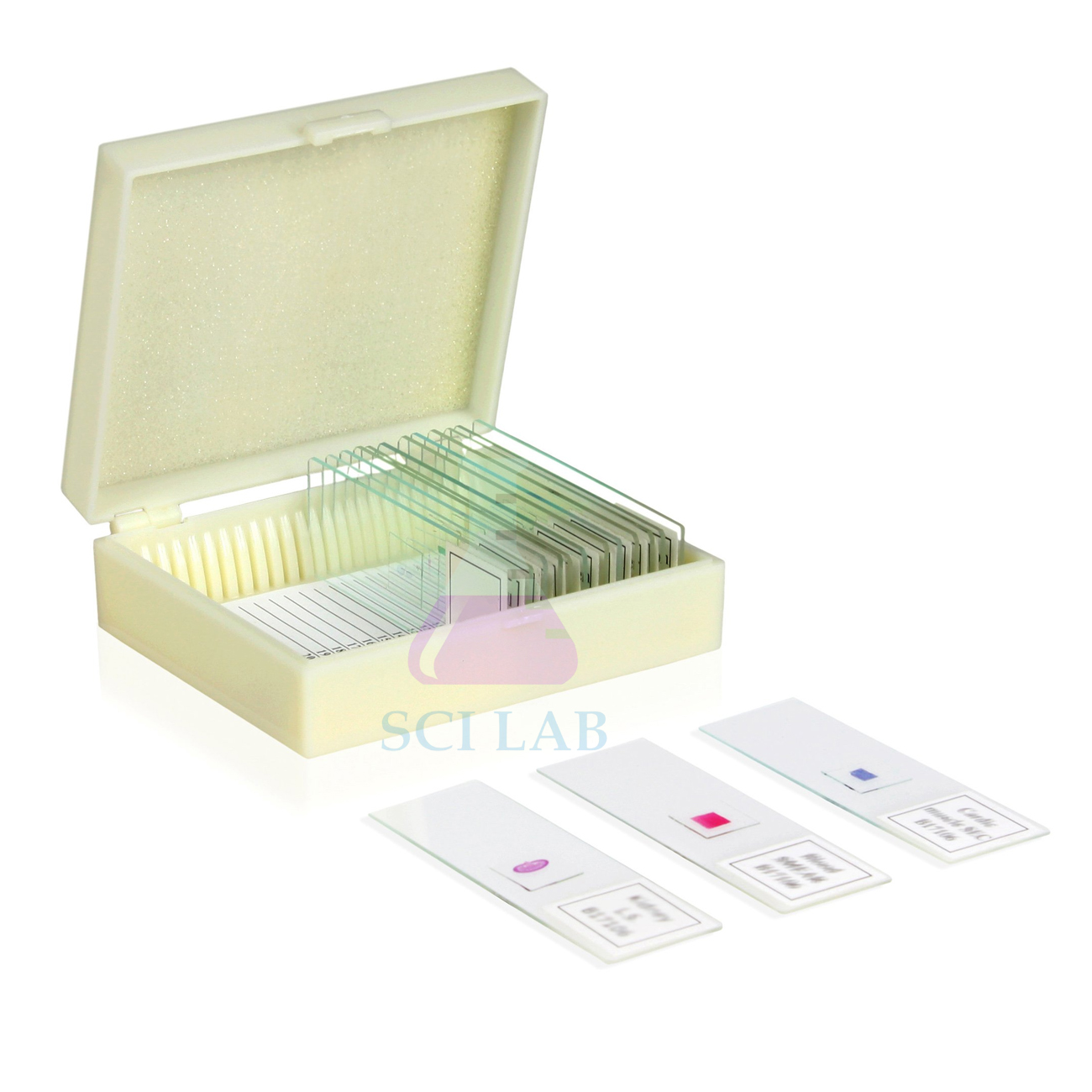
Product Code : SCL-BLE-11681
This slide carries a coloured cross section of a one-year-old stem of Tilia, the linden tree, a woody dicot used to teach the start of secondary growth. Students trace how the vascular cambium has begun to add wood and bark tissue. The section is mounted on rectangular borosilicate glass, 25.4 x 76.2 mm, and kept in a plastic box.
Specifications of the Tilia 1-Year Stem Slide
| Specification | Value |
|---|---|
| Specimen | Tilia (linden tree) stem, one year old |
| Section and preparation | Cross section, coloured |
| Slide | Rectangular borosilicate glass, 25.4 x 76.2 mm (1 x 3 in) |
| Storage box | Plastic |
| Supplied by | Science Lab Supplies, Ambala, India |
Tracing Early Secondary Growth in a Tilia Stem
Work from the outside of the section towards the centre at x10, then study one sector at x40. A Digital Binocular Microscope with its built-in camera lets a teacher show the same sector to the whole class while pupils draw.
- Tissue sequence (Class 11 and B.Sc.): list and label the layers in order, from the outer protective layer through cortex, phloem, cambium and wood to the pith.
- Products of the cambium: mark the narrow cambium zone, then shade the secondary phloem outside it and the secondary xylem inside it in different colours.
- Herbaceous against woody: compare with the Monocotyledonous and Dicotyledonous Stems, Cross Section slide and describe how a ring of separate bundles has become a closed cylinder of vascular tissue.
Common slips: calling the dark phloem fibre bands growth rings, and drawing the cambium as a thick layer when it is only a few cells wide.
Frequently Asked Questions
Is a basswood or lime-tree stem slide the same item as this Tilia slide?
Yes. Tilia is the genus name. The tree is called linden in much of Europe and Asia, lime tree in Britain and basswood in North America, so catalogues in different markets list the same kind of woody stem section under these names.
Which classes is a one-year Tilia stem slide meant for?
Secondary growth is usually taught in Class 11 botany and in first-year college courses, so the slide suits those groups. It is a glass teaching slide for supervised laboratory work, not a handling item for young children.
What are the wedge-shaped areas of phloem in the section?
Tilia phloem forms wedges between rays that widen outwards as the stem grows thicker. These dilated rays push the phloem into tapering blocks. Inside each wedge, bands of thick-walled phloem fibres alternate with softer conducting phloem.
Where is the primary xylem in a one-year-old stem?
The small, first-formed xylem lies at the inner edge of the wood, next to the pith. The wider secondary xylem made by the cambium during the first season lies outside it, between the primary xylem and the cambium.
Has the epidermis been replaced by bark after one year?
Only partly. In Tilia a cork cambium starts just below the epidermis during the first season and begins to form cork cells, so a one-year section often shows a thin new periderm with remains of the epidermis outside it.
Related Stem Slides and Microscopy Items
- Tilia (Linden Tree), 3-Year-Old Stem, Cross-Section: coloured cross section on a 25.4 x 76.2 mm borosilicate slide.
- Cross Section of the Stem: PVC model with non-toxic dyes, 300 x 400 mm.
- Biological Microscope: plan objectives with transmitted LED illumination and coarse and fine focus.
- Microscope Slide Storage Box, 25 Places: plastic box with 25 separate places.
- Cover Glass, 24 x 60 mm: clear rectangular coverslip of No. 1 thickness, chemical resistant.
See the full Biology Lab Equipment list or go back to School Lab Equipments.
Science Lab Supplies is registered to export under an Importer-Exporter Code, so orders can go to Iraq, Nigeria, Kenya, Ghana, Ethiopia and Tanzania. Quotation requests are welcome on the contact page or through the enquiry cart.
Last updated: 15 November 2026


.jpg)


.jpg)