Human Anatomical Torso Model with Head and Removable Organs
Product Code : SCL-BLE-11714
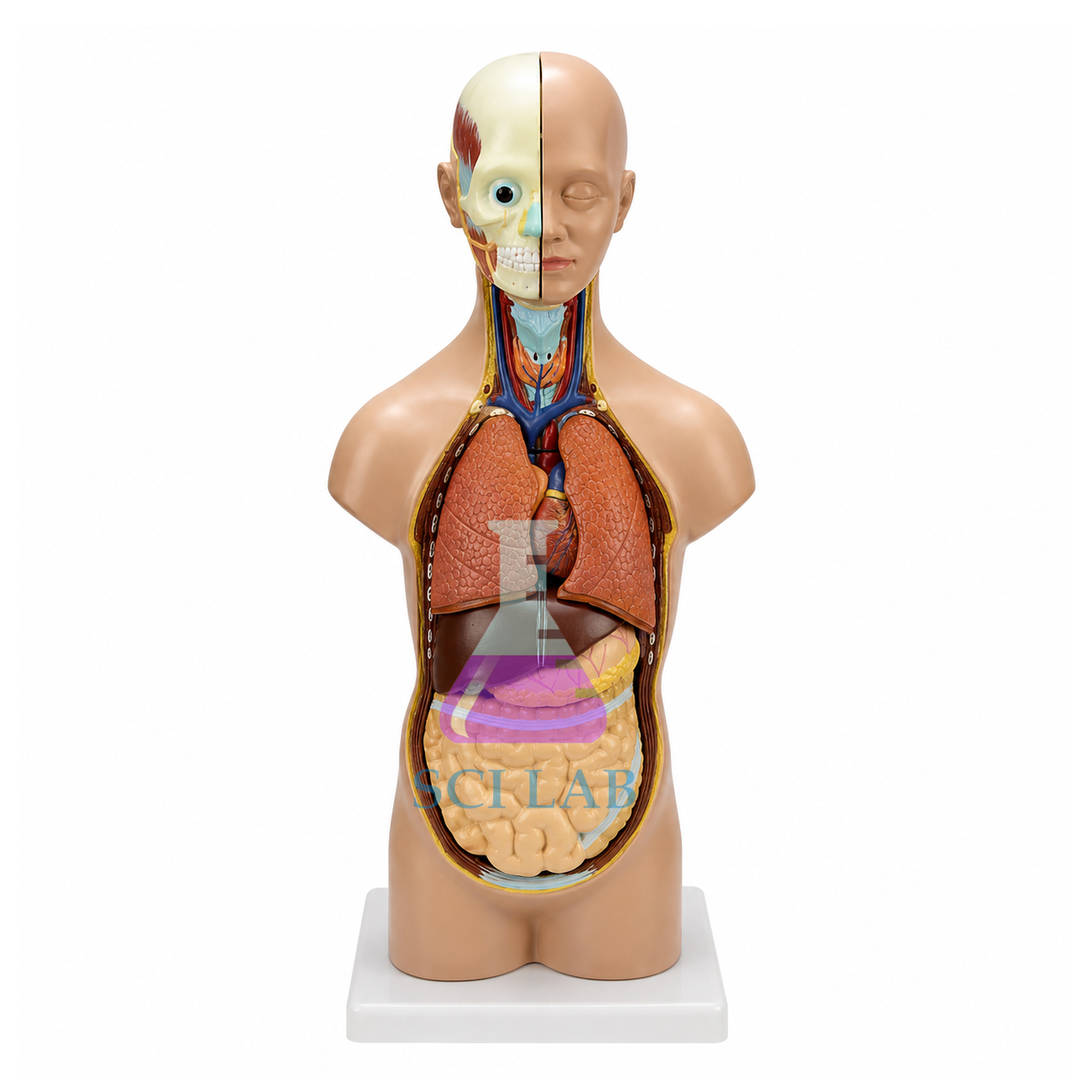
The Human Anatomical Torso Model with Head and Removable Organs is a life-size unisex torso in PVC with non-toxic colouring, about 85 to 90 cm tall on its base. It comes apart into 12 parts, counting the torso body: the head and brain elements, lungs, heart, liver, stomach and bowel sections lift out, and the kidney region is on view. Students see how the organs fit together, then rebuild the body in order.
Specifications of the Human Torso Model
| Specification | Value |
|---|---|
| Type | Life-size unisex torso (bust) with head, on a base |
| Parts | 12, counting the torso body and split organ pieces |
| Removable organs | Head and brain elements, lungs, heart, liver, stomach and bowel sections |
| Also shown | Kidney region, visible in the torso |
| Height | Approx. 85 to 90 cm on its base |
| Material | PVC |
| Colouring | Non-toxic |
| Supplied by | Science Lab Supplies, Ambala, India |
Organ Position Lessons with the Human Torso
Stand the torso on its base on a table where the whole group can walk round it. Lift out the lungs, heart, liver, stomach and bowel sections one at a time, name each organ and its system, and lay them out in order so they can go back the same way. Then point out the kidney region and the head and brain elements.
- Take apart and rebuild (Class 6 to 10): pupils remove and replace the parts in sequence, saying what each organ does.
- Bones and organs: hold the Human Skeleton Model 45 cm beside the torso and find which organs the ribs and breastbone protect.
- Human and animal: compare the torso with a labelled mammal diagram, then view the sealed Rabbit Dissection and discuss which main organs all mammals share.
Care: clean the PVC with a damp cloth and mild soap, avoid solvents, and keep the model out of strong sun so the colours last.
Frequently Asked Questions
Where should a life-size torso stand in a classroom?
It is a large bench model, about 85 to 90 cm tall on its base. Set it on a demonstration table where a group can stand round it, and carry it with both hands with the loose parts packed separately. Schools that also want a model to pass between desks often add a half-size torso.
What should a buyer confirm about the parts before ordering?
Check the count, the sex shown and the organs against the syllabus. This torso is unisex, stands on a base and has 12 parts, counting the torso body and split pieces. The head and brain elements, lungs, heart, liver, stomach and bowel sections come out, and the kidney region is on view.
How can a class use the torso to learn where organs sit?
Take the parts out from front to back, naming each one, then rebuild in reverse order. A timed rebuild in pairs is a quick revision test, and pupils soon learn what lies behind and beneath each organ.
How can a class test organ placement after using the torso?
Pairs trace round one partner on a large sheet of paper and draw or cut out the main organs in their places. They then check the sheet against the torso and correct any organ placed too high, too low or on the wrong side. Marks go to correct placement and labels.
How can one torso support group work in a large class?
Use a jigsaw lesson. Each group studies one system on the torso for a set time, becomes the expert on it, and then teaches the other groups, so everyone handles the model and hears about every system.
How is the human torso like the body of another mammal?
A rabbit or any other mammal has the same main organs in similar places: a diaphragm under the lungs, a heart between them, and a liver just below the diaphragm. The biggest differences lie in the gut, which suits each animal's diet.
Related Human Organ Models
- Human Heart Model, 3 Detachable Parts: PVC model in non-toxic dyes, 3 to 4 times enlarged.
- Human Lung Model with Dissectible Lobe and Alveoli: three-dimensional PVC model with removable parts.
- Kidney Model, Approximately 3-4x Enlarged: PVC model in non-toxic dyes, with removable parts.
- Human Brain Model, Midsagittal Section, 5 Parts: PVC model made as two separate hemispheres.
- Human Digestive System Model: the digestive tract from mouth cavity to rectum, with removable parts.
Look through Biology Lab Equipment for charts, slides and specimens, or start from School Lab Equipments.
Science Lab Supplies is cleared for export through its Importer-Exporter Code and serves customers in Nepal, Bangladesh, Zambia, Rwanda, South Africa and Qatar. Write about the torso through the contact page, or put it in the enquiry cart with other anatomy models, to receive a quotation.
Last updated: 19 November 2026

.jpg)