Farmer's Potometer
.jpg)
Product Code : SCL-LG-11980
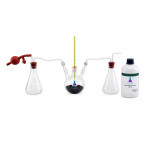
The Farmer's Potometer measures how fast a freshly cut leafy shoot takes up water, as an indirect estimate of transpiration. A wide-mouth bottle closed by a three-hole stopper holds the shoot, a funnel reservoir and a bent capillary tube, and an air bubble moving along the capillary scale shows the uptake.
Specifications of the Farmer's Potometer
| Specification | Value |
|---|---|
| Reservoir | Wide-mouth bottle |
| Closure | Three-hole stopper for the shoot, funnel and capillary |
| Measuring tube | Bent capillary tube with observation scale |
| Bubble reset | Funnel-type water reservoir |
| Measures | Water uptake by a cut shoot, read from air-bubble movement |
| Contents | Bottle, stopper, capillary tube, funnel reservoir and connecting sections |
| Supplied by | Science Lab Supplies, Ambala, India |
Transpiration Practicals with the Farmer's Potometer
The bottle and capillary are filled with water and the shoot is pushed through its hole in the stopper so the joint is airtight. The open end of the capillary dips into water in a Glass Beaker, Low Form, 500 ml, one air bubble is let in, and its travel along the scale is timed.
- Light and shade (Class 10 and 11): time the bubble over a fixed distance with a Digital Stopwatch in bright light, then with the shoot shaded.
- Air movement: repeat with a fan blowing gently on the leaves and compare the rate with still air.
- Leaf surfaces: coat the lower leaf surfaces with petroleum jelly, then the upper ones, to show where most water vapour escapes.
Common errors: air entering the cut stem, stopper holes that leak, and moving the bottle during a run, which shifts the bubble by itself.
Frequently Asked Questions
What should be checked in the specification before ordering a Farmer's Potometer?
Check the bottle capacity and mouth size, that the stopper has three holes for the shoot, funnel and capillary, whether the capillary carries a scale and what its bore is, and the type of glass. These decide how readable the set is and how easily it seals.
Which part of a Farmer's Potometer usually needs replacing first?
The stopper wears first: its holes stretch and stop sealing after many classes, and rubber hardens with age. The thin capillary is the most fragile glass part, so spare stoppers and capillary tubes are worth keeping.
Why does a fan make the bubble move faster?
Moving air carries away the humid layer around the leaves, so the difference in water vapour between leaf and air stays large. More water evaporates from the leaves, and the shoot draws more water from the bottle.
Why does the bubble move faster in bright light?
Light makes the stomata open wider, so more water vapour can leave the leaves. Warmth from the lamp also raises evaporation, which is why a fixed lamp distance or a heat screen keeps the test fair.
How is the bubble brought back to the start of the scale?
Water is let in from the funnel reservoir, which pushes the bubble back along the capillary towards the zero mark. The next reading can then start without taking the shoot out of the stopper.
Related Potometers and Transpiration Kits
- Ganong's Potometer: graduated narrow-bore horizontal tube with a water reservoir and stopcock.
- Student Potometer 'H' Type: H-shaped glass unit with a reservoir and graduated capillary.
- Potometer: water bottle, glass support for plants and a graduated measuring tube.
- Potometer Apparatus: shoot sealed into a stopper on the end tube, with the capillary dipped in water.
- Kit for Demonstration of Transpiration in Plants: tripod, 600 ml beaker, colouring liquid, glass tube and clamp.
To compare this bottle-type unit with the H-type and horizontal potometers or with transpiration kits, open Biology Lab Equipment; measuring cylinders and other glassware are found in Lab Glassware.
Science Lab Supplies holds an Importer-Exporter Code, which allows the Farmer's Potometer to be sent to Zambia, Rwanda, South Africa, Qatar, Sri Lanka and Vietnam. Quotations for single units or class sets start on the contact page; the potometer can also be saved in the enquiry cart.
Last updated: 16 November 2026