Kit for Demonstration of CO2 Emission and Heat Production in Germinating Seeds
Product Code : SCL-BLE-11620
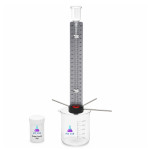
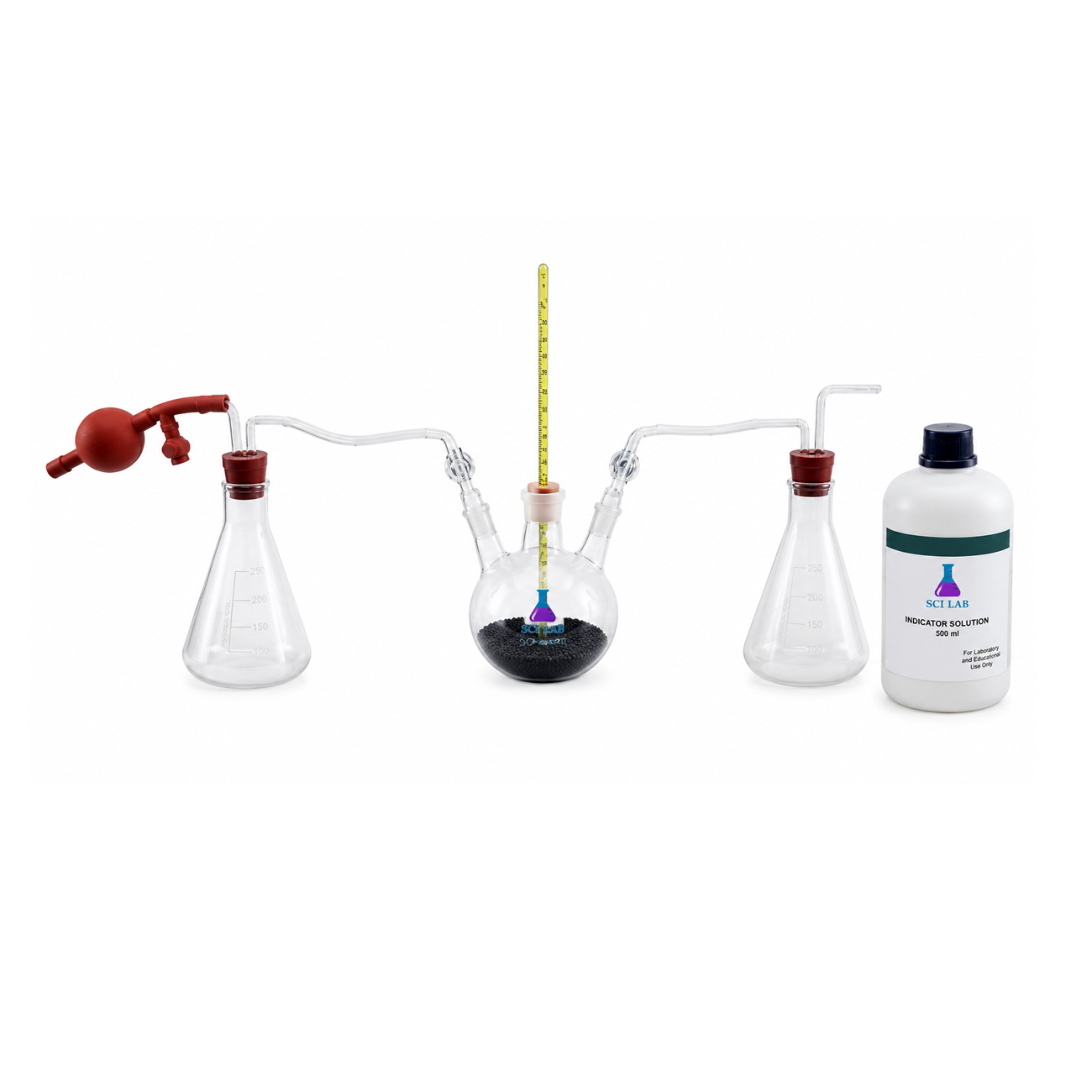
This kit shows two products of respiration in germinating seeds: carbon dioxide and heat. Gas from a 250 ml seed flask passes along tubing into a separate clear 50 ml vessel of limewater, which turns milky with calcium carbonate, while a matched control flask runs beside it. For the heat test, two thermometers follow the temperature in a matched pair of insulated vessels.
Specifications of the CO2 and Heat Kit
| Specification | Value |
|---|---|
| Flasks | Two 250 ml Erlenmeyer flasks: one for the seeds, one for the control |
| Stoppers and tubing | Two stoppers, with tubing for the gas path |
| Indicator vessels | Two, clear, 50 ml, each with an open exhaust |
| Air supply | Low-flow hand bulb |
| Reagent | Limewater, 100 ml, ready-to-use saturated calcium hydroxide solution, with its safety data sheet |
| Heat set-up | Matched pair of insulated vessels with two thermometers |
| Stand | One |
| Supplied by | Science Lab Supplies, Ambala, India |
Showing Carbon Dioxide and Heat from Germinating Seeds
Seeds are soaked, sprouted for a few days and rinsed in mild disinfectant. Living seeds go in one 250 ml flask and boiled, cooled seeds in the other. Each gas path runs from the seed flask along tubing into its own 50 ml limewater vessel, which stays open at the exhaust. The hand bulb moves the air at a low flow.
- Carbon dioxide test: work the hand bulb slowly so that gas from the living-seed flask bubbles through the limewater. A milky cloud of calcium carbonate shows carbon dioxide; the vessel on the boiled-seed flask stays clear much longer.
- Heat test: fill one insulated vessel with living seeds and the other with the same amount of boiled seeds, put a thermometer in each, and read both at the start and after one or two days. Living seeds warm up, while boiled seeds stay near room temperature.
- Seed preparation: sprout the seeds on damp paper in a Glass Petri Dish with Cover, 100 mm so they all start at the same stage.
- Fresh reagent: keep opened limewater in a stoppered bottle from the Bottles of Colorless Glass with Stoppers for Reactants range, and renew worn joints with Rubber Tube (Laboratory).
Precautions: limewater is an alkaline calcium hydroxide solution that irritates the eyes, so wear eye protection, follow its label and safety data sheet, and rinse any splash away with water. Keep the exhaust of each limewater vessel open so that no pressure builds up in the gas path. For the overnight heat test close the insulated vessels only loosely with cotton wool so the seeds get air, and wash hands after handling seeds treated with disinfectant.
Frequently Asked Questions
What should an importer check about the limewater?
The 100 ml of limewater is a ready-to-use saturated calcium hydroxide solution that comes with its safety data sheet. It is a weak alkali and an eye irritant. Importers should follow that SDS for its transport class and storage, and check national rules for laboratory chemicals.
How should the limewater be stored once opened?
Keep the bottle tightly closed in a cool place away from acids. Limewater takes up carbon dioxide from room air and slowly turns milky with calcium carbonate, which spoils the test, so pour out only what the class needs and renew a cloudy solution.
Why does limewater turn milky?
Carbon dioxide reacts with the dissolved calcium hydroxide to form calcium carbonate, which does not dissolve and shows as a white cloud. A long stream of carbon dioxide can clear it again, as soluble calcium hydrogencarbonate forms, so note the result when the cloud first appears.
Why are the seeds rinsed in disinfectant first?
Bacteria and moulds on the seed coats also respire and give out heat and carbon dioxide. A rinse in dilute disinfectant removes most of them, so the result reflects the seeds themselves.
Why are insulated vessels used for the heat test?
The heat from respiring seeds is small and escapes quickly through plain glass. The insulated vessels keep it in long enough for a clear rise on the thermometer, and because the pair is matched, living and boiled seeds lose heat at the same rate.
Related Respiration and Gas-Test Kits
- Germinating Seed Respiration Demonstration Kit: two matched 30 ml vessels on a graduated 1 ml capillary, with control beads and coloured indicator.
- Support Stand and Beaker Set for Plant Experiments: tripod stand with a 500 mm rod and a 600 ml beaker.
- Kit for Experiments with Breathing: bell-jar lung model, hand-operated bulb pipette and a 100 ml bottle of lime water.
- Kit for Experiments on Photosynthesis: photosynthesis cell, CO2 sensor and platinum temperature sensor.
- Laboratory Thermometers: alcohol-filled glass thermometers reading −10 to 100 °C.
Other plant physiology kits are listed under Biology Lab Equipment; flasks and bottles are in Lab Glassware.
Science Lab Supplies exports from India on an Importer-Exporter Code; schools in Tanzania, Uganda, the UAE, Saudi Arabia, Oman and the Philippines can receive this seed kit. Quotation requests for the kit can be sent from the contact page, or built up item by item in the enquiry cart.
Last updated: 19 November 2026