Animal Cell Model, 180 x 300 x 60 mm
Product Code : SCL-BLE-11735
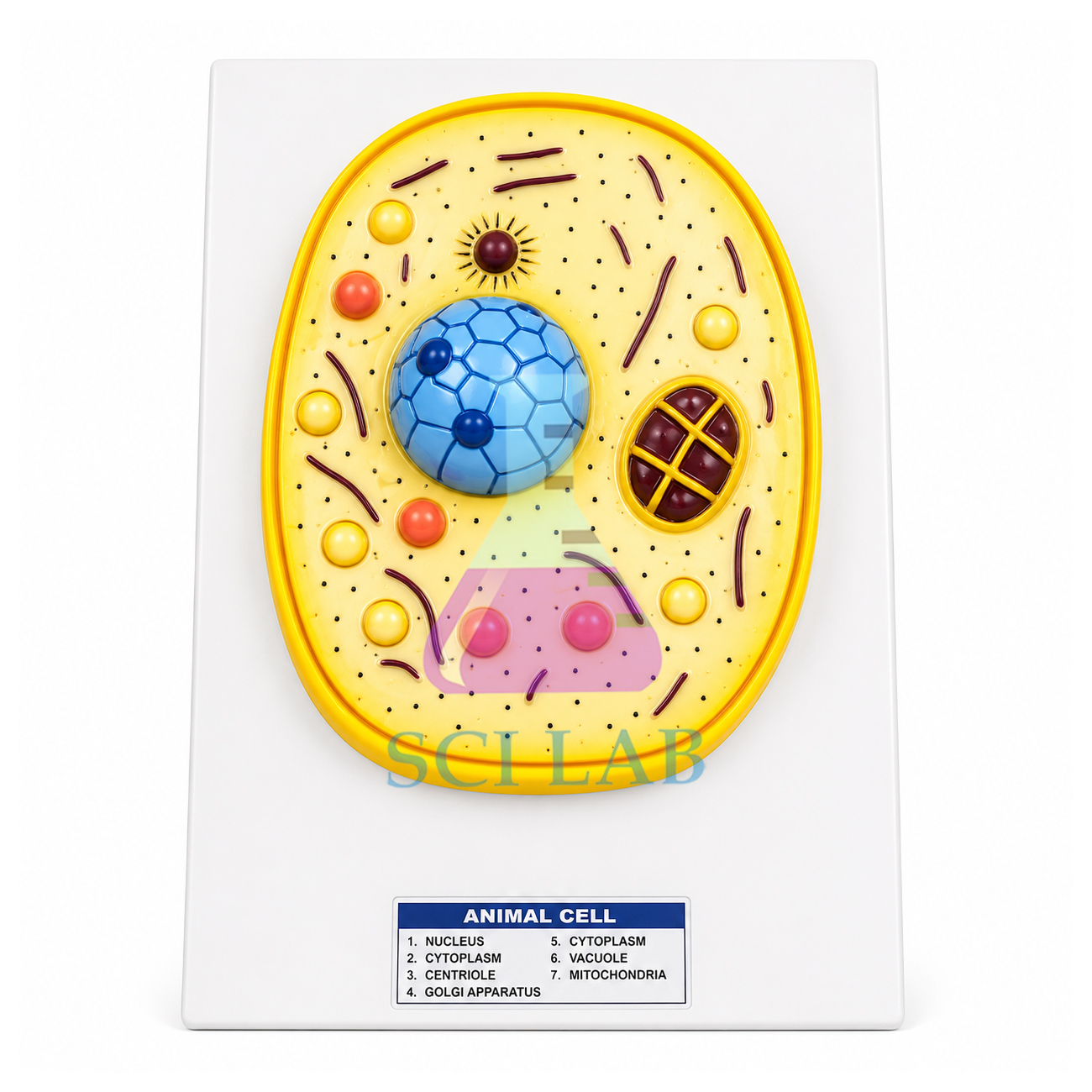
The Animal Cell Model, 180 x 300 x 60 mm, is a three-dimensional PVC model of an animal cell with one side cut open to show the complete internal detail. It is coloured with non-toxic dyes and is mounted on a board with a key card for naming the parts.
Specifications of the Animal Cell Model
| Specification | Value |
|---|---|
| Model type | Three-dimensional animal cell model |
| Material | PVC, coloured with non-toxic dyes |
| Size | 180 x 300 x 60 mm |
| Sectioning | One side dissected to show the complete internal detail |
| Mounting | On a board with a key card |
| Supplied by | Science Lab Supplies, Ambala, India |
Cell Structure Lessons with the Animal Cell Model
Students look at real animal cells first. They then use the open side of the model to place each part they have seen, or read about, inside the cell. Pass the board round small groups, or hold the cut face towards the class.
- Cheek cell practical (Class 8 and 9): stain a cheek cell smear on a slide from the Laboratory Microscope Glass Slides (Pack 50), view it on the Biological Microscope, then find the same parts on the cut face of the model.
- Tissue comparison (Class 9 to 11): study an Animal Tissue Prepared Microscope Slide and discuss why cells of one tissue share a shape and a job.
- Plant and animal cells (Class 9 and 11): set the model beside the Plant Cell Model and list the structures each cell has or lacks.
- Organelle jobs: name each part from the key card and write its job beside it in one exact phrase.
Common errors: drawing a cell wall around an animal cell, and describing an organelle's job in vague words such as "controls the cell".
Frequently Asked Questions
Is a 180 x 300 x 60 mm model large enough for class display?
At about 30 cm long it suits a bench group, or a teacher holding it up at the front of a small class. In a large room, a 70 x 100 cm animal cell wall chart can hang beside it for the back rows.
What is the model made of, and can students handle it?
It is PVC coloured with non-toxic dyes, so students can pass it round and point to the parts. Wipe it with a damp cloth, keep it away from heat and strong sun, and store it flat on its board.
How is the key card used in a lesson?
The key card names the structures on the model. Students read it to learn the names, or the teacher covers it and runs a quick quiz, then uses the card to check the answers together.
How much larger than a real cell is a classroom cell model?
Most animal cells are 10 to 30 micrometres across, so a model 300 mm long shows a cell roughly 10,000 to 30,000 times larger than life. On cell models the organelles are usually simplified in shape and scale for teaching.
Does every animal cell have a nucleus?
No. Most do, but mature human red blood cells lose their nucleus as they develop, which leaves more room for haemoglobin. The model shows a typical cell, so students should not assume that every cell matches it.
Can students identify an organelle from its shape alone?
Not safely. Shapes change with the angle of the cut and with the cell type. On the model, use the key card. In micrographs, look for features such as the folded inner membrane of a mitochondrion or the stacked sacs of the Golgi body.
Related Cell Models and Charts
- Animal Cell Model: enlarged 20,000 times, about 380 x 240 x 460 mm, with nucleus, Golgi apparatus, centrioles and lysosomes.
- Superstructure of the Cell (With Cell Organelles): PVC model, 700 x 400 x 500 mm.
- Amoeba Cell Structure Model: magnified cross-section of an Amoeba proteus cell with nucleus, contractile vacuole and pseudopodia.
- Animal Cell Structure Chart: laminated chart for wall mounting, 70 x 100 cm.
- Cell Reproduction (Mitosis) Chart: laminated wall chart, 70 x 100 cm.
- Enlarged 3D Mitosis Model: multi-stage model of the phases of somatic cell division.
More teaching models sit in the Biology Lab Equipment listings, part of the wider School Lab Equipments range.
Cell models for schools in the Philippines, Nepal, Bangladesh, Zambia, Rwanda and South Africa can be shipped from India by Science Lab Supplies under its Importer-Exporter Code. For a quotation on the board model, write through the contact page or add it to the enquiry cart.
Last updated: 16 November 2026
.jpg)