Dutrochet's End Osmometer for Demonstrating Osmotic Pressure
Product Code : SCL-BLE-11625
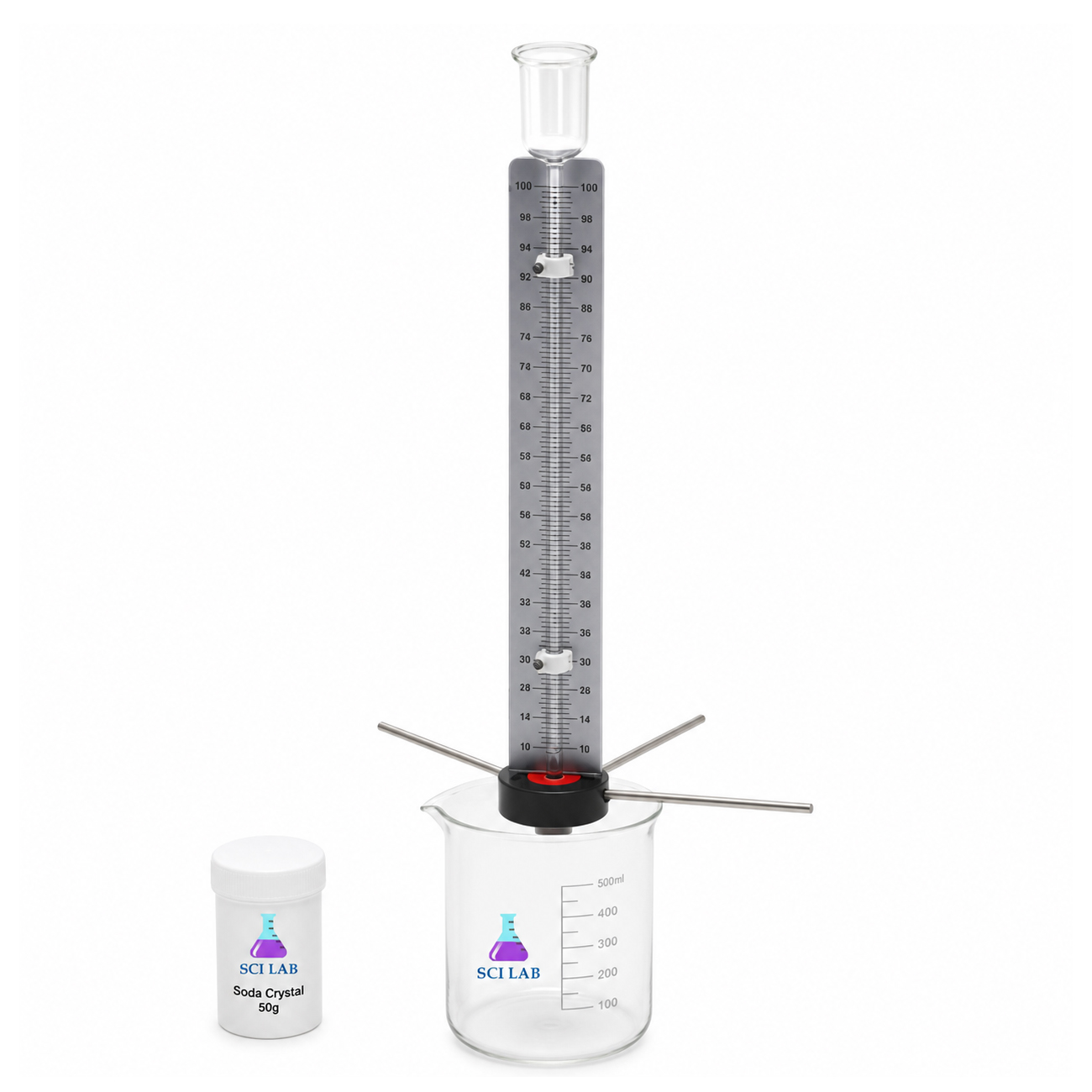
Dutrochet's End Osmometer for Demonstrating Osmotic Pressure shows water moving through a membrane into a stronger solution. A 25-50 ml bulb, closed by a replaceable cellulose membrane that holds back sucrose, feeds a 200 mm rise tube marked in 1 mm divisions and stands in a clear 250 ml beaker of water. It is used to explain how plants absorb water through osmosis.
Specifications of the End Osmometer Set
| Specification | Value |
|---|---|
| Osmometer | Dutrochet's end osmometer with a 25-50 ml bulb |
| Rise tube | 200 mm, 1 mm divisions |
| Membrane | Regenerated cellulose, replaceable, secured over the bulb; retains sucrose |
| Beaker | Transparent, 250 ml, for the outer water |
| Solutions | Sucrose solution in the bulb, water in the beaker |
| Supplied by | Science Lab Supplies, Ambala, India |
Osmosis and Osmotic Pressure with the End Osmometer
The osmometer bulb is closed by its cellulose membrane and joined to the 200 mm rise tube. Fill the bulb with sucrose solution, lower the membrane end into distilled water in the 250 ml beaker, and mark the starting level against the 1 mm divisions. Water passes in through the membrane and the column rises. The membrane holds back sucrose, so a sugar solution is used here rather than salt.
- Rise of the column (Class 9 and 11): read the level at intervals and plot height against time.
- Strength of solution: compare two sucrose concentrations, made up with a Measuring Cylinder 50ml and mixed with a Glass Stirring Rod, 350 x 8 mm.
- Reverse set-up: put water inside and sucrose solution outside; the level falls instead.
- Holding it steady: clamp the osmometer upright on a Retort Stand Set with Clamps and Rings so the membrane stays fully under water.
Precautions: check the membrane end for drips before starting, remove air bubbles from the tube, and rinse the membrane in clean water after use, and fit a new one if it tears.
Frequently Asked Questions
What should a buyer check in the osmometer specification?
Check what the membrane holds back: this one is regenerated cellulose that retains sucrose, so it runs with sugar solution, not salt. Also check the rise tube (200 mm, 1 mm divisions) and the 250 ml beaker, and plan for spare membranes, as a torn one is the usual reason this practical fails.
Which lessons is the end osmometer used for?
Osmosis, osmotic pressure and water uptake by plant roots. These are taught in Class 9 work on cells and in the Class 11 chapter on transport in plants.
Why does the level stop rising after some time?
As the column rises, its weight presses back on the solution. When this hydrostatic pressure equals the osmotic pressure, water enters and leaves at the same rate and the level stays still. A slow fall later usually points to a leak at the membrane or a worn membrane letting sugar through.
How can leaks at the membrane be avoided?
Soak a fresh membrane in water first, fit or tie it tightly over the end, and test with plain water for drips. Fill the osmometer slowly so no air is trapped under the membrane.
Why colour the sugar solution?
Sugar solution is colourless, so a little food colouring makes the column easy to see and read from the back of the room. A small amount of dye does not change the result.
Related Osmosis and Plant Water Kits
- Kit for Demonstration of Transpiration in Plants: tripod, 600 ml beaker, colouring liquid, glass tube and clamp.
- Kit for the Demonstration of Absorption of Mineral Salts in Plants: five complete-nutrient sachets, each for 1 litre, and two 250 ml Erlenmeyer flasks.
- Root Tip Model: PVC model, 300 x 400 mm, with root hairs and vasculature shown.
- Monocotyledons and Dicotyledons, Roots, Cross Sections: coloured borosilicate slide, 25.4 x 76.2 mm.
- Glass Beakers, Assorted Capacities: four low-form glass beakers with rims, in 50, 100, 250 and 500 ml sizes.
Osmosis and water-relations items are listed in Biology Lab Equipment.
Science Lab Supplies holds an Importer-Exporter Code, and orders for the osmometer set from the Philippines, Nepal, Bangladesh, Zambia, Rwanda and South Africa can be exported. Quotation requests go through the contact page; the enquiry cart is handy for a longer list.
Last updated: 19 November 2026
.jpg)