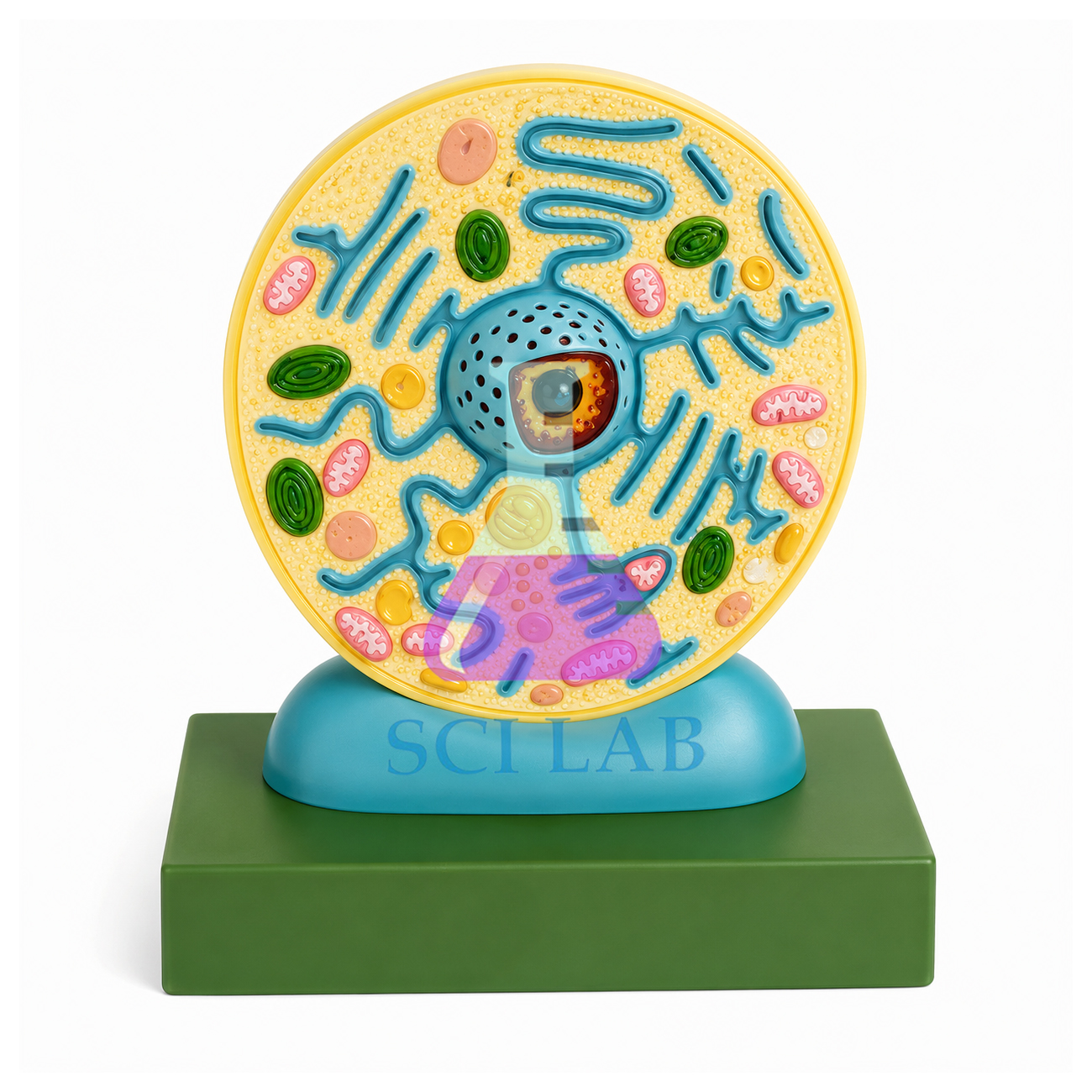
Plant Cell Model, 180 x 300 x 60 mm
Product Code : SCL-BLE-11733
The Plant Cell Model, 180 x 300 x 60 mm shows a plant cell in three dimensions as it appears under an electron microscope. Part of the cell wall is cut away to reveal the plasma membrane (ectoplast), the vacuoles and their tonoplast, the endoplast, nucleus, plastids and mitochondria. The colour-coded PVC model sits on a base with a numbered key card.
Specifications of the Plant Cell Model
| Specification | Value |
|---|---|
| View | Three-dimensional, as seen through an electron microscope |
| Cut-away | Portion of the cell wall removed |
| Structures shown | Plasma membrane (ectoplast), tonoplast, vacuoles, endoplast, nucleus, plastids and mitochondria |
| Finish | Colour coded; PVC with non-toxic dyes |
| Size | 180 x 300 x 60 mm |
| Mounting | Base with numbered key card |
| Supplied by | Science Lab Supplies, Ambala, India |
Cell Biology Lessons with the Plant Cell Model
Students first look at real cells, then use the model to name the parts that a light microscope does not show clearly.
- Onion peel practical (Class 8 and 9): stain onion epidermis, view it on the Biological Microscope, then match the cell wall, nucleus and vacuole to the model.
- Membranes of the plant cell (Class 11): use the cut-away to separate the cell wall from the plasma membrane beneath it, then find the tonoplast around the vacuole.
- Plant and animal cells: list which structures only plant cells have, using the Plant Cell Structure Chart as a wall reference.
- Leaf anatomy link: follow plastid-rich cells into the palisade and spongy mesophyll of the Leaf Transverse Section Model, 300 x 400 mm.
Common errors: treating the cell wall and the plasma membrane as one layer, and thinking plant cells have no mitochondria.
Frequently Asked Questions
Why is the model based on an electron microscope view?
A light microscope shows the cell wall, nucleus and vacuole but little detail of plastids and mitochondria. Modelling the electron microscope view lets students see these organelles in three dimensions.
What does the colour coding help with?
Each kind of structure has its own colour, so students can find all the plastids or all the mitochondria at a glance. The numbers on the model then match the names on the key card.
Is the model detailed enough for senior classes as well as juniors?
For most school levels, yes. Younger classes name the wall, membrane, nucleus and vacuole; senior classes add the plastids, the mitochondria and the tonoplast around the vacuole, as seen in electron micrographs.
What happens to a plant cell when its vacuole loses water?
The vacuole shrinks and turgor pressure falls, so the cell goes soft and the plant wilts. In a strong salt solution the membrane pulls away from the wall, which is called plasmolysis.
How is the cell wall different from the plasma membrane?
The cell wall is a tough outer layer, mainly cellulose, that gives shape and support and lets most substances through. The plasma membrane, or ectoplast, lies just inside it and controls what enters and leaves the cell.
Do all plant cells contain chloroplasts?
No. Root cells and many storage cells have no chloroplasts, though they still hold other plastids, such as starch-storing leucoplasts. Chloroplasts are found mainly in the green parts of the plant.
Related Plant Cell and Botany Items
- Plant Cell Model: plant cell model, 20 cm in diameter, also part of the Plant and Animal Cell Model Activity Set.
- Animal Cell Model, 180 x 300 x 60 mm: PVC model with one side dissected, mounted on a board with a key card.
- Superstructure of the Cell (With Cell Organelles): 700 x 400 x 500 mm PVC model of the cell and its organelles.
- Onion Root Tip Mitosis, Longitudinal Section, Prepared Slide: coloured slide on 25.4 x 76.2 mm borosilicate glass, in a plastic box.
- Meiosis Model 3D Cell: multi-stage model of chromosome reduction and gamete formation.
- Dicotyledon Flower Model, 180 x 300 x 60 mm: three-dimensional PVC flower, 180 x 300 x 60 mm.
Cell and botany models are part of the Biology Lab Equipment range, with more teaching items in the Biology Lab section.
Plant cell models can be exported to Saudi Arabia, Oman, the Philippines, Nepal, Bangladesh and Zambia by Science Lab Supplies, which holds an Importer-Exporter Code. Teachers can request a quotation for the cell model via the contact page, or drop it into the enquiry cart.
Last updated: 19 November 2026


.jpg)