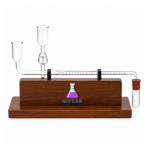
Respirometer with Stand
.jpg)
Product Code : SCL-LG-11978
The Respirometer with Stand measures respiration through gas-pressure change in two connected chambers. Two respiration tubes closed with corks carry three-way taps, and their extensions join a graduated manometer. The stand holds tubes and manometer steady for readings with germinating seeds or small organisms. It is supplied as glassware, stand and connections; carbon dioxide absorbents are separate optional reagents.
Specifications of the Respirometer with Stand
| Specification | Value |
|---|---|
| Chambers | Two respiration tubes closed with corks |
| Taps | Three-way taps for isolating or equalising the tubes |
| Measuring element | Graduated manometer joined to the tube extensions |
| Support | Stand included, holding the tubes and manometer (the Simple Respirometer is the basic version without a stand) |
| Contents | Respiration tubes, taps and manometer, support stand and connections only |
| Absorbent | Potassium hydroxide or soda lime, ordered separately as optional reagents |
| Principle | Manometer fluid moves with the gas-pressure change caused by respiration |
| Supplied by | Science Lab Supplies, Ambala, India |
Respiration Practicals with the Respirometer
Germinating seeds go in one tube and an equal volume of glass beads or boiled seeds in the other, each with a carbon dioxide absorbent, ordered separately, kept apart from the seeds. The taps are opened to equalise pressure, then closed, and the manometer is read at fixed intervals.
- Oxygen uptake by germinating seeds (Class 11): note the manometer level every two minutes, timed on one of the School Digital Stopwatches.
- Effect of temperature: stand both tubes in a Water bath, 7 L at 20, 30 and 40 °C and compare the rates.
- Respiratory quotient (B.Sc.): repeat the run with water in place of the absorbent; the change between the two runs gives the carbon dioxide released.
Precautions: potassium hydroxide and soda lime are corrosive. Follow the supplier label, safety data sheet and instructions of each separately ordered absorbent, leave its handling to trained lab staff, keep it away from the organisms, and never pressurise the apparatus.
Frequently Asked Questions
How does the Respirometer with Stand differ from a loose simple respirometer?
Both use two corked tubes, three-way taps and a graduated manometer. This version comes with a support stand that holds the tubes and manometer upright and still, so readings are not upset when the bench is knocked. The Simple Respirometer is the basic no-stand version and needs a rack or clamp.
Which syllabus practicals can a distributor list for this respirometer?
It covers oxygen uptake during respiration, the rate of respiration in germinating seeds or small invertebrates, the effect of temperature on that rate and, at higher level, the respiratory quotient. These appear in secondary biology and first-year college botany and zoology.
Which way does the manometer liquid move as seeds respire?
With carbon dioxide absorbed, the seeds use up oxygen, so the gas volume and pressure in their tube fall. The manometer liquid therefore moves towards the tube that holds the seeds.
How is the manometer reading turned into a volume of oxygen?
Multiply the distance the liquid moved by the cross-sectional area of the manometer bore, pi times the radius squared. Divide by the time taken, and by the seed mass if wanted, to give a rate in cubic millimetres per minute.
Why does respiration slow down at high temperatures?
Respiration is driven by enzymes. Warming speeds them up to an optimum, but above it the enzymes begin to lose their shape, so oxygen uptake falls and overheated seeds may die.
Related Respiration and Gas-Exchange Apparatus
- Simple Respirometer: basic no-stand version with two matched 30 ml chambers and a capillary manometer in 1 mm divisions.
- Respirometer: stoppered boiling tubes on either limb of a graduated manometer, with wire baskets for the organisms.
- Respirometer: one tube carries a syringe for setting the manometer level before a run.
- Kuhne's Fermentation Tube: closed arm that collects carbon dioxide from yeast fermentation.
- Glass Thermometer: non-mercury, -10 to +110 °C with 1 °C divisions.
Seed-respiration work is backed by the other plant-physiology apparatus in Biology Lab Equipment, the category of this respirometer, and by the flasks and beakers in Lab Glassware.
Under its Importer-Exporter Code, Science Lab Supplies can export respirometers to Nepal, Bangladesh, Zambia, Rwanda, South Africa and Qatar. Teachers and buyers may ask for a quotation on the contact page or through the enquiry cart.
Last updated: 19 November 2026