Potometer
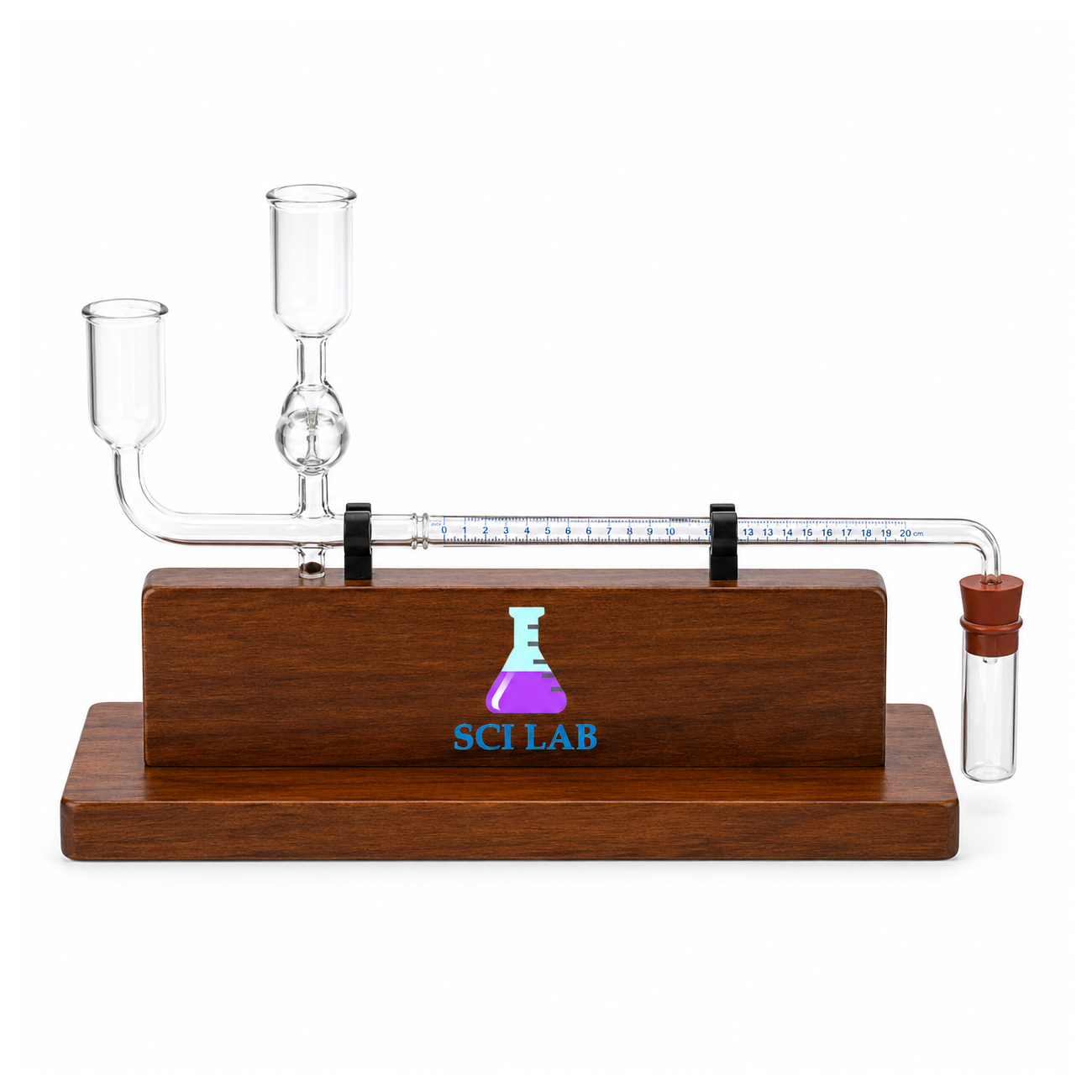
Product Code : SCL-BLE-11636
The Potometer measures how fast a cut leafy shoot takes up water. Under controlled conditions this uptake is used as an estimate of transpiration; it is not a direct measure of all the water the leaves lose. It has a 250 ml refill bottle with a stopcock, a glass plant support with a silicone shoot seal, and a horizontal 100 mm graduated capillary of 1 mm bore marked in 1 mm steps.
Specifications of the Potometer
| Specification | Value |
|---|---|
| Reservoir | Water bottle, 250 ml, for refilling |
| Stopcock | One, for refilling from the bottle and resetting the bubble |
| Plant holder | Glass support with a watertight, interchangeable silicone shoot seal |
| Measuring tube | Graduated capillary, 100 mm long, read horizontally; 1 mm marks, 1 mm nominal bore |
| Reading | Bubble movement in mm |
| Measures | Rate of water absorption by a cut shoot |
| Supplied by | Science Lab Supplies, Ambala, India |
Transpiration Practicals with the Potometer
Cut a leafy shoot under water and push it into a silicone seal that fits the stem, on the glass support, while both are still wet. Fill the bottle and capillary so no air is trapped, and dry the leaves. Let in one small air bubble and read its movement in mm along the capillary at equal time intervals; open the stopcock to refill and send the bubble back to the start.
- Still air (Class 10 and 11 transport in plants): take readings every two minutes, timed on a Digital Stopwatch, to get a base rate.
- Moving air: place a small fan a fixed distance from the shoot and compare the rate with the still-air value.
- Humidity: enclose the shoot in a clear plastic bag, or record room humidity with a Psychrometer (with Thermometer), and note how the rate changes.
- Light: compare readings in bright light and in shade, changing only that one factor.
Common errors: cutting the shoot in air so that air blocks the xylem, leaving water on the leaves, and moving the apparatus between readings.
Frequently Asked Questions
How should the glass parts be handled and stored?
The glass plant support and any glass tubing break into sharp pieces if dropped or knocked. Carry the parts in a tray, assemble them over a sink, rinse and dry them after use and store them in a padded drawer. Brief students on what to do after a breakage and keep a first-aid kit at hand.
What else is needed to set up the potometer for a class?
Each group needs a fresh leafy shoot, a bowl of water for cutting it, a timer and paper towels, plus a little petroleum jelly in case a joint leaks. A fan, lamp or clear plastic bag lets students change one condition at a time.
How is the movement on the graduated tube converted to a volume of water?
This capillary is marked in mm, so readings give bubble movement in mm per minute, which is enough to compare conditions. A volume needs a calibrated bore: with a measured radius r, volume = πr² × distance moved. The 1 mm bore is nominal, so it is not used for exact volumes.
How can students tell that air has got into the system?
The reading stops, moves in jerks or runs far slower than in other groups' set-ups. Air in the cut stem or a loose joint is the usual cause. Re-cut the stem under water, refit the shoot and reseal the joint before timing again.
Why is the uptake rate sometimes divided by leaf area?
Shoots differ in the number and size of their leaves, and a larger leaf area takes up more water. Tracing the leaves on squared paper and dividing the uptake per minute by the total area lets groups compare different shoots fairly.
Why should the potometer stay in one place during a run?
Moving it shakes the water column and can let air in at the joints. It also changes light, air movement and temperature together, so the effect of the single factor under test is lost.
Related Potometers and Plant-Water Kits
- Potometer Apparatus: shoot sealed in a stopper; a glass stopcock admits water from the reservoir to reset the bubble, on a varnished wooden base.
- Student Potometer 'H' Type: H-type layout with a plant connection, reservoir section and graduated capillary tube.
- Farmer's Potometer: wide-mouth reservoir bottle closed by a three-hole stopper.
- Ganong's Potometer: narrow-bore graduated horizontal tube joined to a plant chamber and a water reservoir.
- Kit for Demonstration of Transpiration in Plants: tripod, 600 ml beaker, colouring liquid and a 200 mm borosilicate glass tube of 20 mm outside diameter.
- Kit for the Demonstration of Absorption of Mineral Salts in Plants: two 250 ml Erlenmeyer flasks and five complete-nutrient sachets for tests against water only.
More plant-physiology items are in the Biology Lab Equipment range and the Lab Glassware range.
The potometer can be exported to Egypt, Iraq, Nigeria, Kenya, Ghana and Ethiopia, since Science Lab Supplies works with an Importer-Exporter Code. List the quantities on the contact form, or gather several items in the enquiry cart, to request a quotation.
Last updated: 19 November 2026