Kit for Experiments on Photosynthesis
Product Code : SCL-BLE-11626
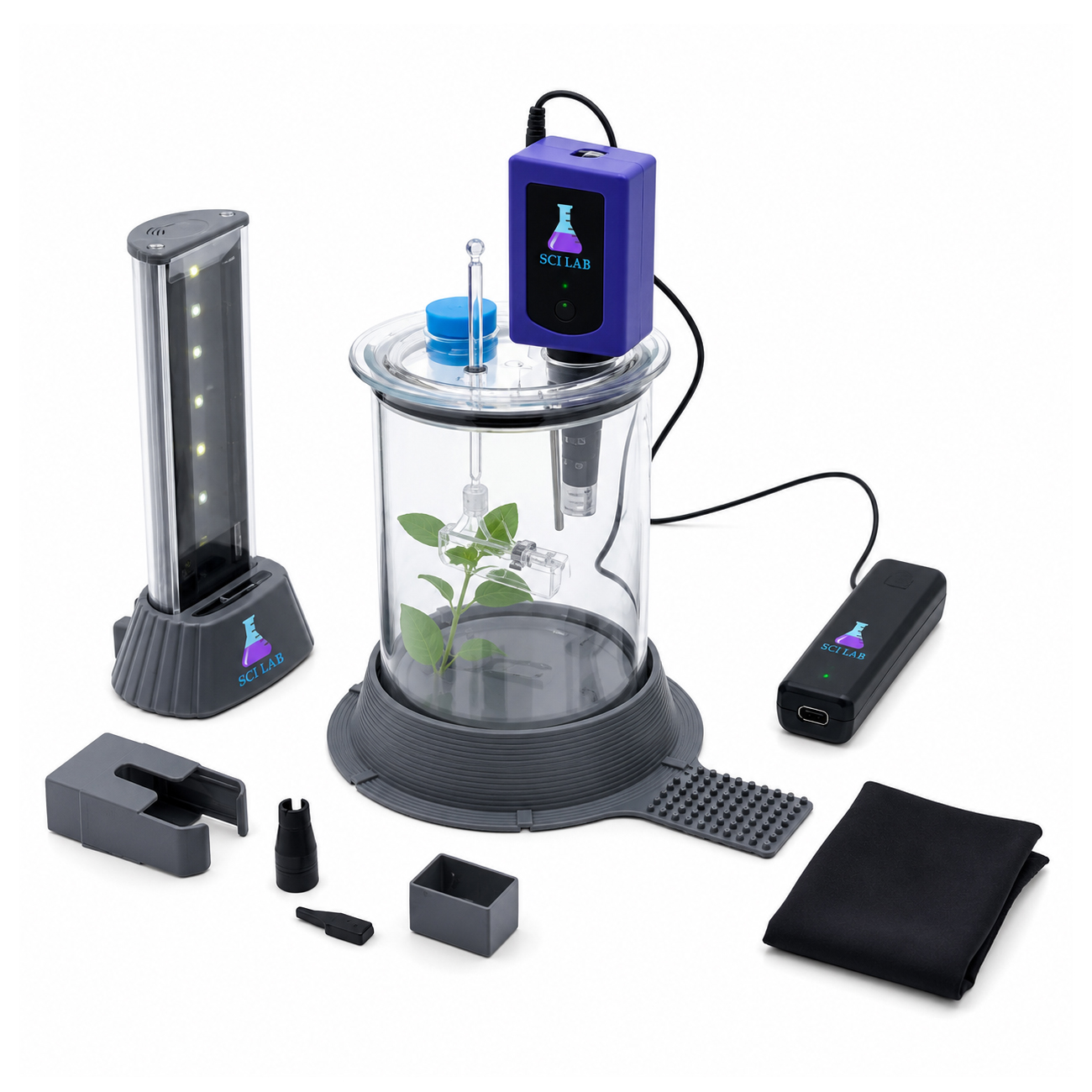
The Kit for Experiments on Photosynthesis measures gas exchange in plants with sensors. It has one photosynthesis cell, a platinum temperature sensor and an infrared CO2 sensor reading 0 to 100,000 ppm, which links by USB or Bluetooth to a computer or tablet. Students can study land and water plants, plant respiration or seed germination, and measure what happens in numbers.
Specifications of the Photosynthesis Sensor Kit
| Specification | Value |
|---|---|
| Cell | One photosynthesis cell |
| CO2 sensor | One, non-dispersive infrared (NDIR), range 0 to 100,000 ppm |
| CO2 resolution and accuracy | 1 ppm; ±(100 ppm + 5% of reading) |
| Connection | USB (cable included) or Bluetooth to graphing software; readings are logged on a compatible computer or tablet provided by the school, with no separate data logger |
| Temperature sensor | One platinum temperature sensor |
| Study material | Land and water plants, plant respiration, germinating seeds |
| Supplied by | Science Lab Supplies, Ambala, India |
Sensor Experiments in the Photosynthesis Cell
Leaves or seeds are placed in the cell and the CO2 sensor is fitted, then linked to the computer or tablet by its USB cable or by Bluetooth. Readings are logged while the temperature sensor checks that the cell is not warming up. Each run starts after a short settling time.
- Light against dark: log CO2 with a lamp on, then cover the cell with foil. CO2 falls in light and rises in the dark.
- Light intensity: repeat at several lamp distances and compare the slopes of the CO2 curves.
- Seed germination: place seeds sprouted in a Glass Petri Dish with Cover, 100 mm in the cell and record the rise in CO2.
- Oxygen by volume: compare the sensor results with the gas collected from pondweed in the Apparatus for Photosynthesis.
Precautions: keep water off the CO2 sensor, blot leaves dry before they go in, and use a cool lamp or a water screen so heat does not upset the readings.
Frequently Asked Questions
How are readings from the sensors recorded?
The CO2 sensor links by its USB cable or by Bluetooth to graphing software on a compatible computer or tablet, which the school provides, so no separate data logger is needed. It reads 0 to 100,000 ppm in 1 ppm steps, with an accuracy of ±(100 ppm + 5% of reading).
Can the CO2 sensor be used with water plants?
Yes, the kit is meant for land and water plants. A CO2 sensor that reads gas must stay dry, since liquid water and heavy condensation upset its readings, so with water plants it reads the air above the water and is mounted clear of splashes.
Why does CO2 keep rising for a short time after the lamp is switched on?
Photosynthesis takes a little time to speed up. Until it outpaces respiration, the leaves still release more CO2 than they take in, so start timing the light rate once the curve turns down.
How is the rate worked out from the graph?
Fit a straight line to the steady part of the CO2 curve. Its slope, in ppm per minute, is the rate; divide by leaf mass or area to compare different runs.
How does the same kit measure respiration?
Run the cell in the dark, for example wrapped in foil. With no photosynthesis, CO2 rises steadily as the leaves respire, and germinating seeds give a similar rise.
Related Plant Physiology Kits
- Aquatic Plant Photosynthesis (Oxygen) Demonstration Kit: 600 ml beaker, funnel and test tube for collecting oxygen from a water plant.
- Experimental Chamber for the Study of Biological Phenomena: 2 litre plastic chamber with sealed ports for CO2, oxygen and temperature sensors.
- Kit for Demonstration of CO2 Emission and Heat Production in Germinating Seeds: limewater, two 250 ml flasks and a matched pair of insulated vessels with thermometers.
- Germinating Seed Respiration Demonstration Kit: matched 30 mL seed and control vessels with a graduated 1 mL capillary and coloured indicator.
- Leaf Transverse Section Model, 300 x 400 mm: PVC model, 300 x 400 mm, showing stomata and guard cells.
More sensor and plant physiology sets appear in Biology Lab Equipment.
Schools and distributors in Nepal, Bangladesh, Zambia, Rwanda, South Africa and Qatar can be supplied from India, as Science Lab Supplies holds an Importer-Exporter Code. To request a quotation, open the contact page or place the kit in the enquiry cart.
Last updated: 19 November 2026


.jpg)