Model of DNA (Helical)
Product Code : SCL-BLE-11718
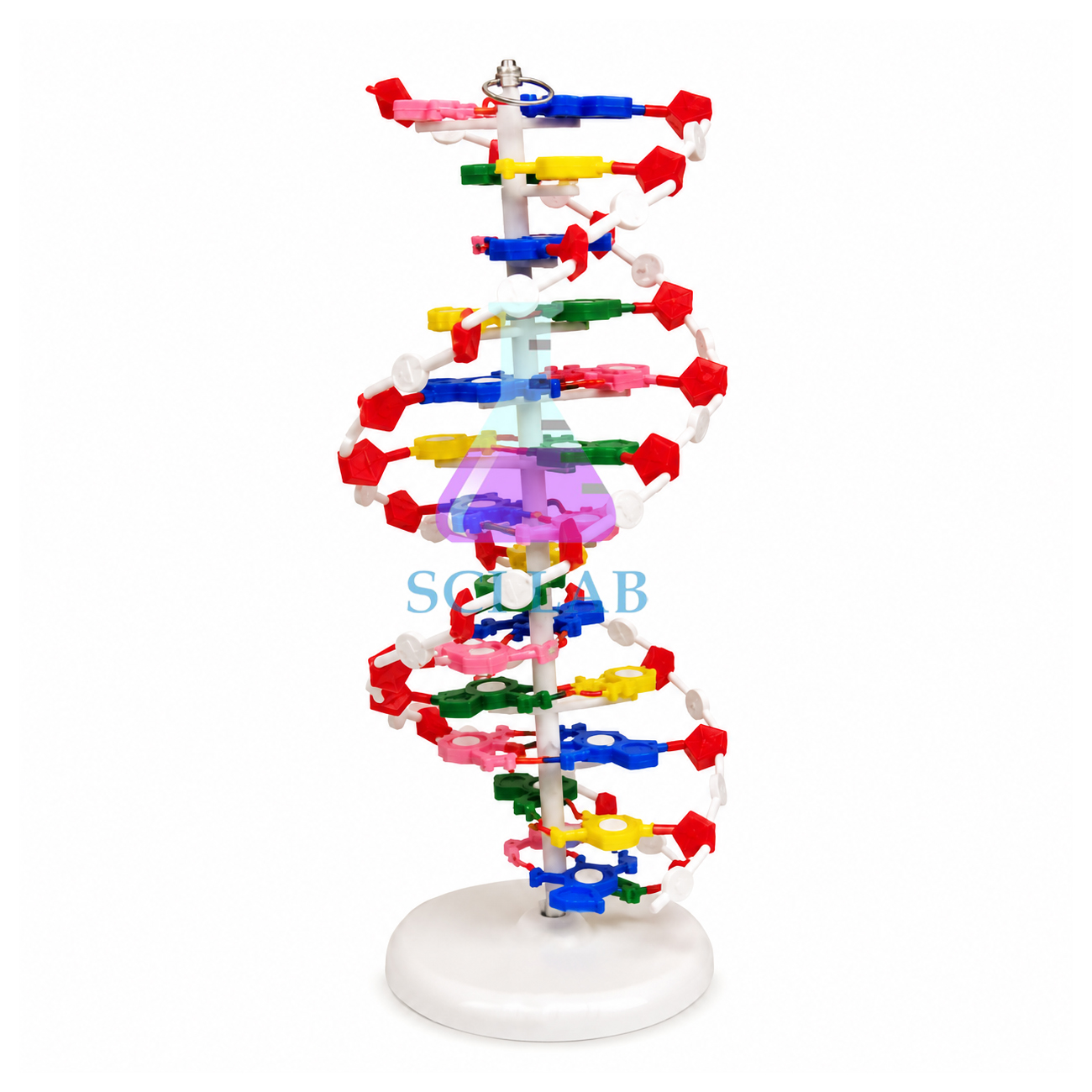
The Model of DNA (Helical) is an assembled PVC model of the DNA double helix with non-toxic colouring. It shows two long chains joined at regular intervals by short cross bars and coiled round each other, with the bases facing the inside and the sugar and phosphate parts forming the backbone on the outside.
Specifications of the DNA Helical Model
| Specification | Value |
|---|---|
| Structure shown | Two long chains joined by short cross bars at regular intervals, coiled into a double helix |
| Arrangement | Bases inside the helix; sugar and phosphate backbone outside |
| Construction | Assembled parts |
| Material and finish | PVC with non-toxic colouring |
| Supplied by | Science Lab Supplies, Ambala, India |
DNA Structure Lessons with the Helical Model
Place the helix where the whole class can see it and turn it slowly. Point out one cross bar, then follow both chains through one full turn before asking students to describe what repeats.
- Build to the helix (Class 10 to 12): students join single units with the Simplified Nucleotide Models for Students, then compare their short strand with the assembled helix.
- Pairing rules: count the cross bars in one turn and record which base pairs with which, using a colour key made by the class.
- From model to chart: label the same parts on the DNA Structure Chart, then discuss how the strands separate when DNA copies itself.
Frequently Asked Questions
Does the DNA model arrive assembled, or must students build it?
It is listed with assembled parts, so it is ready for display and demonstration as soon as it is unpacked. It is not a building kit; schools that want pupils to build strands usually add a nucleotide kit for group work.
What should a buyer check about the colour key before ordering?
The model carries non-toxic colouring. Check that the four bases are shown in four different colours and that a key comes with it or can be made, because students identify the A-T and G-C pairs by colour.
Can adenine pair with guanine?
No. Adenine pairs only with thymine, through two hydrogen bonds, and guanine pairs only with cytosine, through three. Each pair joins a larger base to a smaller one, so every cross bar is the same width.
Do the two chains run in the same direction?
No. They lie side by side but run in opposite directions, which is called antiparallel: one runs 5' to 3' and the other 3' to 5'. This matters when DNA is copied or read, because the enzymes work in one direction only.
Why are the bases inside and the sugar and phosphate outside?
Sugar and phosphate units link by strong bonds into a backbone, and the charged phosphates mix well with water, so they face outwards. The flat bases avoid water, stack inside where they are protected, and pair across the helix.
Related Genetics and Cell Models
- Protein Structure Levels Model: PVC teaching model with assembled parts and non-toxic colouring.
- Mendelian Inheritance Chart (Mendel's First Law), 70 x 100 cm: laminated 70 x 100 cm chart on Mendel's pea-plant work.
- Sex Cell Formation (Meiosis) Chart: wall-mounted laminated chart, 70 x 100 cm.
- Superstructure of the Cell (With Cell Organelles): large PVC cell model, 700 x 400 x 500 mm.
- Plant Cell Model, 180 x 300 x 60 mm: colour-coded PVC model on a base with a numbered key card.
Continue to Biology Lab Equipment for more genetics teaching aids, or return to School Lab Equipments.
With its Importer-Exporter Code, Science Lab Supplies accepts overseas orders from South Africa, Qatar, Sri Lanka, Vietnam, Malaysia and Peru. Write in through the contact page or the enquiry cart to receive a quotation.
Last updated: 15 November 2026
.jpg)