Microscope Slide Preparation Kit
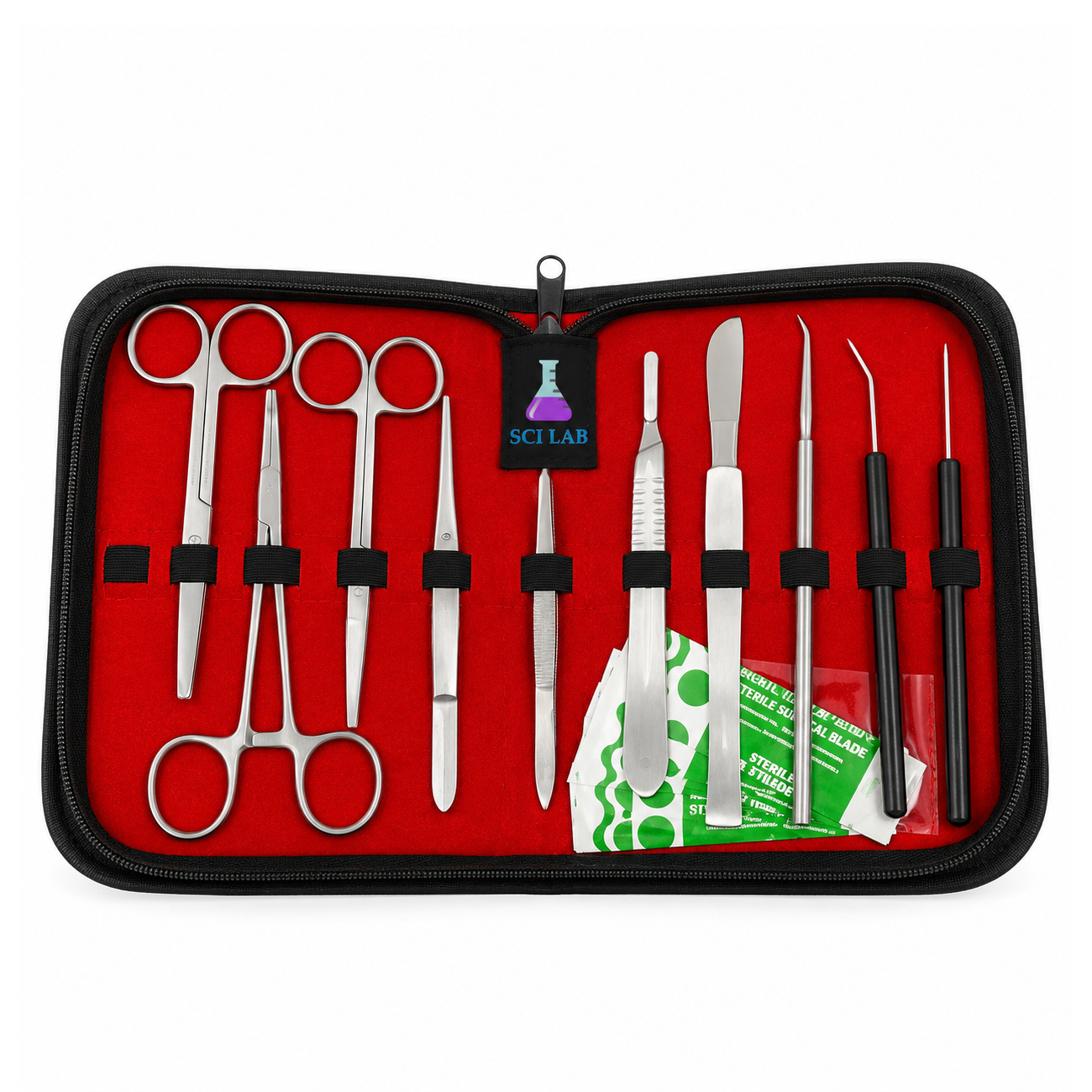
Product Code : SCL-BLE-11616
The Microscope Slide Preparation Kit holds a screw-feed hand microtome for plant sections, tweezers in four tip styles, two scalpels, microscope scissors, a double flexible spatula and two straight, pointed mounted needles. Together they cut, lift, peel and mount plant and animal material for temporary microscope slides.
Specifications of the Slide Preparation Kit
| Specification | Value |
|---|---|
| Hand microtome | Screw-feed, for plant sections; cutting blade packed separately in its own protection |
| Tweezers | Straight-ended, curved-tip and round-end, 120 mm; blunt-end, 105 mm |
| Scalpels | One with an extended blade; one with a plastic handle and stainless-steel blade |
| Scissors | Microscope scissors |
| Spatula | Double flexible spatula, 120 x 6 mm |
| Needles | Two straight, pointed mounted needles with handles, nominal 130 mm |
| Stainless steel parts | All four tweezers; extended-blade scalpel; blade of the plastic-handle scalpel; spatula |
| Supplied by | Science Lab Supplies, Ambala, India |
Making Temporary Slides with the Preparation Kit
A clear slide needs a thin specimen. Cut or peel the material thin, lift it into water with the spatula or the round-end tweezers, stain it, and lower a cover slip from one edge with a needle so that no air is trapped.
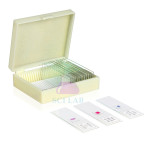
- Stem anatomy: set a short piece of young maize or sunflower stem in the hand microtome, raise it a little with the feed screw and cut thin cross sections across the top with the microtome blade. Stain the thinnest and compare them with the prepared Monocotyledonous and Dicotyledonous Stems, Cross Section slide.
- Staining in small dishes: move sections between stain, water and glycerine in a Watch Glass, Pack of 12.
- Leaf epidermis: grip the lower skin with the curved-tip tweezers, peel a strip and mount it to count stomata.
- Root sections: cut across a young root to find the central vascular cylinder, where groups of xylem and phloem alternate.
The microtome blade, scalpels and needles are sharps for supervised use only. Keep the microtome blade in its protection until it is needed, keep fingers behind the cutting edge and cut away from the hand, store the tools in a closed case after the lesson, and put used blades into a sharps container.
Frequently Asked Questions
Why does the kit hold tweezers with four different tips?
Each tip suits a different job. Straight and curved tips grip small pieces, and the curve reaches under a peel lying flat on the slide. Round and blunt ends lift thin sections and move cover slips without piercing or scratching them.
What else is needed to make slides with the kit?
Slide work also needs glass slides, cover slips, a stain such as methylene blue or safranin, glycerine or water for mounting, a dropper, and a small dish for staining sections.
How does a hand microtome differ from a rotary or sliding microtome?
A hand microtome is held in the hand: its feed screw raises a fresh specimen and a blade is drawn across the top, which suits plant sections in class. Rotary and sliding microtomes are bench machines that cut wax- or resin-embedded tissue at set thicknesses for research and pathology.
Why is safranin used on stem sections?
Safranin stains lignified walls, such as xylem and sclerenchyma, red. A counter-stain such as fast green colours the cellulose walls green, so the two tissue types are easy to tell apart.
How is a monocot stem told from a dicot stem?
In a monocot stem the vascular bundles are scattered and there is no cambium. In a dicot stem they form a ring with cambium between xylem and phloem, around a central pith.
Why mount the section in glycerine?
Glycerine dries far more slowly than water, so the section stays flat and clear for the whole practical. A water mount can dry out and fill with air within minutes.
Related Dissecting and Sectioning Tools
- Microscopy Accessory Kit: 150 mm ruler, two pairs of scissors, two tweezers, a No. 3 scalpel handle with a No. 11 blade and two needles.
- Large Dissecting Set: 20 stainless-steel instruments in a velvet-lined leatherette case.
- Dissecting Board: soft wood board with raised edges, 550 x 400 mm or 450 x 300 mm.
- Needle with Handle: straight, bent and arrow-head needles, 110–125 mm.
- Microscope Cover Glass, 20 x 20 mm (10 g): borosilicate cover slips for flat mounts.
Further sectioning and dissecting tools are listed in Biology Lab Equipment and Dissecting and Surgical.
Preparation kits can leave India for Nigeria, Kenya, Ghana, Ethiopia, Tanzania and Uganda, as Science Lab Supplies is an Importer-Exporter Code holder. Ask for your quotation through the contact page, or note this kit in the enquiry cart.
Last updated: 19 November 2026