Kit for the Demonstration of Absorption of Mineral Salts in Plants
Product Code : SCL-BLE-11624
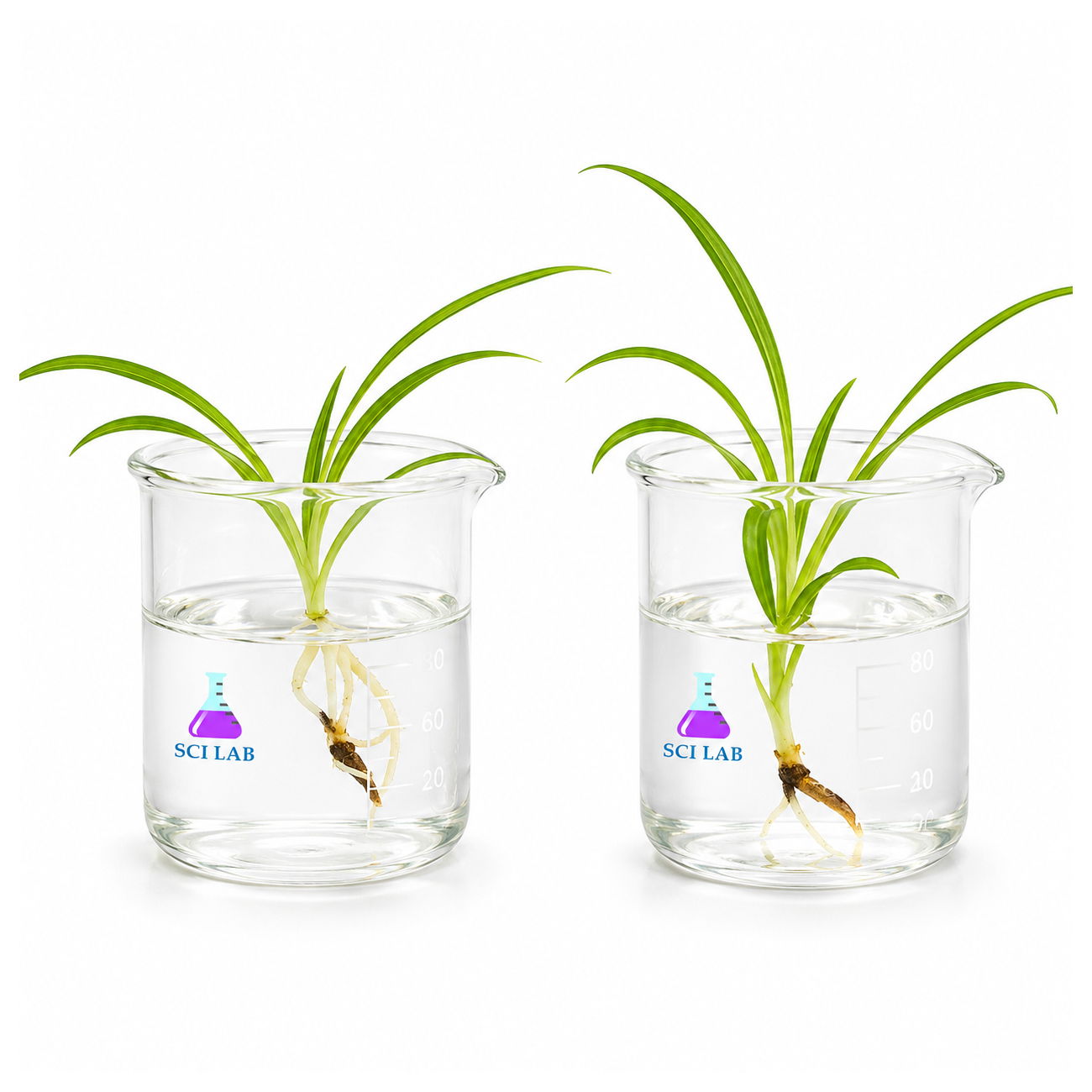
The Kit for the Demonstration of Absorption of Mineral Salts in Plants has two 250 ml Erlenmeyer flasks and five labelled sachets of complete plant nutrient, each made up with 1 litre of water, for five class runs. One seedling grows in the nutrient solution and a matched seedling in water only, so students can see how mineral uptake affects growth. Seedlings are raised separately.
Specifications of the Mineral Salt Absorption Kit
| Specification | Value |
|---|---|
| Flasks | Two Erlenmeyer (conical) flasks, 250 ml each |
| Nutrient | Complete hydroponic nutrient with major and trace elements, in 5 individually labelled sachets |
| Dose | One sachet per 1 litre of solution, with the dosing label in the box |
| Runs | Five class runs, each against a matched water-only control |
| Supplied by | Science Lab Supplies, Ambala, India |
Running the Water-Culture Comparison
Dissolve one sachet in 1 litre of distilled water as the dosing label directs, measuring the water with a Measuring Cylinder 500ml, and fill one flask. Fill the other with distilled water only as the matched control. Hold a seedling in the neck of each flask with a cotton wool plug so its roots hang in the liquid.
- Growth comparison (Class 11 mineral nutrition): measure shoot height and count leaves every few days for three to four weeks.
- Deficiency signs: look for pale or yellow leaves and weak roots in the plain-water flask.
- Repeats: a Conical Flasks Set (50-500 ml) gives extra flasks for more seedlings in the same nutrient solution and in water, so one odd plant does not decide the result.
- Even start: raise the seedlings on damp paper first and choose two of the same size.
Precautions: wrap each flask in black paper to keep light off the roots, top up with distilled water as it is used, and renew the solution regularly.
Frequently Asked Questions
How long does the water-culture comparison take to show results?
Plan for several weeks. Differences in leaf colour and shoot height usually become clear after two to four weeks, so pupils check and record a few times each week. The five sachets give five such runs.
How does this kit differ from a nutrient-deficiency kit with many salts?
Deficiency kits supply separate salt solutions so pupils can make media that each lack one element. This kit has five sachets of one complete nutrient, with major and trace elements, and two flasks for a with-and-without test against plain water.
Why is the second flask filled with distilled water only?
It is the comparison. Both seedlings get water, light and air, and only the minerals differ. Poor growth in the distilled-water flask shows that the minerals are needed.
Why are the flasks covered with black paper?
Darkness around the roots stops algae growing in the solution, where they would compete for minerals and oxygen. Roots also grow normally in the dark, as they would in soil.
Why must air reach the roots?
Roots respire and need oxygen to take up mineral ions, which uses energy. Bubbling air through the solution now and then, or leaving an air space above it, keeps the roots healthy.
Related Plant Nutrition and Water Kits
- Kit for Demonstration of Transpiration in Plants: tripod, 600 ml beaker, colouring liquid and a borosilicate glass tube, 20 mm across and 200 mm long.
- Dutrochet's End Osmometer for Demonstrating Osmotic Pressure: 250 ml beaker, 25-50 ml bulb and replaceable cellulose membrane for sucrose solutions.
- Soil Analysis Kit: colour-comparison tests for soil pH, nitrogen, phosphorus and potassium, 20 of each.
- Monocotyledons and Dicotyledons, Roots, Cross Sections: coloured slide on borosilicate glass, 25.4 x 76.2 mm.
- Root Tip Model: PVC model, 300 x 400 mm, showing root hairs and the inner vasculature.
See the full Biology Lab Equipment category, or go up to School Lab Equipments.
Science Lab Supplies is able to take export orders for this kit from Oman, the Philippines, Nepal, Bangladesh, Zambia and Rwanda, using its Importer-Exporter Code. Ask for a quotation by message on the contact page, or by adding the kit to the enquiry cart.
Last updated: 19 November 2026