Conical Flasks Set (50-500 ml)
Product Code : SCL-BLE-11658
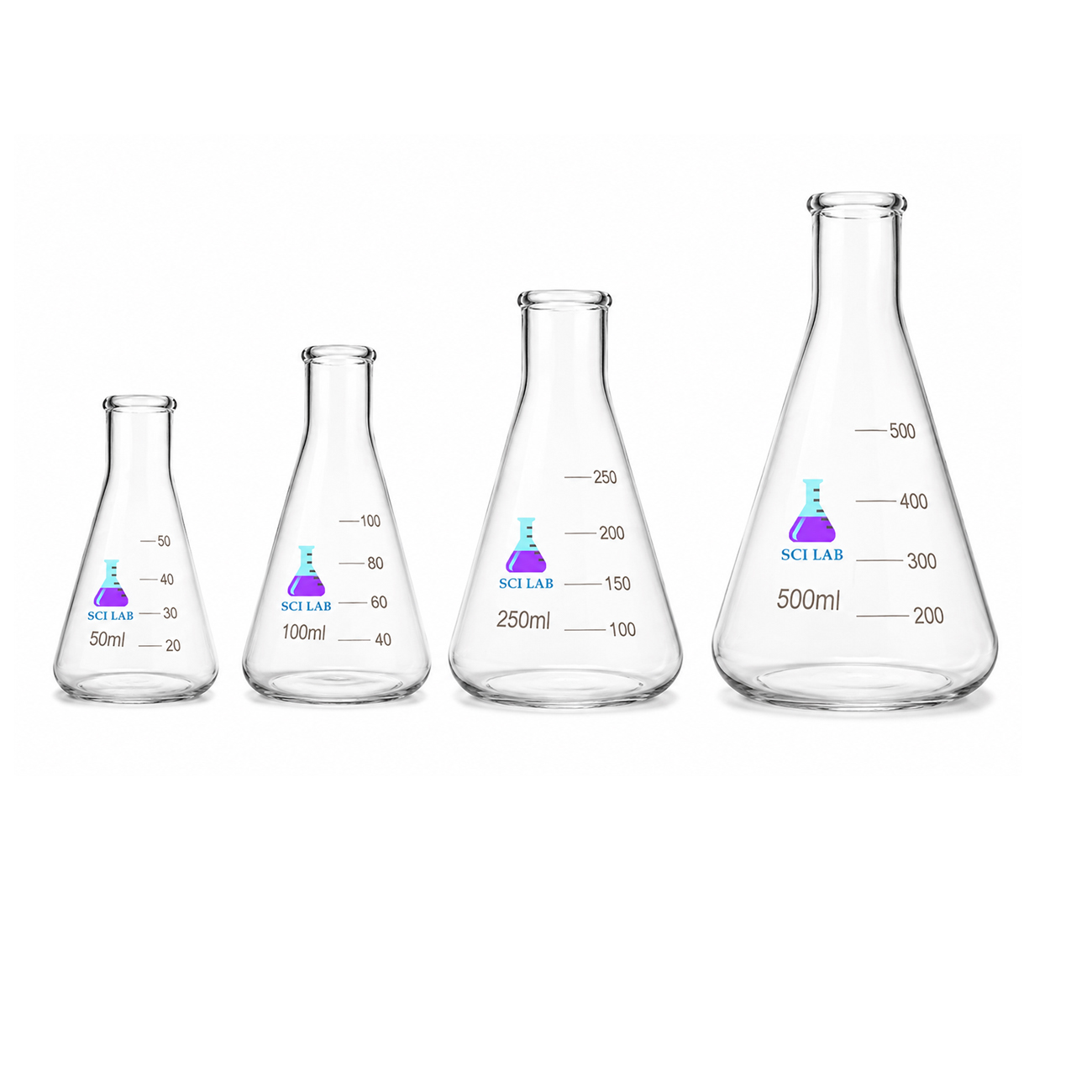
The Conical Flasks Set (50-500 ml) holds four graduated Erlenmeyer flasks with narrow mouths, in 50, 100, 250 and 500 ml sizes, made of transparent borosilicate glass. The sloping walls and narrow neck let students swirl and mix liquids with little splashing, from small reactions to larger batches of solution.
Specifications of the Conical Flasks Set
| Specification | Value |
|---|---|
| Type | Erlenmeyer (conical) flask, narrow mouth |
| Sizes in the set | 4 flasks: 50, 100, 250 and 500 ml |
| Material | Borosilicate glass, transparent |
| Marking | Graduated |
| Supplied by | Science Lab Supplies, Ambala, India |
Titration and Mixing Work with the Conical Flasks
The flask is the receiving vessel in most school titrations and the mixing vessel in many biology tests. Its shape lets the contents be swirled hard without spilling, and the narrow mouth can be closed with cotton wool, foil or a stopper.
- Acid-alkali titration: run 10 ml of alkali from a 10 ml graduated pipette into the 100 ml flask, add two drops of indicator and add acid from a Borosilicate Glass Burette 50ml, swirling all the time.
- Yeast fermentation: mix warm sugar solution and yeast in the 250 ml flask, stretch a balloon over the mouth and compare how far it inflates at two temperatures.
- Preparing a solution: dissolve a weighed solid in water in the 500 ml flask by swirling, then filter it through a 75 mm glass funnel if any solid remains.
Common errors: treating the flask graduations as exact volumes, swirling so hard that liquid climbs the neck, and leaving a splash of acid on the inner wall above the solution.
Frequently Asked Questions
Why stock the flasks as a set of four sizes?
Each size covers different work: 50 ml for small reactions, 100 and 250 ml for titrations, and 500 ml for preparing solutions or media. One set per bench gives a group all four sizes without ordering odd numbers of single flasks.
Which stoppers or plugs fit these flasks?
The listing gives no neck diameter, so measure the inside of each mouth before ordering rubber stoppers. Cotton-wool plugs or foil caps fit any size and suit culture work. Flasks with ground-glass stoppers are a separate item, listed as a stoppered conical flask.
Does a school flask set need to be borosilicate?
It helps. Borosilicate glass expands little with heat, so a flask can be warmed on a gauze or filled with hot solution with less risk of cracking than soda-lime glass. It also resists the acids and alkalis used in school titrations.
How should the flask be swirled during a titration?
Hold the neck between thumb and fingers and move the base in small circles, keeping the flask on or just above the white tile. Swirl after each addition from the burette so the acid mixes fully before the next drop goes in.
Why add only two or three drops of indicator?
Indicators are weak acids or bases themselves, so a large amount reacts with some of the solution and moves the end point. A few drops give a clear colour change while the error stays too small to see.
Related Flasks and Volume Glassware
- Glass Beakers, Assorted Capacities: four low-form glass beakers with rims: 50, 100, 250 and 500 ml.
- Conical (Erlenmeyer) Flask, 250 ml: single graduated 250 ml flask with a narrow mouth.
- Conical Flask (Erlenmeyer) with Stopper, 25-500 ml: ground-glass fixed stopper, in sizes from 25 to 500 ml.
- Filter Flask (Buchner Flask) with Side Arm, 250 ml: 250 ml flask with a side arm for vacuum filtration.
- Glass Measuring Cylinders, Assorted Capacities: five glass cylinders on plastic bases, from 10 to 250 ml.
- Borosilicate Conical Flask: conical body, flat base and narrow neck in borosilicate glass.
Find more vessels in Biology Lab Equipment and the Laboratory Flasks range.
With its Importer-Exporter Code, Science Lab Supplies can export flask sets to Egypt, Iraq, Nigeria, Kenya, Ghana and Ethiopia. Use the contact page or the enquiry cart to request a quotation for the number of sets you need.
Last updated: 15 November 2026