Glass Measuring Cylinders, Assorted Capacities
Product Code : SCL-BLE-11645
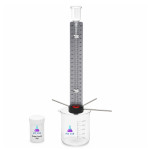
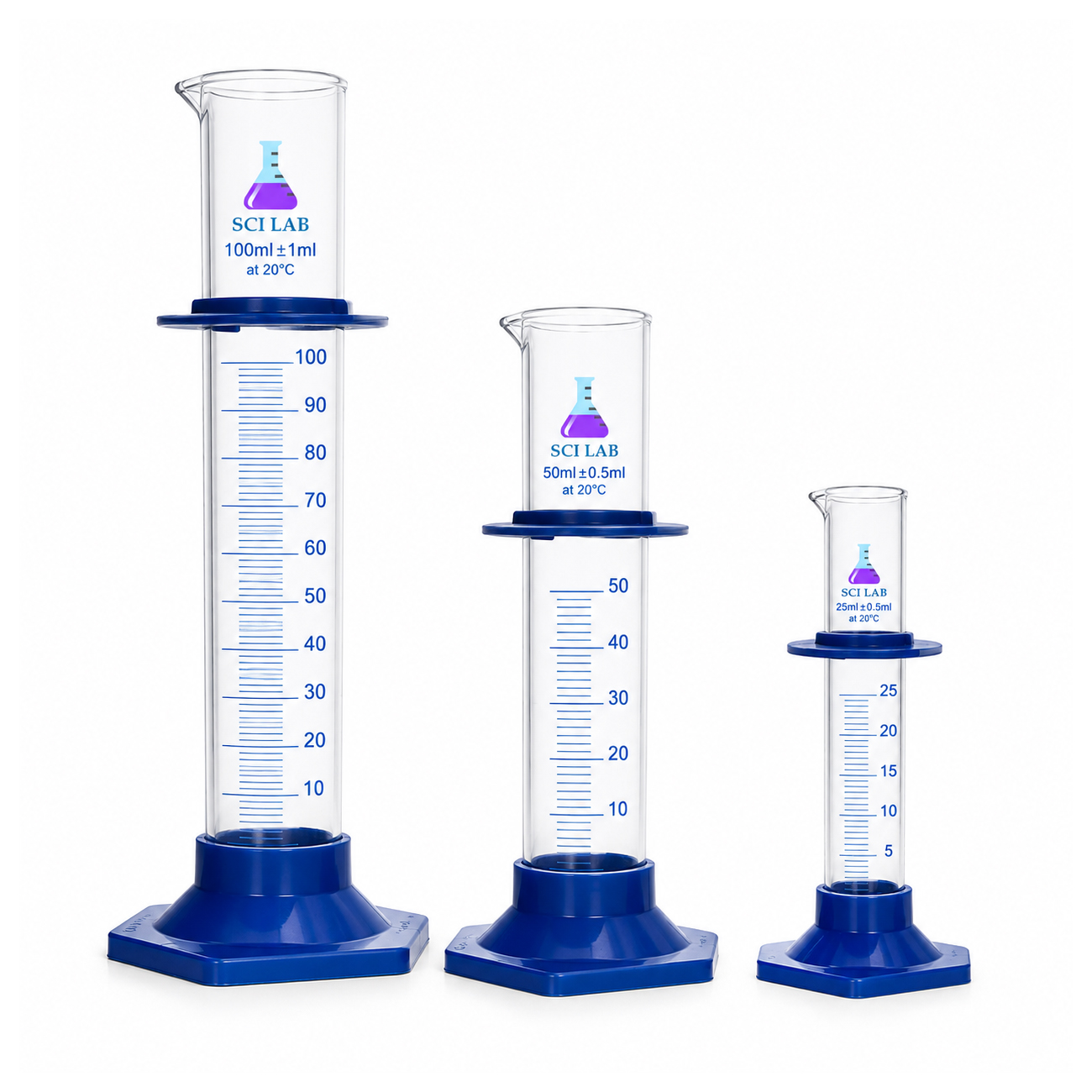
This set of Glass Measuring Cylinders, Assorted Capacities, contains five glass measuring cylinders of 10, 25, 50, 100 and 250 ml, each on a plastic base, graduated in divisions of 0.2, 0.5, 1, 1 and 2 ml in that order. The glass resists chemicals and heat, and the size range lets students pick a cylinder close to the volume they need.
Specifications of the Measuring Cylinders Set
| Specification | Value |
|---|---|
| Contents | 5 measuring cylinders |
| Capacities | 10, 25, 50, 100 and 250 ml |
| Graduation interval | 10 ml: 0.2 ml; 25 ml: 0.5 ml; 50 ml: 1 ml; 100 ml: 1 ml; 250 ml: 2 ml |
| Body | Glass, chemical and heat resistant |
| Base | Plastic |
| Supplied by | Science Lab Supplies, Ambala, India |
Measuring Liquids with the Cylinder Set
Stand the cylinder on a level bench, pour to just below the line and add the last few drops with a Dropper. Bend down so the eye is level with the liquid before reading.
- Osmosis solutions: measure the water for sugar or salt solutions of different strengths.
- Oxygen from pondweed: fill the 25 ml cylinder with water, turn it upside down over the plant in a beaker of water and read the gas collected at the top.
- Small volumes: for a few millilitres that need closer measurement, use a 10 ml Graduated Pipette instead of the 10 ml cylinder.
Never heat a measuring cylinder or fill it with hot mixtures, as heat can distort the glass and change its calibration.
Frequently Asked Questions
What does the plastic base add to a glass measuring cylinder?
It widens the footprint so the cylinder is harder to knock over, and it cushions the glass if the cylinder tips or is put down hard. This matters most for the tall 250 ml cylinder on a crowded bench.
What do TC and TD markings on a cylinder mean?
TC (also written In) means calibrated to contain the marked volume; TD (or Ex) means calibrated to deliver it when poured, allowing for the film left on the wall. The marking and any accuracy class are printed on the glass, so buyers should read them on the cylinders rather than judge from the capacity.
Why estimate between two graduation marks?
The liquid surface often lies between two lines. Judging how far it sits across the gap, for example about halfway, adds one more figure to the reading, which is more exact than rounding to the nearest line.
How do students find the value of one division?
Take two numbered marks, subtract the smaller from the larger and divide by the number of spaces between them. This stops students counting each line as one millilitre. In this set one division is 0.2 ml on the 10 ml cylinder, 0.5 ml on the 25 ml, 1 ml on the 50 and 100 ml, and 2 ml on the 250 ml.
Related Measuring Cylinders and Tubes
- Measuring Cylinder 10ml: 10 ml glass cylinder graduated every 0.2 ml.
- Measuring Cylinder 250ml: 250 ml graduated glass cylinder, heat and chemical resistant.
- Volume Measuring Cylinder: transparent plastic cylinders in 10, 50 and 100 ml.
- Glass Beakers, Assorted Capacities: four low-form borosilicate 3.3 beakers with pouring spouts, 50 to 500 ml.
- Graduated (Measuring) Tubes with Stoppers: 10 ml and 25 ml glass tubes with stoppers.
- Test Tube Rack, 12 Places, Autoclavable: rack with large holes that keeps 12 tubes or cylinders upright.
Single cylinders and other glass items are in the Lab Glassware range; sets for biology are in the Biology Lab Equipment range.
Science Lab Supplies' Importer-Exporter Code allows the cylinder set to be exported to Saudi Arabia, Oman, the Philippines, Nepal, Bangladesh and Zambia. Get a quotation by sending a message on the contact page or adding the set to the enquiry cart.
Last updated: 19 November 2026