Tilia (Linden Tree), 3-Year-Old Stem, Cross-Section

Product Code : SCL-BLE-11682
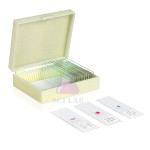
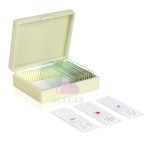
This coloured cross section of a three-year-old Tilia (Linden Tree) stem shows how wood builds up season by season. Students can count three growth increments of secondary xylem, see the change from early to late wood, and follow rays out into a thicker bark. It is mounted on a rectangular borosilicate glass slide, 25.4 x 76.2 mm, in a plastic box.
Specifications of the Tilia 3-Year Stem Slide
| Specification | Value |
|---|---|
| Specimen | Tilia (Linden Tree) stem, three years old |
| Section and preparation | Cross section, coloured |
| Slide | Rectangular borosilicate glass, 25.4 x 76.2 mm (1 x 3 in) |
| Storage box | Plastic |
| Supplied by | Science Lab Supplies, Ambala, India |
Reading Annual Rings in a Three-Year Tilia Stem
Find the pith at x4 or x10 and keep it in view while counting outwards. A Digital Trinocular Microscope with its 3 MP camera and tablet can capture the whole section, so the class can mark each ring on one shared image.
- Ageing the stem: count the wood increments from the pith to the cambium and write the age beside a sector drawing.
- Early and late wood: at x40, draw a strip of cells across one ring boundary and compare cell width and wall thickness on each side.
- One year against three: set the slide beside the Tilia (Linden Tree), 1-Year-Old Stem, Cross-Section and record what has changed in the wood, the phloem and the outer bark.
Common slips: counting the pith edge as a ring, and taking the bands of phloem fibres in the bark for extra growth rings.
Frequently Asked Questions
How does this slide differ from a one-year Tilia slide that a distributor may already carry?
The one-year section shows only the first season of wood. The three-year section shows three increments, so the progression of ring formation and a thicker bark can be seen. Many colleges keep both to follow secondary growth over time.
How is each slide protected in storage and transit?
Each slide is kept in a plastic box, which guards the glass against scratches and chipped edges. On arrival, store the boxes flat in a cool, dark cupboard; sunlight slowly fades coloured sections and heat can soften the mount.
How are the growth rings counted on the section?
Start at the pith and count outwards to the cambium. Each sharp line where small late-wood cells meet the wide early-wood cells of the next season marks the end of one year, so this stem should show three increments.
Why are the cells at the end of each ring smaller and thicker-walled?
Early wood forms in spring, when growth is fast, so its cells are wide with thin walls. Late wood forms as growth slows towards the end of the season, giving narrow, thick-walled cells. The contrast with the next spring's wood makes the ring visible.
Is Tilia wood ring-porous like oak?
No. Tilia is diffuse-porous: its vessels are of fairly similar size and are spread across the whole ring. In ring-porous woods such as oak, the widest vessels are crowded into the early wood of each year.
Related Slides, Models and Storage
- Monocotyledonous and Dicotyledonous Stems, Cross Section: coloured monocot and dicot stem sections on borosilicate glass.
- Cross Section of the Stem: 300 x 400 mm three-dimensional PVC model.
- Microscope Slide Box for 100 Slides: holds 100 standard slides of 7.6 x 2.6 cm.
- Biological Prepared Slide Kit (10 Slides): ten prepared slides for classroom microscopy practice.
- Microscopy Accessory Kit: ruler, scissors, tweezers, a scalpel and two needles with handles.
Other plant and animal teaching material sits in the Biology Lab Equipment section of the School Lab Equipments catalogue.
Export shipments from Science Lab Supplies, which holds an Importer-Exporter Code, can reach laboratories in Nigeria, Kenya, Ghana, Ethiopia, Tanzania and Uganda. A quotation can follow once the three-year Tilia slide is listed in the enquiry cart or mentioned in a message from the contact page.
Last updated: 16 November 2026




.jpg)