Lungs, Cross Section

Product Code : SCL-BLE-11674
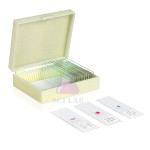
Lungs, Cross Section is a coloured prepared slide of lung tissue cut across, showing the honeycomb of thin-walled air sacs where oxygen enters the blood and carbon dioxide leaves it. The section is mounted on a rectangular borosilicate glass slide of 25.4 × 76.2 mm and stored in a plastic box.
Specifications of the Lung Cross Section Slide
| Specification | Value |
|---|---|
| Specimen | Lung tissue |
| Section | Cross section |
| Preparation | Coloured |
| Slide size | 25.4 × 76.2 mm (1 × 3 in) |
| Slide | Rectangular, borosilicate glass |
| Box | Plastic |
| Use | Laboratory microscopy |
| Supplied by | Science Lab Supplies, Ambala, India |
Tracing the Gas-Exchange Surface on a Lung Section
Scan the whole section at 4X to find an airway, then follow it outwards to the air sacs. At 40X each alveolar wall shows as a thin coloured line with a few nuclei.
- Breathing and exchange of gases (Class 11): on a Junior School Microscope with 4X, 10X and 40X achromatic objectives, label a bronchiole, a group of alveoli and a blood vessel.
- From section to organ: set the Human Lung Model, which has removable parts, beside the microscope and show where a slice like this would be taken.
- Structure and breathing: after the slide, use the lung model and lime water in the Kit for Experiments with Breathing to show carbon dioxide in exhaled air.
Common errors: taking collapsed or torn areas for diseased tissue, and labelling every round space as an alveolus when some are blood vessels holding red cells.
Frequently Asked Questions
Which animal is a lung slide usually taken from, and does it matter for teaching?
Teaching lung slides are often cut from small mammals, and the plan of airways, air sacs and vessels is the same in all mammals. This listing does not name the source, so a buyer who needs human tissue for a medical course should ask in the enquiry.
Which parts of the respiratory syllabus does a lung section support?
It serves the breathing and gas exchange chapter of secondary biology, where students must find alveoli, and respiratory histology in B.Sc. zoology, nursing and paramedical courses, which adds bronchioles and the vessels beside them. Distributors can offer it with a lung model and a respiratory chart for the same lessons.
How do students tell a bronchiole from a blood vessel in the section?
A bronchiole has a lining of epithelial cells and a ring of smooth muscle, and its space is usually empty. A blood vessel has a very thin inner lining and often holds red cells. Branches of the pulmonary artery run beside the airways.
Why is there no cartilage around most airways on the slide?
Cartilage plates and glands belong to the larger bronchi. Once the airways narrow into bronchioles, the cartilage stops and smooth muscle controls their width. Most of a lung section is bronchioles and alveoli, so cartilage appears only beside a large bronchus.
What are the dark specks inside some air sacs?
These are usually alveolar macrophages, also called dust cells. They take up inhaled particles, which show as dark or brown grains. The type 2 cells that make surfactant sit in the alveolar wall and look rounder and paler, with a foamy cytoplasm.
Can students see the thin cells that the gases pass through?
Not clearly. Type 1 cells and capillary walls are so thin that, under a light microscope, the alveolar wall looks like a fine coloured line with scattered nuclei. That thinness is the point of the lesson: gases cross a very short distance.
Related Respiratory System Teaching Aids
- Human Respiratory System Chart, Laminated, 70 x 100 cm: laminated wall chart, 70 × 100 cm.
- Windpipe (Trachea) Model, Enlarged: enlarged three-dimensional PVC model.
- Peak Expiratory Flow Meter, Piston Type: reads peak flow in L/min on a scale starting at 60 L/min.
- Simple Squamous Epithelium: coloured slide kept in a plastic box.
- Artery and Vein, Cross Section: coloured slide on borosilicate glass.
The Biology Lab Equipment range carries more respiration apparatus, and Microscope Slides and Cameras lists other prepared slides.
As an Importer-Exporter Code holder, Science Lab Supplies can ship lung slides from Ambala to South Africa, Qatar, Sri Lanka, Vietnam, Malaysia and Peru. One message on the contact page, or a list built in the enquiry cart, is enough to ask for a quotation on the lung slide.
Last updated: 15 November 2026

.jpg)