Entomological Needles
Product Code : SCL-BLE-11643
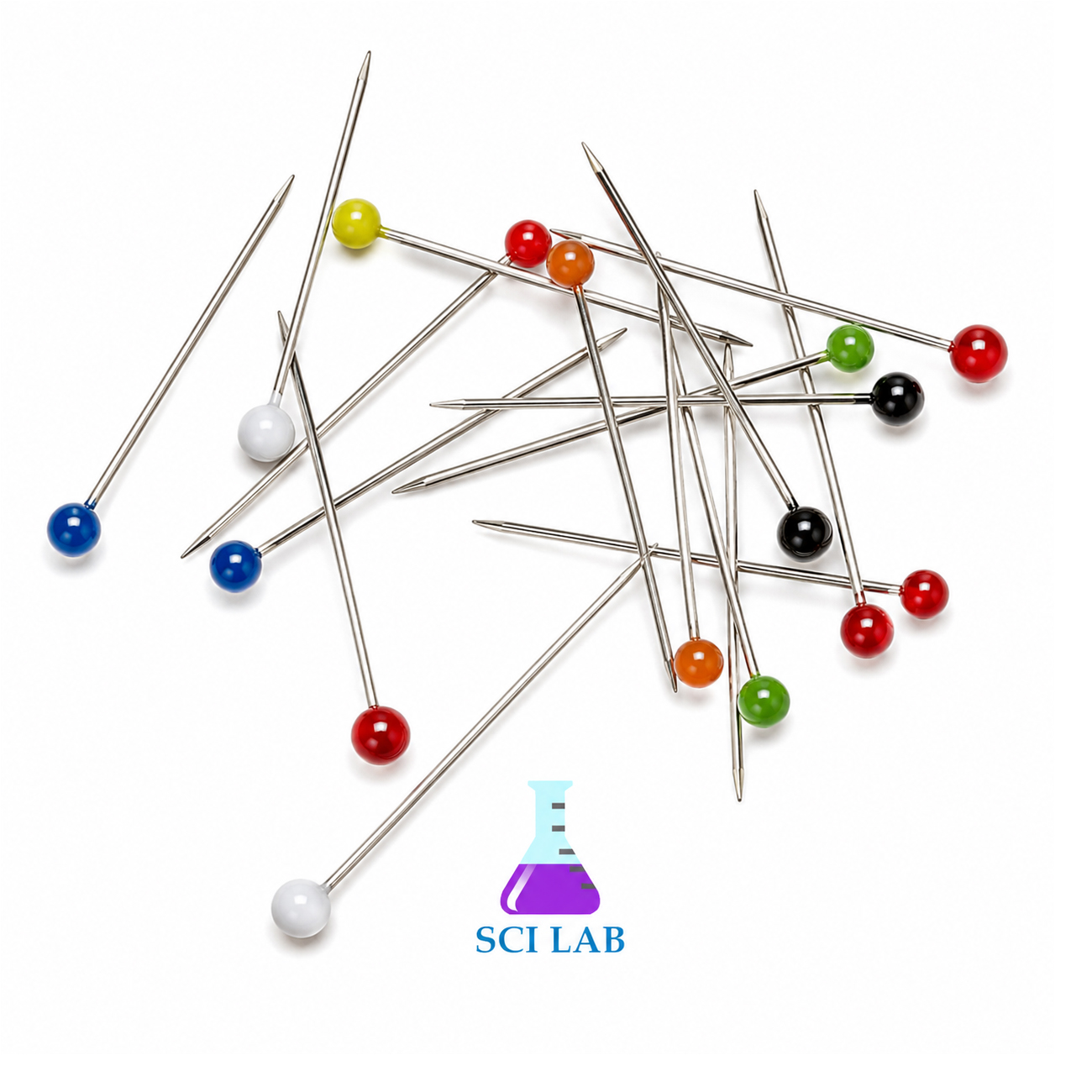
Entomological Needles are insect pins for mounting preserved insect specimens in a collection. The set holds 100 pins, 20 in each of five sizes from 00 to 3, all 38 mm long, with corrosion-resistant stainless steel shafts, small heads and a coloured, chemical-resistant enamel finish, for school and college laboratories.
Specifications of the Entomological Needles
| Specification | Value |
|---|---|
| Pins | 100: 20 each of sizes 00, 0, 1, 2 and 3 |
| Diameter | 0.30, 0.35, 0.40, 0.45 and 0.50 mm (sizes 00 to 3), nominal |
| Length | 38 mm, nominal |
| Shaft | Corrosion-resistant stainless steel |
| Head | Small |
| Finish | Coloured enamel, chemical resistant |
| Use | Insect pinning in laboratories and schools |
| Manufacturer | Science Lab Supplies, Saha, Ambala, India |
Pinning Insects for a School Collection
Insects are pinned while fresh or after softening in a humid box. Large insects need thicker pins than small ones, so the pin is chosen to suit each specimen: the fine 00 and 0 pins for small, slender insects, sizes 1 and 2 for most medium-sized ones, and size 3 for big, heavy-bodied beetles and moths. It goes straight down through the thorax so the specimen sits level, with room above it for handling and below it for labels.
- Beetles: pin through the right wing cover near the front.
- Flies, bees and wasps: pin through the thorax just to the right of the midline.
- Butterflies and moths: pin through the middle of the thorax and set the wings on an Insect Spreading Board.
- Small or delicate specimens: hold them steady with Plastic Forceps while the pin goes in.
The pins have sharp points. Pupils pin specimens under supervision and push with the fingers well clear of the point. Keep pins in a closed, labelled container or a secure pinning tray, and put bent or damaged pins into a sharps container, never the general bin.
Frequently Asked Questions
Why are stainless steel pins used for long-term collections?
Stainless steel does not rust in a humid store or from insect body fluids, so the pin stays sound inside the specimen for many years. These pins have stainless shafts under a coloured enamel finish. Enamel can chip if a pin is bent, so handle and store them with care.
What should a distributor check before ordering insect pins?
Check the pin sizes and diameters, the length, the head, the finish and the count per pack. This set gives 100 pins, 20 each of sizes 00 to 3, from 0.30 to 0.50 mm thick, all 38 mm long with small heads. Schools use the middle sizes most, plus fine pins for small flies.
Why is a beetle pinned through the right wing cover?
Pinning to one side keeps the left wing cover, the legs and the line down the middle of the back undamaged. These features are used for identification, and a pin through the centre would destroy them.
Why must dried insects be relaxed before pinning?
Dry insects are brittle, and legs, antennae or wings snap when a pin goes in. A day or two in a closed box with damp paper softens the joints, so the pin passes cleanly and the limbs can be arranged.
How are very small insects mounted?
Insects too small for even a fine pin are glued to the tip of a small paper triangle, called a point, which is then pinned. The specimen stays whole and its label goes on the same pin.
Related Insect Mounting Equipment
- Dissecting Pins: mild steel or brass chrome-plated pins in 25 mm and 50 mm sizes.
- Insect Collecting Net, 24 cm Ring, Plastic Handle: 30 cm polyester net on a metal ring.
- Dissection Pan: metal pan with wax, 28 x 20 cm.
- Junior Dissecting Microscope: high-eyepoint lenses on a jointed arm scan the whole stage.
- Insect Observation Magnifier with 2x and 4x Acrylic Lenses: 70 mm pot for viewing live insects.
Mounting tools continue in the Dissecting and Surgical range and the Biology Lab Equipment range.
An Importer-Exporter Code lets Science Lab Supplies export the needles to Uganda, the UAE, Saudi Arabia, Oman, the Philippines and Nepal. Write to the team on the contact page or use the enquiry cart to request a quotation.
Last updated: 19 November 2026
.jpg)