
Single Phase Mobile Transformer
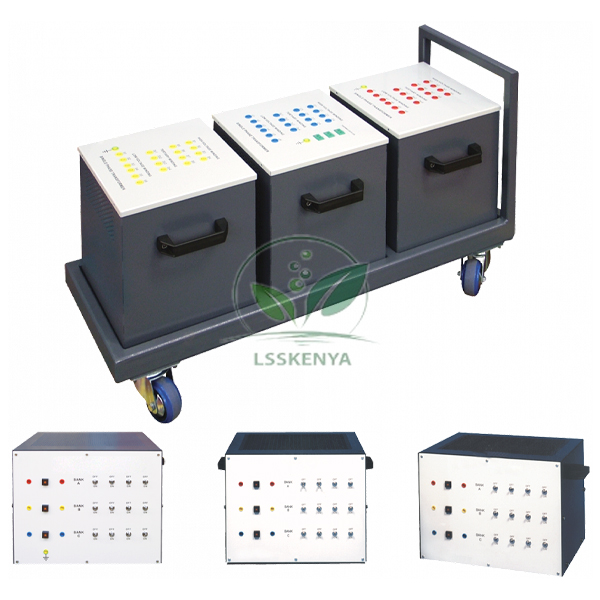
Product Code : LSK-EPS-10529
The Single Phase Mobile Transformer is a set of three single-phase teaching transformers, identical except for their tertiary windings. Each sits in its own steel enclosure, and all three fit on a frame with small wheels. They work as three individual single-phase transformers or connect together as one three-phase transformer.
Specifications of the Single Phase Mobile Transformer
| Specification | Value |
|---|---|
| Transformers | Three separate single-phase units, each in its own steel enclosure |
| Windings | High-voltage (primary) and low-voltage (secondary) tappings for a range of input and output voltages |
| Tertiary windings | Extra windings that compensate for slight differences between the transformers when used in parallel |
| Connections | All tappings on coloured, shrouded sockets for any of the common single-phase and three-phase connections |
| Turns and voltage | One volt per turn: the no-load output voltage equals the number of turns on the secondary |
| Temperature sensing | Thermocouples on the primary windings, the secondary windings and the core of one transformer |
| Frame | Holds all three enclosures, with small wheels for moving |
| Supplied by | Science Lab Supplies, Ambala, India |
Single-Phase, Parallel and Bank Experiments
Each transformer can be tested alone, run in parallel with another, or linked with the other two as a three-phase bank. The coloured sockets make every winding end easy to trace while wiring.
- Single-unit tests: check the turns ratio at each tapping, reading the secondary voltage on a Digital Multimeter, then run open-circuit and short-circuit tests.
- Parallel operation: parallel two units, use the tertiary windings to balance them and measure how they share the load.
- Three-phase bank: connect all three as one three-phase transformer and compare with the common-core Three Phase Mobile Transformer.
- Temperature changes: load the transformer fitted with thermocouples and follow its winding and core temperatures.
Precaution: check polarity before closing any parallel connection, since a reversed unit drives a large circulating current.
Frequently Asked Questions
Can the three units be used separately as well as together?
Yes. Each transformer works on its own as a single-phase unit, and the three can be linked as one three-phase transformer. A class can split into groups for single-phase tests and then join up for three-phase work.
How is the set moved and stored in the lab?
Each transformer sits in its own steel enclosure, and all three fit onto a frame with small wheels. The set rolls as one unit between benches or into storage. Disconnect all leads and the supply before moving it.
What are the tertiary windings for?
They compensate for small differences between the transformers when they run in parallel. Without that correction, a slight mismatch in voltage would drive a circulating current between the units even with no load connected.
What conditions must be met before two transformers are paralleled?
They need the same voltage ratio, the same polarity and similar per-unit impedance. For three-phase banks the phase sequence and phase shift must also match. Check polarity with a voltmeter across the open link before closing it.
How do paralleled transformers share the load?
Each carries a share in inverse proportion to its impedance. Units with equal per-unit impedance share in proportion to their ratings. Measuring each unit's current on load shows how well the pair is matched.
Related Transformer Equipment
- Transformer Trainer: adjustable auto-transformer for lower-voltage experiments with the educational transformers.
- Power Factor Load Bank: each line set to different values for balanced and unbalanced load tests.
- Portable Resistive Load Bank: thermally operated circuit-breaker protecting each bank of resistors.
- Differential Protection Relay: magnetising inrush restraint and high stability during out-of-zone faults.
- Multitap Transformer: tapped outputs of 2, 3, 8 and 12 V AC for high-current, low-voltage circuits.
- Transformer: 400-turn secondary with primaries of 200 and 800 turns.
For the rest of the power engineering range, open Electrical Power System; the Engineering Laboratory Equipment page links every engineering subject.
For buyers in Rwanda, South Africa, Qatar, Sri Lanka, Vietnam and Malaysia, Science Lab Supplies can arrange export of the transformer set under its Importer-Exporter Code. Quotations start from a message on the contact page or from items gathered in the enquiry cart.
Last updated: 20 November 2026


