
Distribution Trainer
Product Code : LSK-EPS-10524
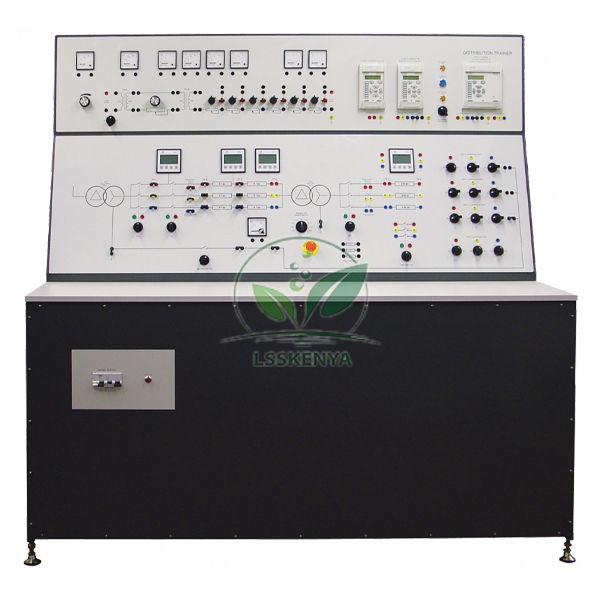
The Distribution Trainer takes students through electrical power distribution, from basic feeder circuits to balanced and unbalanced three-phase systems. Its upper panel holds low-voltage a.c. and d.c. supplies, lamps and variable resistances, while the lower panel joins two three-phase transformers, lines and loads to model industrial distribution, with protection relays on both.
Specifications of the Distribution Trainer
| Specification | Value |
|---|---|
| Upper panel | Low-voltage a.c. and d.c. supplies, a set of lamps as loads and variable resistances simulating a feeder cable |
| Lower panel | Connections to two three-phase transformers, lines and loads for industrial power distribution |
| Line power transformer | Reduces the incoming supply to the voltage used in the experiments |
| Line receive transformer | Reduces the line voltage to 110 V; adjustable primary tappings; secondary star point can be earthed |
| Meters | All current, voltage and power meters needed for the experiments |
| Protection | Current transformers feeding the relays; two simpler relays set from their own panels, one more complex relay set locally or from a suitable computer, software included; fault and disturbance records |
| Circuit-breakers | Opened by the relays on a fault; hand-operated switches and lamps showing open or closed |
| Safety and leads | Emergency switch, mains supply isolator and protection fuses; set of shrouded leads |
| Supplied by | Science Lab Supplies, Ambala, India |
Distribution Exercises on the Two Panels
Students begin on the upper panel, with lamps as loads and resistances standing in for cable, then move to the lower panel for three-phase work through the two transformers. Each step is wired with shrouded leads and read on the panel meters.
- Radial and ring main circuits: connect the feeder both ways, switch on lamps along it and compare the voltage at the last lamp.
- Regulation: use the low-voltage a.c. supplies to show voltage falling with load, then correct it with the receive transformer tappings.
- Three-phase loads: run balanced and unbalanced loads with the star point earthed or isolated. Separate resistive load studies use the switchable banks of the Portable Resistive Load Bank.
- Protection: apply faults and see each relay open its breaker. Earth fault relaying is taken further with the Overcurrent And Earth Fault Relay.
Precaution: start with the low-voltage supplies, and isolate the panel before changing transformer tappings or earthing links.
Frequently Asked Questions
Which distribution topics can a college teach on this trainer?
Radial and ring main feeders, voltage regulation, transformer tap changing, balanced and unbalanced three-phase loads, earthing of a star point, and relay protection with circuit-breakers. Students progress from low-voltage panel work to three-phase industrial distribution on one console.
What supplies does the trainer provide for the experiments?
The upper panel carries its own low-voltage a.c. and d.c. supplies. On the lower panel, the line power transformer reduces the incoming mains to the experiment voltage, and the receive transformer steps the line down to 110 V. Mains enters through an isolator with protection fuses.
Why is a ring main preferred to a radial feeder?
Each load on a ring is fed from both directions, so the voltage drop is smaller. A fault on one section can be switched out while the rest stays supplied. On a radial feeder, a fault near the source cuts off every load beyond it.
Why do lamps at the far end of a radial feeder glow dimmer?
All the load current flows one way from the source, so each section of cable adds its own voltage drop. The last load sees the sum of those drops. The variable resistances on the upper panel let students measure this directly.
What do the primary tappings on the receive transformer do?
Moving a tapping changes the turns ratio. When the line voltage sags under load, a different tapping brings the 110 V side back towards its set value. Distribution transformers use the same method to keep consumer voltage within limits.
Related Distribution and Protection Trainers
- Switched Busbar Module: radial system with one incoming and three outgoing feeders, each with a circuit-breaker.
- Feeder Management Relay: four independent stages of directional or non-directional overcurrent.
- Circuit Breaker Trainer: four test circuits with fuses, magnetic-only, thermal-only and thermomagnetic circuit-breakers.
- Transmission Line Simulator: single-phase line with tapping points for Pi or Tee loss profiling.
- Electrical Power System Simulator: monitored and protected grid transformer giving the distribution voltage at a grid bus.
- Three Phase Mobile Transformer: three identical transformers on a common three-limb core.
See every power trainer in Electrical Power System, or step back to Engineering Laboratory Equipment for the other engineering subjects.
Science Lab Supplies exports under an Importer-Exporter Code and is able to ship distribution trainers to Oman, the Philippines, Nepal, Bangladesh, Zambia and Rwanda. A note on the contact page brings a quotation, and the enquiry cart collects the trainer with related items.
Last updated: 20 November 2026


