
Electrical Power System Simulator
Product Code : LSK-EPS-10518
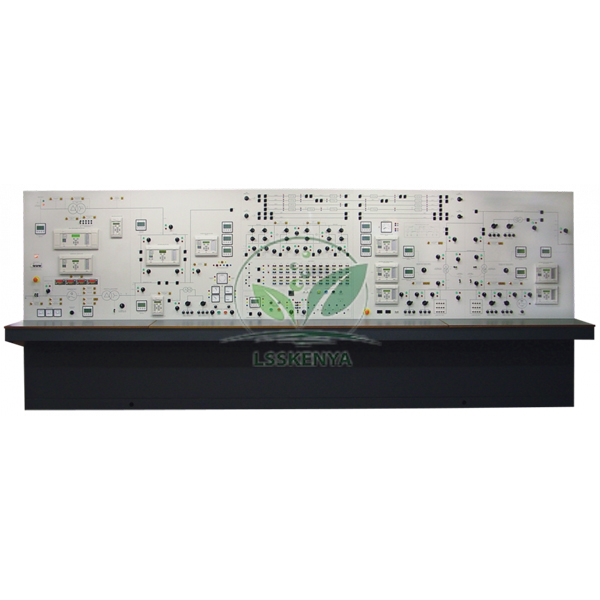
The Electrical Power System Simulator models a complete power system for teaching, from generation and grid supply to transmission, distribution, utilisation and protection. A motor-generator set and a grid transformer feed simulated lines, distribution transformers and loads. Industrial-standard relays and circuit-breakers protect every part, so students can apply faults and study how the system responds.
Specifications of the Power System Simulator
| Specification | Value |
|---|---|
| Generation | Motor and generator set with characteristics similar to industrial turbine and generator sets; generator transformer feeding a generator bus |
| Grid supply | Monitored and protected grid transformer giving the distribution voltage at a grid bus; used to synchronise the generator to the grid |
| Transmission lines | Reactances simulating overhead or underground lines of different lengths, with test points along each line |
| Distribution | Two identical distribution transformers with variable tappings, feeding a utilisation bus |
| Loads | Variable resistive, capacitive and inductive loads, plus an induction motor load |
| Busbars | Switched main bus and reserve bus; one feeder has a point-on-wave circuit breaker |
| Protection | Industrial-standard relays set from the control panels, with sockets for a computer; distance protection relay on the lines; blocking switches with warning lights |
| Fault switches | One standard three-phase fault switch and one timed circuit breaker with a programmable digital timer |
| Instruments | Multi-function digital meters on all main circuits, phase-angle meter, moving coil meters for the prime mover; transducers and an oscilloscope supplied |
| Supplied by | Science Lab Supplies, Ambala, India |
Power System Experiments on the Simulator
Students choose the grid supply or the generator as the source, then route power through the lines, transformers and busbars to the loads. Digital meters show all three phases, and every important circuit has test sockets for linking or for other instruments.
- Synchronising: match the generator voltage, frequency and phase to the grid bus with the phase-angle meter, then close the breaker.
- Line faults: apply a timed fault at different points on a line and read the distance relay; the Transmission Line Simulator takes line studies further.
- Protection schemes: set zone protection, grading, auto-reclose, back tripping and directional tripping on the relays. Single relays can be studied on the Protection Relay Test Set.
- Load studies: switch resistive, inductive, capacitive and motor loads on the utilisation bus and watch voltage and power factor change.
- Transients: capture switching and fault transients on the supplied oscilloscope through the transducers.
Safety: use the blocking switches only under supervision, since they override relay protection, and isolate the supply before rewiring test sockets.
Frequently Asked Questions
What should an importer check before ordering the simulator?
Check the mains voltage and frequency in the receiving lab, since the grid transformer works from the incoming supply. Plan for a computer if relays will be programmed in detail. The oscilloscope and transducers for transient work come with the simulator.
Can the simulator be extended with a second generator?
Yes. The Second Generator for Electrical Power System Simulator is a self-contained motor-generator set. It links at transmission level to model central generation, and at utilisation level to model embedded generation feeding a load directly.
How does the distance relay tell how far away a fault is?
It measures voltage and current at the line end and works out the impedance between itself and the fault. Line impedance rises with length, so the impedance gives the distance. Zones of reach decide how fast it trips.
What is protection grading?
Relays are set so the one nearest a fault trips first, while relays further back wait a little longer. Only the faulty section is then cut off, and the upstream relays act as back-up if the nearer one fails.
Why do power systems use auto-reclose?
Many overhead line faults, such as a lightning flashover, clear once the line is switched off. The breaker opens, waits briefly and closes again. If the fault is still there, the relay trips again and locks out.
Related Power System Trainers
- Second Generator for Electrical Power System Simulator: motor and generator set in the base of its own control console.
- Switched Busbar Module: double bus with six bi-directional feeders and a radial system.
- Salient Pole Generator: prime mover and generator set with resistive, capacitive and inductive load banks.
- Distance Protection Relay: educational relay for protection of overhead transmission lines.
- Transformer Trainer: single-phase and three-phase educational transformers with full metering.
- Power Factor Load Bank: separate resistive, inductive and capacitive banks, giving unity or reactive power factor loads.
The full set of trainers is in the Electrical Power System category, one part of the Engineering Laboratory Equipment range.
Power system simulators are supplied by Science Lab Supplies, an Importer-Exporter Code holder, to universities in Ghana, Ethiopia, Tanzania, Uganda, the UAE and Saudi Arabia. A short message on the contact page starts a quotation, and the enquiry cart can hold the simulator with its add-ons.
Last updated: 20 November 2026


