
Transmission Line Simulator
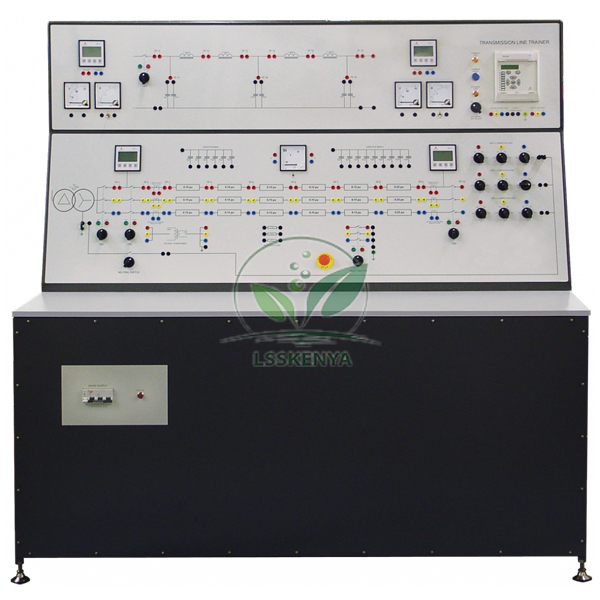
Product Code : LSK-EPS-10523
Transmission Line Simulator (SKU LSK-EPS-10523) models single-phase and three-phase transmission lines so students can study short, medium and long lines under changing load, power factor and fault conditions. It is designed for power systems and protection practicals in B.Tech/B.E. electrical engineering, and its open layout supports student projects. Engineering colleges, universities, tender contractors and distributors can order the simulator through Science Lab Supplies, which handles quotations from Ambala, India.
Specifications
Each transmission line simulator detail takes one row of the table. In short, an upper panel carries a tapped single-phase line of series inductive impedances, a lower panel a three-phase line in six per-unit sections, with included RLC loads, send- and receive-end instruments, fault switching and a protection relay.
| Specification | Value |
|---|---|
| SKU | LSK-EPS-10523 |
| Line types | Single-phase and three-phase |
| Line lengths simulated | Short, medium and long |
| Control panels | Two, each with a detailed mimic diagram |
| Upper panel | Single-phase transmission line equivalent circuit |
| Single-phase line | Inductive impedances connected in series |
| Tapping points | Pi or Tee loss profiling with different capacitance values; line length change; monitoring at any point |
| Lower panel | Three-phase transmission line |
| Three-phase line sections | Six, in per-unit values |
| Neutral | Selectable |
| Length parameters | Variable |
| Loads | Resistive, inductive and capacitive (included); balanced or unbalanced |
| Instruments | At send and receive ends |
| Relay inputs | Current transformers in the test circuits |
| Fault equipment | Fault application switch and earth fault resistors |
| Relay functions | Line and earth current detection; fault event recording |
| Relay setting | Local control panel or computer cable link (software included) |
| Circuit-breakers | Hand-operated switches and open/closed lamps |
| Documentation | User guide with descriptions, theory and experiments |
| Leads | Set of shrouded leads |
| Safety | Emergency switch, mains isolator, protection fuses |
| Supplied by | Science Lab Supplies, Ambala, India |
Applications and Experiments for the Transmission Line Simulator
With the simulator, students can change line length, load and power factor, then measure sending and receiving end values to find regulation, losses and efficiency. A fault application switch and earth fault resistors add protection studies with relays of varying sensitivity.
- B.Tech power systems lab: performance of short, medium and long lines.
- Pi and Tee equivalent circuits using different capacitance values.
- Balanced and unbalanced RLC loading with selectable neutral, also explored with the star or delta connected Power Factor Load Bank.
- Lagging power factor operation, a condition the Inductive Load 415V AC Three Phase simulates for three-phase networks.
- Earth fault currents and relays of varying sensitivity.
The simulator is mains-powered; fault tests must be supervised by qualified staff.
Standard Scope of Supply
Supplied with the console are the resistive, capacitive and inductive loads, the protection relay and its software, circuit-breakers with lamps and hand switches, a set of shrouded leads and a user guide with equipment descriptions, theory and experiments, plus the built-in emergency switch, mains isolator and protection fuses.
Packing, MOQ and Lead Time
Quotations are available for one simulator or for a set of power system trainers. Each shows packing, delivery time and price for your quantity, and relays or companion modules can be listed together, so buyers of engineering lab equipment in India or abroad receive one consolidated price.
Holding an Importer-Exporter Code, Science Lab Supplies can ship to buyers in Saudi Arabia, Oman, the Philippines, Nepal, Bangladesh and Zambia. Pricing for a line trainer starts with the enquiry cart, technical questions go to the contact page, and tender guidance sits on the lab tender page.
Frequently Asked Questions
Can the line length be changed?
Yes. Tapping points on the single-phase line and variable length parameters on the three-phase line let students simulate short, medium and long transmission lines and compare their behaviour.
Are loads included?
Yes. Variable resistive, inductive and capacitive loads are included, and they can be set for balanced or unbalanced conditions on the single-phase and three-phase lines.
Who supplies the Transmission Line Simulator?
Science Lab Supplies prepares quotations for the simulator in Ambala, India, either for a single console or as part of a complete electrical power system laboratory package.
How does the relay respond to faults?
When a fault is applied, the relay detects line and earth currents, records the event and opens circuit-breakers in the test circuit; lamps show each breaker's state.
Related Line, Protection and Load Equipment
These Electrical Power System and Electrical and Electronics items pair with line studies: the complete network simulator, relays for line and cable protection, the relay test set, a busbar module, a distribution trainer and a capacitive load, and any of them can share one quotation.
- Electrical Power System Simulator — dedicated distance relay shows how far along a line a fault lies.
- Distance Protection Relay — relay module in a robust enclosure with carrying handle, for overhead line protection.
- Feeder Management Relay — keypad-programmed relay for overhead lines and underground cables.
- Protection Relay Test Set — upper-panel transmission line for distance protection and parallel feeder tests.
- Switched Busbar Module — radial system of one incoming and three outgoing feeders.
- Distribution Trainer — low-voltage a.c. supplies that show the principles of regulation.
- Laboratory Capacitive Loading Unit 1.2 kVAR — capacitive steps for line compensation and power factor correction studies.
Browse the full Electrical Power System range, the Electrical and Electronics range, or all engineering laboratory equipment.
Last updated: 22 October 2026


