
Overcurrent And Earth Fault Relay
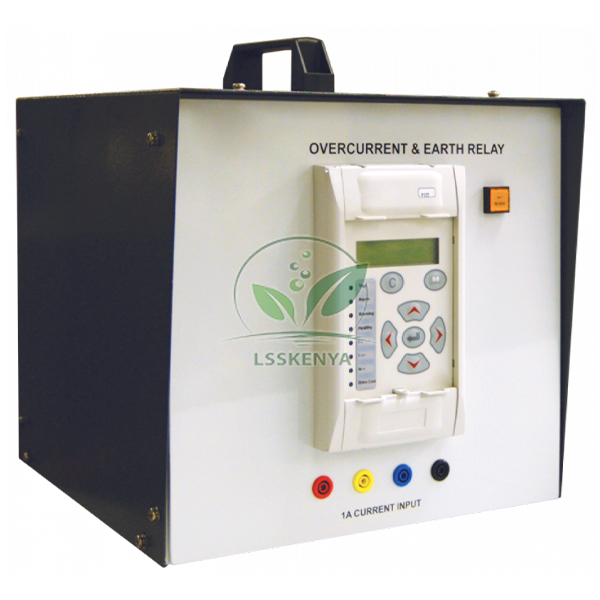
Product Code : LSK-EPS-10530
The Overcurrent And Earth Fault Relay is an entry-level three-phase and earth fault overcurrent relay in an educational format, based on an industrial relay. It mounts on the desk area of the Protection Relay Test Set and is used to investigate protection and monitoring of transformers, transmission lines and distribution schemes.
Specifications of the Overcurrent and Earth Fault Relay
| Specification | Value |
|---|---|
| Relay type | Three-phase and earth fault overcurrent relay module based on an industrial relay |
| Overcurrent stages | Three independent stages: the first selectable from any of 12 IDMT curves, the others with a direct time characteristic |
| Other protection | High-impedance restricted earth fault, thermal overload, broken conductor detection, undercurrent, negative-phase sequence overcurrent in two independent stages, selectable blocking |
| Records | Trend, fault and disturbance records; circuit monitoring |
| Setting | Keypad and display on the module, or the relay support software of the test set on a suitable computer |
| Connection | Multi-core cable and safety leads to the test set; current transformers with a ratio to suit the relay inputs |
| Enclosure | Sturdy enclosure with carrying handle |
| Manufacturer | Science Lab Supplies, Saha, Ambala, India |
Overcurrent and Earth Fault Tests
The lecturer or student sets up a fault circuit on the Protection Relay Test Set, programs the relay for the test and connects it to the circuit through the current transformers. The fault current is then raised and the trip time recorded.
- IDMT characteristic: set the first stage to one of the 12 curves, plot trip time against current, then repeat on a second curve.
- Earth faults: apply an earth fault and compare how the earth element and the phase elements respond.
- Broken conductor: open one phase on load and watch the negative-phase sequence and broken conductor elements pick up.
- CT effects: change the CT ratio or connection and see the effect on relay pick-up.
- Two relays: the test set has connections for two modules at once, so this relay can be graded against a Feeder Management Relay.
Precaution: allow the thermal overload element to cool back between runs, because its thermal memory shortens the next trip.
Frequently Asked Questions
What is needed to use the relay in practicals?
The Protection Relay Test Set, which the relay is supplied with and whose fault circuits it protects. It is also an optional add-on for selected power system trainers. A suitable computer allows programming with the relay support software, while the keypad and display work without one.
How does the relay connect to the fault circuits?
Through current transformers whose ratio suits the relay inputs, plus a multi-core cable and safety leads to the test set. Changing CT ratio or connection shows students how these choices affect what the relay sees and how it operates.
What does IDMT mean?
Inverse definite minimum time. The larger the fault current, the faster the relay trips, but never faster than a set minimum time. The curve chosen decides how steeply the trip time falls as current rises.
When is a very inverse curve chosen instead of standard inverse?
Where fault current falls sharply with distance from the source, a steeper curve grades better between relays in series. Standard inverse suits circuits whose fault level depends mainly on how much generation is running.
Why does the relay have direct time stages as well as an IDMT stage?
The IDMT stage handles moderate overcurrents with a delay that shortens as current rises. A direct time stage trips after a fixed delay once its current setting is passed, so it can be set high to clear heavy close-in faults quickly.
Related Relay Modules and Protection Trainers
- Differential Protection Relay: numerical differential relay connected through 4 mm shrouded sockets.
- Distance Protection Relay: full scheme phase and ground distance protection with up to five zones.
- Circuit Breaker Trainer: adjustable residual current detector with a digital display on circuit one.
- Distribution Trainer: two simpler relays set from their own panels, and a more complex relay set locally or by computer.
- Transmission Line Simulator: selectable neutral and balanced or unbalanced RLC loads.
- Salient Pole Generator: integral shaft encoder for load angle readings.
All relay modules and the test set are found in the Electrical Power System section of Engineering Laboratory Equipment.
Science Lab Supplies is able to ship relay modules to South Africa, Qatar, Sri Lanka, Vietnam, Malaysia and Peru as the holder of an Importer-Exporter Code. A quotation can be requested on the contact page, and several modules fit in one enquiry cart list.
Last updated: 20 November 2026


