
Second Generator for Electrical Power System Simulator
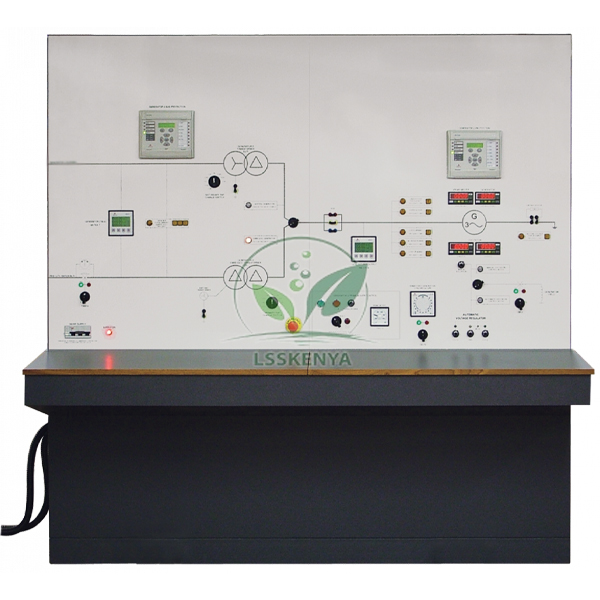
Product Code : LSK-EPS-10519
The Second Generator for Electrical Power System Simulator is a self-contained motor and generator set that works as a second power source for the Science Lab Supplies Electrical Power System Simulator. Two coupled machines sit in the base of its control console. A vector drive sets the motor speed, manual or automatic excitation controls the generator output, and relays protect the set.
Specifications of the Second Generator Set
| Specification | Value |
|---|---|
| Machines | Motor and generator set: two coupled machines in the base of the control console |
| Speed control | Vector drive for the motor |
| Excitation | Manual or several types of automatic excitation control the generator output |
| Protection | Generator protection relays set from the control panel, with sockets for a computer; the relays operate the circuit-breakers |
| Circuit-breakers | Hand-operated switches and lamps showing open or closed |
| Metering | Digital meters for prime mover and generator; multifunction meters for all three phases at the generator, distribution and utilisation outputs |
| Connection | Links to the simulator at transmission level for central generation, or at utilisation level for embedded generation |
| Base system | Matched to the Science Lab Supplies Electrical Power System Simulator |
| Manufacturer | Science Lab Supplies, Saha, Ambala, India |
Two-Generator Studies with the Simulator
The set connects to the simulator at one of two voltage levels. Students set the motor speed on the vector drive and the generator output with the excitation control, then read all three phases on the multifunction meters.
- Central generation: link the set at the transmission level of the Electrical Power System Simulator so it behaves like a main power station.
- Embedded generation: link it at the utilisation level to feed a load directly, as a generator at an industrial plant does.
- Load sharing: run both generators together and change the speed setting and excitation of each, noting how real and reactive power move between them.
- Generator protection: set the relays, apply faults and watch the breakers trip. Single-machine tests such as load angle are covered by the Salient Pole Generator.
Safety: close the breakers by hand only after checking the lamps and meters, and switch off before changing any link to the simulator.
Frequently Asked Questions
Can the Second Generator be used without the simulator?
It is a self-contained motor and generator set, built as the second generator of the Science Lab Supplies Electrical Power System Simulator. A second generator must match the base system in rated voltage, phase, frequency, speed, synchronising and protection scheme and interfaces, so a lab plans it as an add-on to that simulator.
Is a computer needed to set the generator relays?
Not for everyday settings, which are made on the control panel. A computer is needed only for more detailed relay programming, through the sockets on the relays.
What is the difference between central and embedded generation?
Central generation feeds the transmission network from large power stations. Embedded generation sits close to its load, such as a generator at an industrial plant. The set models both, depending on whether it links at the transmission or the utilisation level.
What decides how two generators in parallel share real power?
The power their prime movers put in, set by each speed governor. With droop control, raising one machine's speed setting makes it take a larger share of the load.
What does changing the excitation do once the generator runs in parallel?
It changes the reactive power and power factor of the generator, not its real power. Real power comes from the prime mover. Raising the excitation makes the generator supply more reactive power; lowering it makes the generator absorb reactive power.
Related Power System Trainers
- Switched Busbar Module: main and standby buses split by circuit-breakers, with bus-coupler switches.
- Differential Protection Relay: numerical relay for generators, transformers and other two-winding apparatus.
- Distribution Trainer: ring main and radial circuits built from feeder resistances and lamp loads.
- Transformer Trainer: educational transformers that work at one volt per turn.
- Portable Resistive Load Bank: three switchable resistor banks for star or delta loads.
See all generation, transmission and protection trainers under Electrical Power System, within Engineering Laboratory Equipment.
Second generator sets reach Ethiopia, Tanzania, Uganda, the UAE, Saudi Arabia and Oman through Science Lab Supplies, which exports with an Importer-Exporter Code. Name the simulator it will join when writing via the contact page for a quotation, or add both to the enquiry cart.
Last updated: 20 November 2026


