
Distance Protection Relay
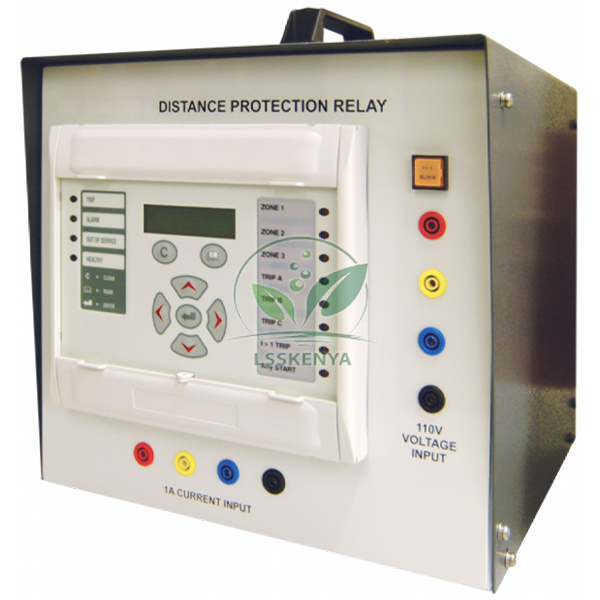
Product Code : LSK-EPS-10533
The Distance Protection Relay is a distance relay in an educational format for studying how overhead transmission lines are protected and monitored. It gives full-scheme phase and ground distance protection in up to five zones, backed by directional overcurrent and earth fault elements, and it mounts on the desk area of the Protection Relay Test Set.
Specifications of the Distance Protection Relay
| Specification | Value |
|---|---|
| Relay type | Distance protection relay in an educational format |
| Distance protection | Full scheme, phase and ground, up to five zones |
| Overcurrent elements | Phase overcurrent and negative sequence overcurrent, each directional or non-directional |
| Earth fault | Directional or non-directional |
| Other functions | Thermal overload protection, broken conductor detection, blocking of any one protection element |
| Records | Fault and disturbance records |
| Setting | Keypad and display on the module, or the software supplied with the test set on a suitable computer |
| Mounting and connection | Desk area of the Protection Relay Test Set; multi-core cable and safety leads |
| Enclosure | Sturdy enclosure with carrying handle |
| Manufacturer | Science Lab Supplies, Saha, Ambala, India |
Line Protection Practicals with the Distance Relay
The module rests on the desk of the Protection Relay Test Set, takes its multi-core cable from the test set and is wired to the fault circuits with safety leads. Students enter the zone settings on the keypad, or load them from a computer, then apply faults and read the result on the relay display and in its records.
- Zone reach: set the reach and time step of each zone, apply faults at different points on the test set's line circuit and note which zone trips and how fast.
- Phase and ground faults: compare a phase-to-phase fault with a phase-to-earth fault, then study the fault and disturbance records the relay stores.
- Back-up protection: block the distance element and watch the directional overcurrent or earth fault element clear the same fault more slowly.
- Line impedance: relate the zone settings to the short, medium and long line models studied on the Transmission Line Simulator.
Most tests use one relay, but the test set has enough connections for two relay modules at the same time. Change leads only with the test set switched off, and work under a qualified supervisor.
Frequently Asked Questions
Which protection topics can a university course cover with this relay?
Stepped distance zones and their reach, phase and ground faults on an overhead line, and directional overcurrent and earth fault back-up. Students can also study thermal overload, broken conductor detection, the effect of blocking one element, and the fault and disturbance records.
How does it differ from the overcurrent and feeder relays in the same range?
Overcurrent and feeder relays act mainly on the size and direction of the current. This relay compares voltage with current to measure impedance, so its trips are graded by distance along the line in up to five zones. It still keeps directional overcurrent and earth fault elements as back-up.
Why is zone 1 set to cover only part of the protected line?
Zone 1 trips with no intended delay, so it must never reach past the far busbar. Errors in the current and voltage transformers and in the line data could make a full-length setting overreach into the next line, so the far end is left to a delayed zone.
Why are the outer zones given a time delay?
Zone 2 reaches past the end of the line to cover the part zone 1 leaves out, and zone 3 backs up the next line. The delay lets the relay nearest the fault clear it first, so only the faulty section is switched out.
How can arc resistance make the relay under-reach?
An arcing fault adds resistance to the loop the relay measures. The impedance it sees is then larger than the true line impedance to the fault, so a fault near a zone boundary can appear to lie outside that zone and be cleared later by a slower zone.
Related Protection Relays and Power System Trainers
- Overcurrent And Earth Fault Relay: three overcurrent stages, the first selectable from any of 12 IDMT curves.
- Differential Protection Relay: numerical three-phase relay for transformers, auto-transformers and generators.
- Feeder Management Relay: four directional or non-directional overcurrent stages for overhead lines and underground cables.
- Electrical Power System Simulator: a motor-generator set and grid transformer feed simulated lines, distribution and loads.
- Switched Busbar Module: double busbar with six bi-directional feeders, plus a radial system.
- Distribution Trainer: low-voltage supplies, lamp loads and variable resistances that simulate a feeder cable.
Generation, line and protection trainers are grouped under Electrical Power System, one section of the Engineering Laboratory Equipment catalogue.
Relay modules like this one can be exported to colleges in Vietnam, Malaysia, Peru, Egypt, Iraq and Nigeria, as Science Lab Supplies is registered with an Importer-Exporter Code. For a quotation, write through the contact form or place the relay in the enquiry cart.
Last updated: 20 November 2026


