
Circuit Breaker Trainer
Product Code : LSK-EPS-10527
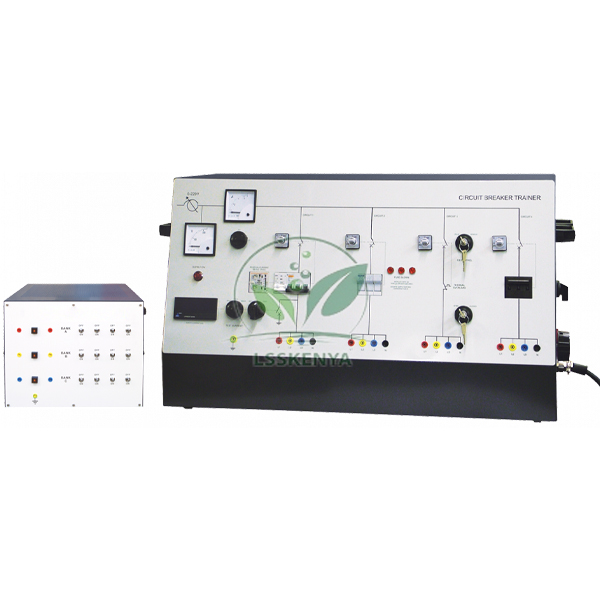
The Circuit Breaker Trainer shows how the most common circuit protection devices perform. Working with a suitable three-phase supply and load, it lets students set the fault current in four separate circuits, each with a different protection device, and compare fuses with magnetic-only, thermal-only and thermomagnetic circuit-breakers.
Specifications of the Circuit Breaker Trainer
| Specification | Value |
|---|---|
| Test circuits | Four, each with a different current protection device: fuses, a magnetic-only circuit-breaker, a thermal-only circuit-breaker and a thermomagnetic circuit-breaker |
| Fault current | Set and controlled by an internal variable transformer working with the load |
| Circuit one | Extra adjustable residual current detector, with digital display and switches to set the earth leakage fault current before the test |
| Circuit two | Fuse tests, one fuse for each of the three phases, with a fuse-break detector that lights a lamp when each fuse breaks |
| Circuit three | Remote and local control key switches to switch its contact breaker and break the circuit |
| Switching | A contact breaker in each circuit, switched by an industrial-standard discrepancy switch |
| Meters | Incoming voltage and current to the test circuits |
| Works with | A suitable three-phase supply and load |
| Supplied by | Science Lab Supplies, Ambala, India |
Protection Device Tests
Students connect the trainer to the supply and a three-phase load, such as the Portable Resistive Load Bank, pick a circuit, set the fault current and time how long the device takes to break. Repeating at several currents gives a time-current curve for each device.
- Fuse breaking time: on circuit two, the lamps show which phase fuse broke; compare breaking time against fault current for different fuse types.
- Breaker comparison: pass the same overcurrent through the magnetic-only, thermal-only and thermomagnetic circuits and compare trip times.
- Earth leakage: set a residual current on circuit one with the digital display, then apply it and note the trip.
- Remote and local control: switch circuit three from the local key and from the remote key, as a control room operator and a remote operator would. Relay-based overcurrent protection follows on the Overcurrent And Earth Fault Relay.
Precaution: let a thermal device cool between runs, because a warm bimetal trips early and spoils the curve.
Frequently Asked Questions
What does the trainer need besides the unit itself?
A suitable three-phase supply and a load. The internal variable transformer works with that load to set the fault current in each test circuit. Meters for the incoming voltage and current to the test circuits are built in.
Which protection devices can students compare on it?
Fuses, a magnetic-only circuit-breaker, a thermal-only circuit-breaker and a thermomagnetic circuit-breaker, each in its own circuit, plus an adjustable residual current detector on circuit one. Every circuit also has a contact breaker switched by a discrepancy switch.
Why does a thermal-only breaker take time to trip?
Current heats a bimetal strip, which must warm and bend before it releases the latch. A small overload takes a long time, while a larger one heats the strip faster. This suits overloads that build up slowly.
Why does a magnetic-only breaker trip almost at once?
Its coil pulls a plunger onto the latch as soon as the current passes the trip level. No heating is involved, so the delay depends on the mechanism alone. Below that level it does not trip at all.
What does the residual current detector respond to?
It compares the current going out with the current coming back. When some current leaks to earth, the two no longer balance and the detector trips. On circuit one the leakage level is set on the digital display before the test.
Related Switchgear and Protection Trainers
- Protection Relay Test Set: CTs, VTs, power supplies, a configurable transformer and load resistors.
- Distribution Trainer: protection relays open circuit-breakers in the test circuits when a fault is applied.
- Switched Busbar Module: one feeder with a point-on-wave circuit-breaker for switching transients.
- Power Factor Load Bank: separate resistive, inductive and capacitive banks on a free-standing mobile unit.
- Feeder Management Relay: under and over frequency, thermal overload and broken conductor elements.
Browse Electrical Power System for more switchgear and protection trainers, or Engineering Laboratory Equipment for every engineering lab.
Colleges in Bangladesh, Zambia, Rwanda, South Africa, Qatar and Sri Lanka can order this trainer from Science Lab Supplies, an Importer-Exporter Code holder. Send the request for a quotation from the contact page, or save the trainer to the enquiry cart first.
Last updated: 20 November 2026


