
Reduction Potential
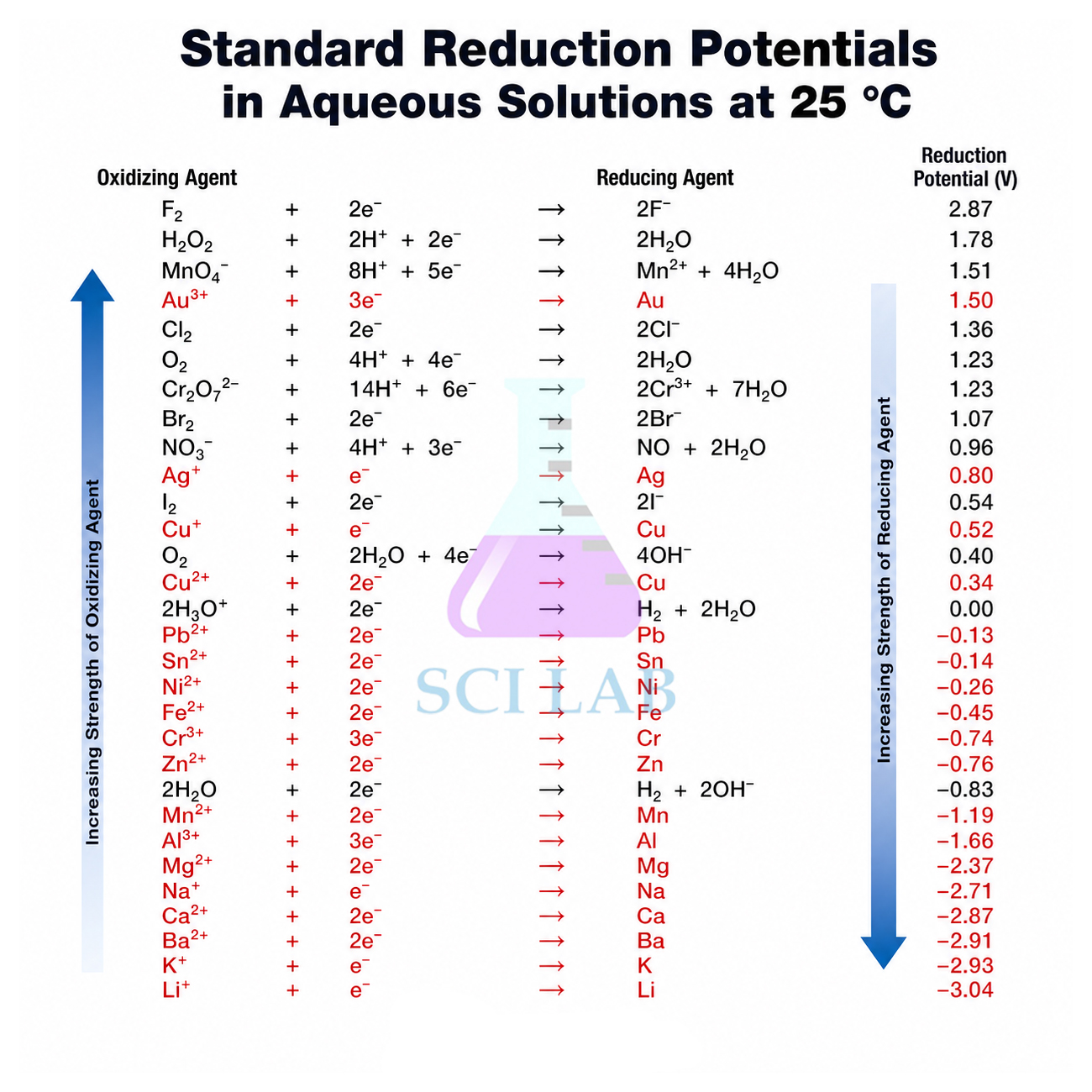
Product Code : SCL-CL-11600
Reduction Potential (SKU SCL-CL-11600) is a laminated 70 x 100 cm wall chart for teaching standard reduction (electrode) potentials, the values that rank how readily species gain electrons and let students predict cell EMF and the direction of redox reactions. It suits Class 12 electrochemistry and college courses. Science Lab Supplies prepares quotations for it in Ambala, India, covering schools, colleges, training institutes, tender contractors and distributors.
Specifications
Every specification of the Reduction Potential chart has its own row in the table. In short, it is a laminated sheet measuring 70 x 100 cm and made for wall mounting, intended for classrooms and for laboratories where cells and electrolysis set-ups are used, so the reference stays in view at the benches.
| Specification | Value |
|---|---|
| SKU | SCL-CL-11600 |
| Product type | Wall chart |
| Topic | Reduction potential (electrode potentials) |
| Size | 70 x 100 cm |
| Finish | Laminated |
| Mounting | Wall mounted |
| Use | Classrooms and laboratory |
| Supplied by | Science Lab Supplies, Ambala, India |
Applications and Experiments for the Reduction Potential Chart
Reduction potentials underpin every galvanic cell calculation and explain why some metals displace others from solution. Mounted near the electrochemistry bench, this electrode potential chart lets students check values while building a Daniell cell, calculating EMF or predicting the products of a redox reaction.
- NCERT Class 12 chemistry, Electrochemistry: standard electrode potentials and the electrochemical series.
- Class 12 chemistry: calculating the EMF of a galvanic cell and applying the Nernst equation.
- NCERT Class 11 chemistry, Redox Reactions: redox couples and predicting reaction direction, then comparing electrode products in the U-tube Apparatus for the Electrolysis of Salts with its 60 mm graphite electrode.
- B.Sc. physical chemistry: potentiometry and electrode potential practicals, with gases collected over the twin carbon electrodes of the Electrolysis Cells.
Standard Scope of Supply
This item is one laminated Reduction Potential wall chart of 70 x 100 cm, supplied as described above; any optional accessories appear on the quotation. Electrochemical cells, salt bridges and electrodes for the matching practicals are separate products that can be added to the same request.
Packing, MOQ and Lead Time
From a single chart to a full set for several chemistry laboratories, any quantity can be quoted. The quotation shows packing, delivery time and price, and school chemistry lab equipment in India such as Daniell cells or salt bridges can be included in the same quotation.
With its Importer-Exporter Code, Science Lab Supplies is a registered exporter and can ship to buyers in the UAE, Saudi Arabia, Oman, the Philippines, Nepal and Bangladesh. Science Lab Supplies is registered for GST (GSTIN 06ADEPJ0574F2ZU). To equip an electrochemistry bench, ask about the chart and cells on the contact page, add them to the enquiry cart, or read the lab tender page for tender buying.
Frequently Asked Questions
What is a reduction potential chart used for?
It is used to compare how readily different species are reduced, so students can predict cell EMF, choose anode and cathode, and decide whether a redox reaction will occur.
What size is the chart?
It is 70 x 100 cm, laminated, and meant to be mounted on a wall in the classroom or chemistry laboratory, where students can read off values while they set up cells.
Who supplies the Reduction Potential chart?
Science Lab Supplies, working out of Ambala, India, prices this chart for schools and colleges needing a few copies and for contractors and distributors with larger requirements, along with any electrochemistry apparatus.
Which practical apparatus goes with it?
A Daniell cell, salt bridge and electrolysis apparatus suit the same lessons, letting students measure what the chart predicts; these are separate items that can share one quotation with the chart.
Related Electrochemistry Apparatus and Charts
Electrode potentials come alive through galvanic cells, salt bridges and electrolysis. The items below give students the apparatus and a companion chart to see those ideas in practice, from a copper-zinc cell to a water voltameter, and they can be quoted together with the Reduction Potential chart.
- Daniel Cell — copper vessel and zinc amalgam rod giving an EMF of about 1.1 V, with 4 mm sockets.
- Salt Bridge — for cell EMF measurements under forward, zero and reverse current; 13 mm arms.
- Apparatus for Demonstration of Electrolytic Processes — carbon, copper, zinc, lead and brass electrodes with a light bulb.
- Electrolytic Breakdown — laminated 70 x 100 cm wall chart on electrolysis.
- Cell Daniel Copper With Zinc — heavy gauge copper vessel and porous pot; theoretical voltage 1.1 V.
- Apparatus for Demonstrating the Galvanic Element (With Galvanometer) — two 250 ml cups, zinc and copper plates and a laboratory galvanometer.
- Hoffman Voltameter With Electrodes — two 50 ml limbs graduated 2–50 ml, with carbon and platinum electrodes.
Browse the full Chemistry Lab range, the Charts & Portraits range, or all school lab equipment.
Last updated: 9 October 2026

.jpg)
.jpg)


.jpg)