Distribution of Electrons in Electronic Layers
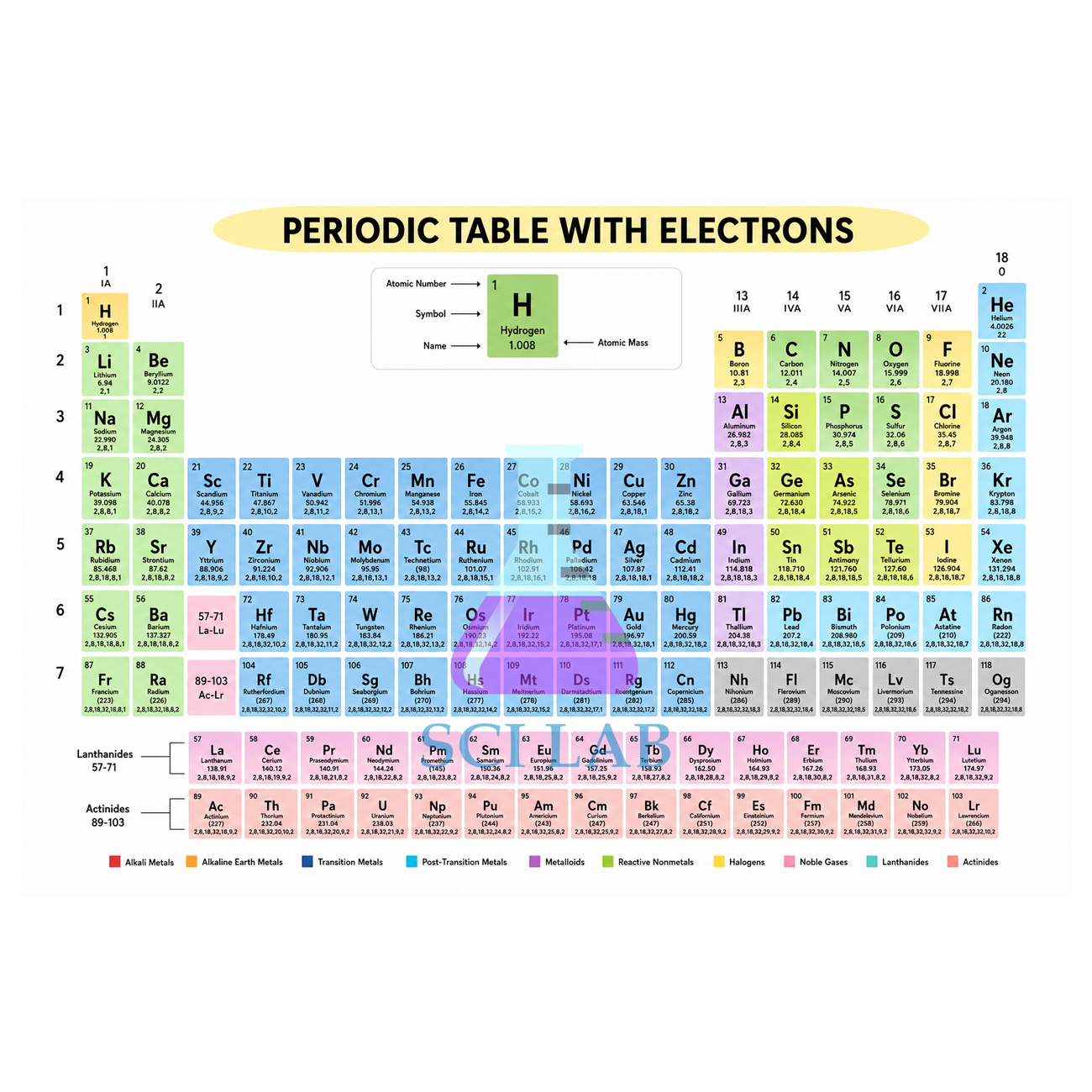
Product Code : SCL-CL-11705
The Distribution of Electrons in Electronic Layers chart is a 70 cm x 100 cm laminated wall chart for classrooms and laboratories. It supports lessons on how electrons fill the shells, or layers, around the nucleus.
Specifications of the Electron Shells Chart
| Specification | Value |
|---|---|
| Size | 70 cm x 100 cm |
| Mounting | Wall mounted |
| Finish | Laminated |
| Use | Classrooms and laboratory |
| Supplied by | Science Lab Supplies, Ambala, India |
Teaching Electron Arrangement with the Chart
Learners use the chart while drawing shell diagrams and writing arrangements such as 2, 8, 1 for the first 20 elements.
- Build an atom: place protons, neutrons and electrons on the Model of The Atom and compare the shells with the chart.
- Link to the table: find each element's period and group on the Periodic Table of Chemical Elements from its arrangement.
- Beyond shells: show orbital shapes with the Atomic Orbital Model Px.
Frequently Asked Questions
How many electrons can each shell hold?
The maximum is 2n squared, where n is the shell number: 2 in K, 8 in L, 18 in M and 32 in N.
Why is potassium 2, 8, 8, 1 and not 2, 8, 9?
In the school scheme the outermost shell holds no more than 8 electrons, so the 19th electron starts the N shell. In energy terms the 4s level fills before 3d.
What are valence electrons?
They are the electrons in the outermost shell. For the first 20 elements their number is the last figure of the arrangement, so sodium, 2, 8, 1, has one valence electron and forms Na+ ions.
What is the arrangement of calcium?
It is 2, 8, 8, 2, not 2, 8, 10. Calcium loses its two outer electrons easily, which is why it forms Ca2+ ions and has a valency of 2.
Related Atomic Structure Aids
- Relationships of Quantum Number Values for n = 4: laminated wall chart, 70 cm x 100 cm.
- Ionization Energies of Elements According to Groups A of the Periodic System: laminated wall chart, 70 cm x 100 cm.
- Dynamic Model for Atomic Orbital Demonstration: model with display screen and key and an 8V DC power supply.
- Schrodinger Atomic Model: shows the shape of each orbital and nodal planes in 3D.
- Atom Activity Model: transparent plastic model covering the filling of electron layers.
See the rest of the Chemistry Lab range and the wider School Lab Equipments catalogue.
With an Importer-Exporter Code, Science Lab Supplies can send orders to schools and labs in Kenya, Ghana, Ethiopia, Tanzania, Uganda and the UAE. Quotations can be requested on the contact page or through the enquiry cart.
Last updated: 14 November 2026