Graduated (Measuring) Tubes with Stoppers
Product Code : SCL-CL-11893
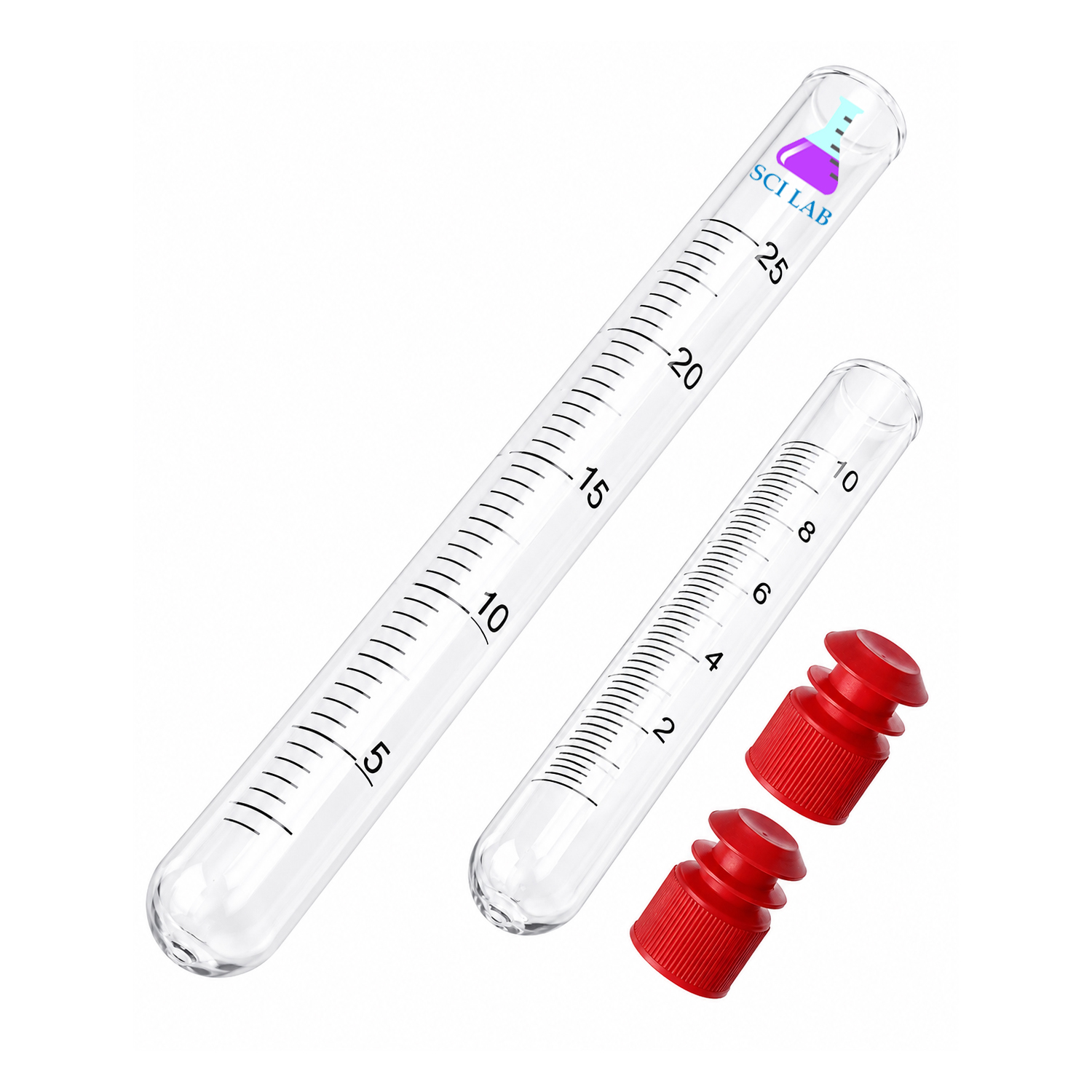
These graduated glass measuring tubes come with stoppers in 10 ml and 25 ml capacities. The marked scale lets students measure small liquid volumes, and the stopper closes the tube so the contents can be mixed or kept. The glass resists common lab chemicals and heat.
Specifications of the Graduated Tubes with Stoppers
| Specification | Value |
|---|---|
| Capacity | 10 ml and 25 ml |
| Material | Glass, chemical resistant and heat resistant |
| Scale | Graduated along the tube |
| Closure | Stopper |
| Supplied by | Science Lab Supplies, Ambala, India |
Measuring and Mixing in the Graduated Tubes
Stand the tube upright on a level bench, add liquid to just below the mark, then top up drop by drop. Insert the stopper only when the tube is cool and nothing is reacting inside.
- Dilution: measure 2 ml of a coloured solution with Graduated Pipettes 2ml, make it up to 10 ml with water, stopper and invert to mix.
- Comparing scales: read the same volume in the tube and in a Measuring Cylinder 10ml and discuss any difference.
- Volume of a small solid: note the water level, drop in a pebble or bead, and read the rise.
Common errors: reading with the eye above the mark, and reading the top edge of the curved surface instead of its lowest point.
Frequently Asked Questions
Should I use the 10 ml or the 25 ml tube?
Choose the smallest tube that holds the whole volume. Seven millilitres read in a 10 ml tube use more of the scale, so small reading errors matter less than in a 25 ml tube.
Where on the liquid surface do I take the reading?
Water and most solutions curve down in the middle. Read the bottom of that curve, the meniscus. A liquid that curves upwards, such as mercury, is read at the top of the curve instead.
Why must my eye be level with the mark?
Looking from above makes the level seem higher, and from below makes it seem lower. This parallax error disappears when the eye, the meniscus and the mark are on one line.
How do I read a level that falls between two marks?
Estimate the position between the nearest marks, for example halfway or one quarter. Record the value to the same number of decimal places for every reading in the experiment.
Does temperature change the volume reading?
Yes. Liquids expand as they warm, so a hot liquid reads more than the same liquid at room temperature. Let warm liquids cool before measuring them.
Related Volumetric Glassware
- Measuring Cylinder 25ml: glass cylinder with 0.25 ml graduations.
- Volumetric Flask with Stopper (One-Mark), 50-500 ml: glass flasks of 50, 100 and 500 ml.
- Graduated Pipettes: 5 ml graduated glass pipettes.
- Burette: borosilicate glass with a self-lubricating PTFE stopcock plug.
- Test Tube Rack, 12 Places, Autoclavable: holds 12 cylinders upright in large circular holes.
Further glassware is grouped under Chemistry Lab within School Lab Equipments.
Thanks to its Importer-Exporter Code, Science Lab Supplies can ship to Rwanda, South Africa, Qatar, Sri Lanka, Vietnam and Malaysia. To ask for a quotation, use the contact page or put the item in the enquiry cart.
Last updated: 14 November 2026