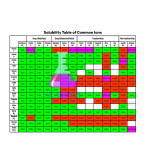
Elementary Reactions and Rate Equation

Product Code : SCL-CL-11596
Elementary Reactions and Rate Equation is a laminated wall chart, 70 cm x 100 cm, for chemical kinetics. It deals with single-step (elementary) reactions, molecularity and how a rate equation links reaction rate to concentration.
Specifications of the Rate Equation Chart
| Specification | Value |
|---|---|
| Format | Laminated wall chart |
| Size | 70 cm x 100 cm |
| Mounting | Wall mounted |
| Use | Classrooms and laboratory |
| Supplied by | Science Lab Supplies, Ambala, India |
Rate Experiments Using the Kinetics Chart
Students measure how rate changes with concentration, work out the order from their data, and then use the chart to check whether a one-step mechanism fits.
- Disappearing cross: mix sodium thiosulfate and dilute acid in a 100 ml Conical (Erlenmeyer) Flask and time how long a mark takes to vanish at several concentrations.
- Volume control: make each dilution with a Measuring Cylinder 50ml so the total volume stays the same.
- Order from data: plot 1/time against concentration and decide whether the reaction is first or second order in thiosulfate.
Common errors: changing two concentrations at once, and letting the temperature drift between runs.
Frequently Asked Questions
Can the rate equation be written from the balanced equation?
Only for an elementary step, where the orders equal the numbers of each particle that collide. For an overall reaction the orders must be found by experiment, because the balanced equation does not show the mechanism.
What is the difference between molecularity and order?
Molecularity is the number of particles that take part in one elementary step and is always a whole number. Order is found from experiment and can be zero, fractional or differ from the coefficients.
What is the rate-determining step?
It is the slowest step in a mechanism. The overall rate cannot be faster than this step, so the rate equation reflects the species that take part in it or before it.
Why do the units of the rate constant change?
The units of k make both sides of the rate equation equal. For a first-order reaction k is in s-1; for a second-order reaction it is in dm3 mol-1 s-1.
Does a mechanism that fits the rate equation prove it?
No. Agreement with the rate equation only shows the mechanism is possible. Other mechanisms may fit the same data, so further evidence, such as detecting an intermediate, is needed.
Related Physical Chemistry Charts
- Thermodynamic Data for Some Substances: laminated wall chart, 70 cm x 100 cm.
- Constants of Ionic Equilibria: 70 cm x 100 cm chart.
- Equilibrium Shifts Kit: explores equilibrium shifts in systems such as iron(III) thiocyanate and chromate/dichromate.
- Le Chatelier's Principle Kit: students test the principle with two simultaneous reactions.
- Laboratory Thermometers: alcohol glass thermometers reading -10 to 100 °C.
You can browse the whole Chemistry Lab range for related apparatus.
Science Lab Supplies can export to Ghana, Ethiopia, Tanzania, Uganda, the UAE and Saudi Arabia under its Importer-Exporter Code. To get a quotation, contact us through the contact page or the enquiry cart.
Last updated: 14 November 2026

.jpg)
.jpg)