Adapter (Allonge), Glass, 150 mm
Product Code : SCL-CL-11470
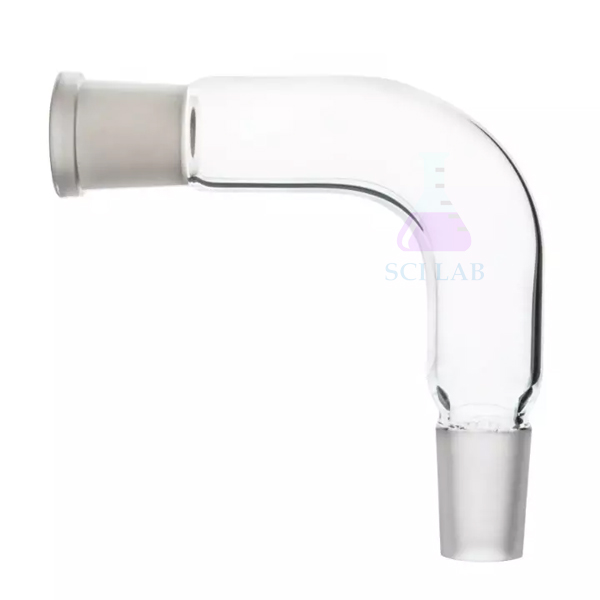
This adapter, also called an allonge or receiver adapter, is a clear 150 mm glass tube. It fits on the lower end of a condenser and guides the distilled liquid down into the receiving flask.
Specifications of the Adapter (Allonge)
| Specification | Value |
|---|---|
| Type | Adapter tube (allonge) |
| Material | Refractory glass, clear |
| Length | 150 mm |
| Resistance | Heat and chemical resistant |
| Supplied by | Science Lab Supplies, Ambala, India |
Collecting Distillate with the Adapter
One end joins the outlet of the condenser and the other end points into the receiver. Liquid leaving the condenser runs down the adapter instead of dripping outside the flask.
- Distilling water: boil salty or coloured water in a 250 ml Distillation Flask with Side Arm, cool the vapour in the Liebig Condenser and collect clear water through the adapter.
- Separating ethanol and water: collect the first fraction in a small flask, then change the receiver when the temperature rises.
- Steam distillation of plant oils: the adapter guides the oil and water distillate into a separating vessel.
Precaution: leave the receiver open to the air. A fully sealed set builds pressure when heated.
Frequently Asked Questions
What does the adapter do in a distillation set?
It links the condenser outlet to the receiving flask. The distillate runs down the tube into the flask, so less is lost and the receiver can stand lower on the bench.
Does this adapter have a ground-glass joint?
The listing gives a plain 150 mm refractory glass tube with no joint size. Join it to the condenser with a short rubber sleeve or a bored stopper, as your set needs.
In what order is a distillation set assembled?
Clamp the flask first at a working height, then fit the still head or stopper, the condenser, the adapter and finally the receiver. Build from the heat source upwards and outwards.
Should the receiving flask be sealed onto the adapter?
No. Leave a gap or vent so air can escape. A closed set can build pressure and crack the glass or push joints apart.
Why is the receiver sometimes stood in cold water?
With volatile liquids such as ethanol, a cold-water or ice bath around the receiver cuts loss by evaporation and keeps vapour in the room low.
Related Distillation Glassware
- Apparatus for Distilling Liquids: set with a 250 ml flask, a 300 mm straight cooler and a 0–100 °C thermometer.
- Distillation Apparatus: Liebig condenser, receiver adapter, 500 ml round-bottom flask and still head with 19/26 joints.
- Liebig Condenser, 450 mm, 14/29 Joint: 450 mm molybdenum glass condenser with a 14/29 joint.
- Round Bottom Flask, 500 ml, Long Neck: 500 ml round-bottom flask with a long neck.
- Flat-Bottomed Flasks 100ml: flat-bottomed glass flask with a long neck, heat and chemical resistant.
Browse the Chemistry Lab range or the Lab Glassware range.
With an Importer-Exporter Code, Science Lab Supplies can export this item to schools and laboratories in Oman, the Philippines, Nepal, Bangladesh, Zambia and Rwanda. For a quotation, write to us through the contact page or add the item to the enquiry cart.
Last updated: 13 November 2026