Liebig Condenser, 450 mm, 14/29 Joint
Product Code : SCL-CL-11909
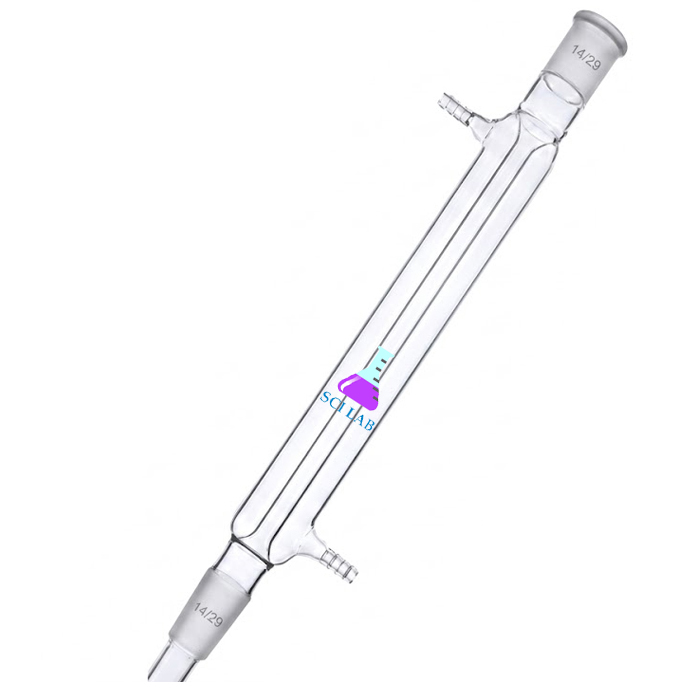
This Liebig condenser cools hot vapour back into a liquid during distillation. It is made of molybdenum glass, 450 mm long, with a 14/29 joint size. Steady condensation keeps the distillate from being lost as vapour.
Specifications of the Liebig Condenser
| Specification | Value |
|---|---|
| Material | Molybdenum glass |
| Length | 450 mm, on 14 mm section |
| Joint size | 14/29 |
| Use | Distillation, reflux and purification |
| Supplied by | Science Lab Supplies, Ambala, India |
Distilling Water with the Liebig Condenser
Clamp the condenser sloping down from the still head. Connect the lower water inlet to the tap and the upper outlet to the sink, start the water, and only then begin heating.
- Distilled water from tap water: boil the water in one of the 500 ml Round Bottom Flasks, heated in a Flask Heating Mantle, and collect the drops at the far end.
- Separating salt from water: distil salt water, show that the salt stays in the flask and test the distillate for chloride.
- Reflux: stand the condenser upright above a boiling flask so the vapour runs back down as liquid.
Add anti-bumping granules before heating, and keep the receiving end open to the air so the apparatus is never a closed system.
Frequently Asked Questions
How fast should the cooling water run?
A steady, gentle flow is enough: the jacket stays full and the water leaving the outlet feels cool. Set the flow before heating starts and check it now and then, as tap pressure can change during a run.
How can students show that the distillate is water?
A steady thermometer reading close to 100 degrees Celsius while it collects is good evidence. Cobalt chloride paper turning pink, or white anhydrous copper sulfate turning blue, shows water is present, but these tests do not prove it is pure.
How should the condenser be cleaned and stored?
Drain the jacket, rinse the inner tube with distilled water and let it dry. Store it lying flat in a padded drawer or rack where the long tube cannot roll off or be knocked, never standing on its end.
How strongly should the flask be heated?
Gently and evenly, so the distillate comes over as a steady stream of drops. Strong heating drives vapour through faster than the condenser can cool it.
How are the water tubes fitted?
Wet the rubber tubing and push it over the inlet and outlet with a twisting movement. Hold the glass near the base of each nozzle so it does not snap.
Related Distillation Apparatus
- Liebig Condenser 200mm: borosilicate condenser with a narrow 200 mm jacket.
- Liebig Condenser (Straight Cooler), 480 mm: Liebig-type glass condenser, 480 mm long.
- Distillation Flask with Side Arm, 250 ml: 250 ml borosilicate flask with a 175 mm side pipe.
- Apparatus for Distilling Liquids: set with a 250 ml flask, 300 mm straight cooler and 0 to 100 °C thermometer.
- Distiller for Distilled Water: gives 1 to 2 litres per hour on 220 V.
More glassware is listed in the Chemistry Lab category, part of School Lab Equipments.
Colleges in Saudi Arabia, Oman, the Philippines, Nepal, Bangladesh and Zambia can order this condenser from Science Lab Supplies, whose Importer-Exporter Code covers export shipments. Condenser quotations are given on request; use the contact page or the enquiry cart.
Last updated: 15 November 2026
.jpg)