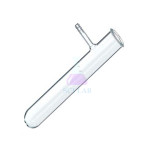
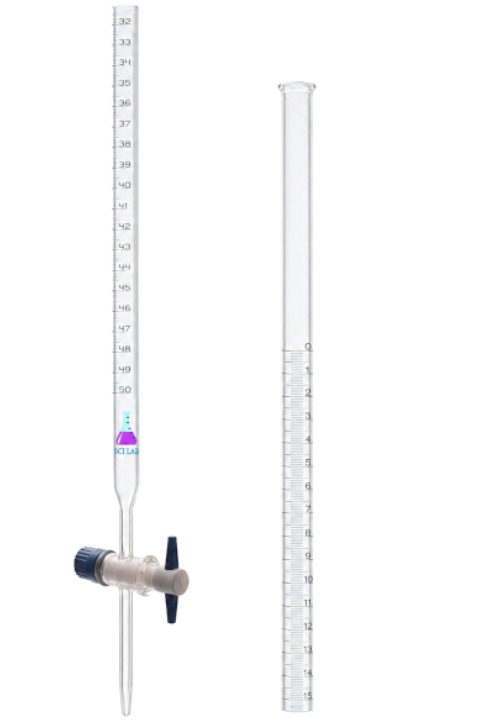
Burette, 50 ml, with Sampler Nozzles
Product Code : SCL-CL-11902
This Burette is a 50 ml graduated glass tube with a stopcock valve at the bottom. It measures and dispenses variable volumes of liquid during titration, the stopcock gives smooth control of the flow, and the construction resists laboratory chemicals.
Specifications of the Burette
| Specification | Value |
|---|---|
| Capacity | 50 ml |
| Tube | Graduated glass tube |
| Flow control | Bottom stopcock valve |
| Construction | Chemical-resistant |
| Supplied by | Science Lab Supplies, Ambala, India |
Titration Practicals with the 50 ml Burette
Clamp the burette upright, rinse it with the solution it will hold, fill it through a small funnel and run a little out to clear air from the tip. Read the start and end levels at eye level.
- Acid-base titration: hold the burette in a Burette Stand with Double Burette Clamp and add acid to an alkali with indicator until one drop changes the colour.
- Standardising a solution: titrate it against a standard solution made up in a volumetric flask, and repeat until the results agree.
- Redox titration (Class 12): titrate oxalic acid or iron(II) solution with potassium permanganate, which acts as its own indicator.
- Filling: pour through a small Glass Funnel with the stopcock closed, then lift the funnel out.
Common errors: leaving the funnel in the top, an air bubble in the tip, and reading with the eye above the mark.
Frequently Asked Questions
Why must the air bubble in the tip be removed?
A bubble below the stopcock takes up space that should hold liquid. If it escapes during the titration, the scale shows more liquid used than really went into the flask. Run a little solution out quickly until the tip is full.
Why should the solution not be run out too fast?
Liquid clings to the inside wall and keeps draining down after the tap is closed. If it runs out fast and you read at once, the reading is wrong. Open the tap gently and wait a few seconds before reading.
Which part of the meniscus do I read for potassium permanganate?
Read the top of the meniscus, because the bottom cannot be seen through a dark solution. For colourless solutions, read the bottom of the curve at eye level.
Why is a reading written as 23.40 ml and not 23.4 ml?
Readings are recorded to two decimal places, with the last figure estimated between the smallest marks. Writing 23.40 shows the reading was taken that closely; 23.4 suggests a rougher reading and loses precision in the titre.
Related Titration Apparatus
- Burette for Acids: 25 ml glass burette with 0.1 ml divisions and a stopcock.
- Burette for Bases: 50 ml burette graduated in 0.1 ml steps.
- Burette Clamps with Fasteners: mild steel clamps with rubber-covered self-closing jaws.
- Burette Storage Rack: holds up to 12 burettes of up to 20 mm diameter.
- Universal pH Indicator Paper, pH 0-14: test paper covering pH 0 to 14.
More titration glassware is in the Chemistry Lab category; the School Lab Equipments index covers other subjects.
Science Lab Supplies exports under an Importer-Exporter Code and can ship this item to Nigeria, Kenya, Ghana, Ethiopia, Tanzania and Uganda. Send burette quotation requests through either the contact page or the enquiry cart.
Last updated: 15 November 2026