Periodic Table of Chemical Elements with Orbitals, 100 x 70 cm
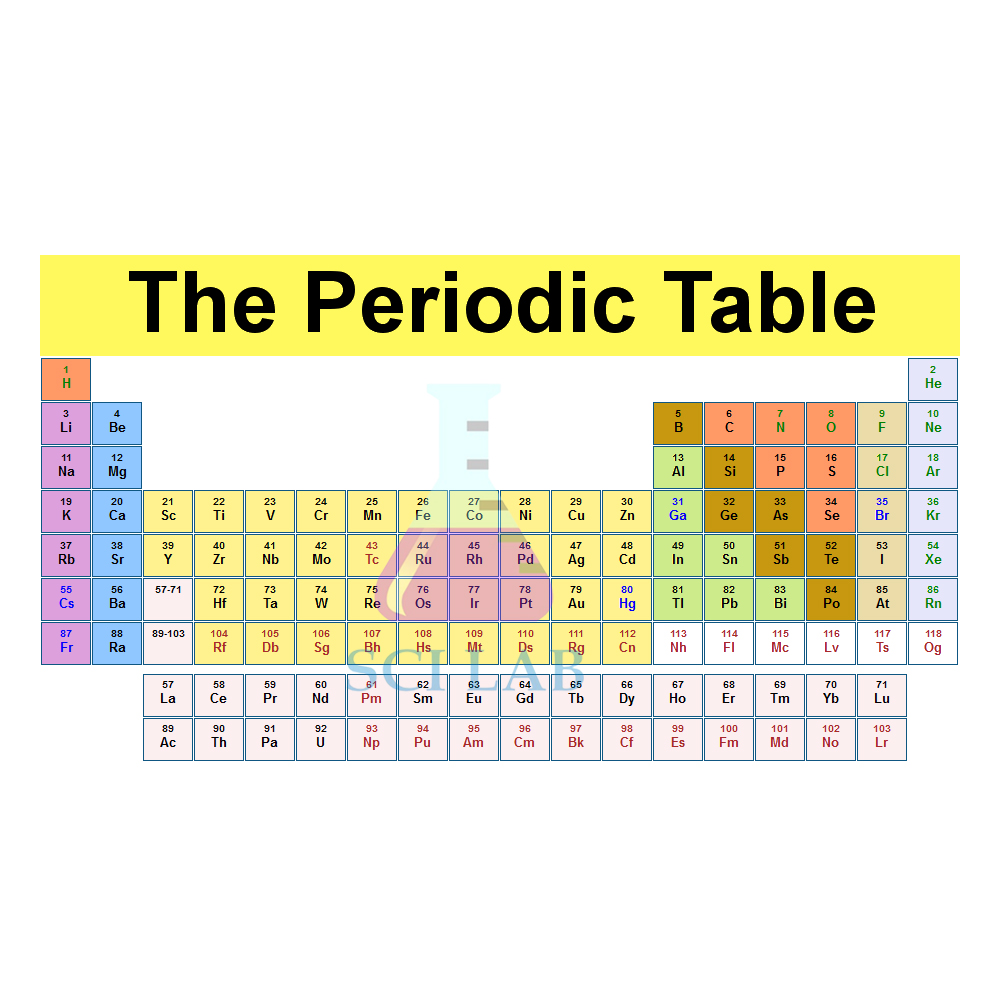
Product Code : SCL-CL-11591
The Periodic Table of Chemical Elements is a laminated wall chart, 100 cm x 70 cm. Beside the table it shows a graph of orbital energy levels and a drawing of the s, p, d and f orbitals, so electron configuration can be taught from the same sheet.
Specifications of the Periodic Table Chart
| Specification | Value |
|---|---|
| Format | Laminated wall chart |
| Extra content | Graph of the energy levels of the orbitals; representation of the s, p, d and f orbitals |
| Size | 100 cm x 70 cm |
| Mounting | Wall mounted |
| Use | Classrooms and laboratory |
| Supplied by | Science Lab Supplies, Ambala, India |
Teaching Electron Configuration from the Wall Chart
The teacher points to an element, and students read its position, then build the configuration from the energy-level graph.
- Orbital shapes: compare the printed p orbital with a three-dimensional Atomic Orbital Model Px.
- Shells and nodes: use the Schrodinger Atomic Model to show what the s, p and d drawings stand for in space.
- Group work: let teams assemble a table themselves with the Game - Understanding The Periodic Table, then check it against the chart.
Common errors: writing 3d before 4s for potassium and calcium, and counting groups without the d-block.
Frequently Asked Questions
Why does the 4s orbital fill before 3d?
For potassium and calcium the 4s level lies lower in energy than 3d, so it takes electrons first. Once 3d holds electrons in the transition metals, the order shifts, and 4s electrons are the first lost when ions form.
Does each shell fill completely before the next one starts?
No. The third shell can hold 18 electrons, but after 3s and 3p hold eight, the next electrons go into 4s at potassium. The energy-level graph shows why.
How are the s, p, d and f blocks linked to the orbitals?
The block is named after the subshell that takes the last electron. Groups 1 and 2 are the s-block, groups 13 to 18 the p-block, the transition metals the d-block and the lanthanides and actinides the f-block.
What does periodicity mean on the table?
Properties such as atomic radius, ionisation energy and metallic character repeat in a regular pattern as atomic number rises. Elements in one group share a similar outer electron arrangement, so they behave alike.
Related Periodic Table and Atomic Structure Aids
- Periodic Table of Chemical Elements (Short Version): 140 cm x 100 cm laminated wall chart.
- Periodic Table of Chemical Elements (Long Version), Personal, 41.4 x 15.5 cm: 41.4 cm x 15.5 cm with fold, laminated.
- Symbols of Chemical Elements: laminated wall chart, 70 cm x 100 cm.
- Distribution of Electrons in Electronic Layers: 70 cm x 100 cm wall chart for classroom and lab.
- Model of The Atom: atom model table with 48 electron, 57 proton and 57 neutron spheres, 475 x 475 mm.
See the full Chemistry Lab section, or go up to School Lab Equipments.
We hold an Importer-Exporter Code and can send orders to Peru, Egypt, Iraq, Nigeria, Kenya and Ghana. For a quotation, write through the contact page or add the item to the enquiry cart.
Last updated: 14 November 2026
.jpg)