Sodium Chloride Crystal Model
Product Code : LSK-CL-10076
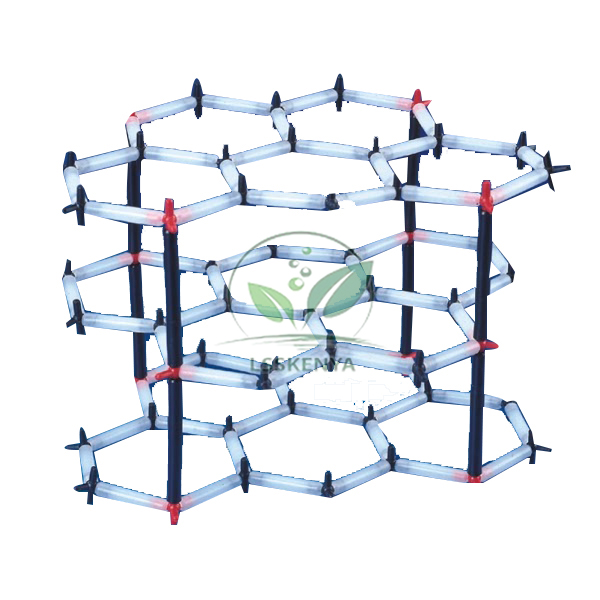
The Sodium Chloride Crystal Model is an assembly set for building the cubic lattice of common salt, with sodium and chloride ions shown in two colours. It contains 54 connectors, 13 black jacks and 14 red jacks, enough for a cube three ions along each edge, plus an instruction manual.
Specifications of the Sodium Chloride Crystal Model
| Specification | Value |
|---|---|
| Model | Crystal structure model of an ionic compound (sodium chloride) |
| Connectors | 54 |
| Jacks | 13 black and 14 red |
| Documentation | Instruction manual included |
| Supplied by | Science Lab Supplies, Ambala, India |
Ionic Lattice Lessons with the Sodium Chloride Model
The 27 jacks build into a 3 x 3 x 3 cube with the two colours alternating in every direction. Once built, the cube can be turned in the hand so each face and the centre ion are easy to see.
- Coordination number: pick the centre ion and count its nearest neighbours of the other colour. Then compare with the giant covalent layers of the Graphite Crystal Model.
- Ions per unit cell (Class 12): count corner, edge, face and centre ions, apply the sharing fractions and show that the cell holds four of each ion.
- Unit cell types: set the model beside the body-centred and hexagonal cells of the Crystal Lattice Model Set and name each lattice.
Common error: calling the structure a set of NaCl molecules. Each ion is held equally by all six neighbours, so there are no separate molecules.
Frequently Asked Questions
What is the coordination number of each ion in the model?
Six. Every sodium ion has six chloride ions as nearest neighbours, and every chloride ion has six sodium ions. On the built model, the centre ion shows this most clearly.
Why are there 13 jacks of one colour and 14 of the other?
A 3 x 3 x 3 cube has 27 positions, and alternating colours leave one extra of the colour at the corners. In a real crystal the block repeats endlessly, so the ratio becomes exactly 1:1.
How many ions belong to one unit cell?
Four of each. Corner ions count one eighth, edge ions one quarter, face ions one half and the centre ion counts whole. Adding these gives four sodium and four chloride ions.
Which colour stands for sodium and which for chloride?
Follow the instruction manual that comes with the set. Whichever key is used, write it on the board so students do not mix up the two ions when counting neighbours.
Which age group is the set meant for?
The set has small plastic jacks and connectors, which are a choking risk for young children. It is meant for secondary school chemistry, from the first lessons on ionic bonding up to Class 12 work on unit cells, with a teacher present.
What should be checked when the set arrives?
Count the 54 connectors, 13 black jacks and 14 red jacks and look for the instruction manual. A single missing jack leaves a gap in the cube, so check the contents when the set arrives and again each time it is packed away.
Related Chemistry Models
- Diamond Crystal Model: set of 84 connectors and 57 jacks with an instruction manual.
- Carbon-Carbon Molecular Model: orbital models of four carbon-carbon molecules, 510 x 345 x 140 mm overall.
- Molecular Model Kits for Students: student version with about 52 atoms for organic and inorganic chemistry.
- Atom Activity Model: transparent plastic model for overhead projector use, covering ionic and covalent bonding.
- Geometry of Molecules: laminated wall chart, 70 x 100 cm, for classroom or laboratory.
Ionic and covalent structure models for the same unit appear across the Chemistry Lab pages, and the School Lab Equipments hub links every other subject.
Salt lattice sets reach Nigeria, Kenya, Ghana, Ethiopia, Tanzania and Uganda as export orders from Science Lab Supplies, which is registered under an Importer-Exporter Code. For a quotation, write to Science Lab Supplies through the contact page or add the item to the enquiry cart.
Last updated: 15 November 2026


.jpg)