Signs of The Danger of Chemical Substances
Product Code : SCL-CL-11583
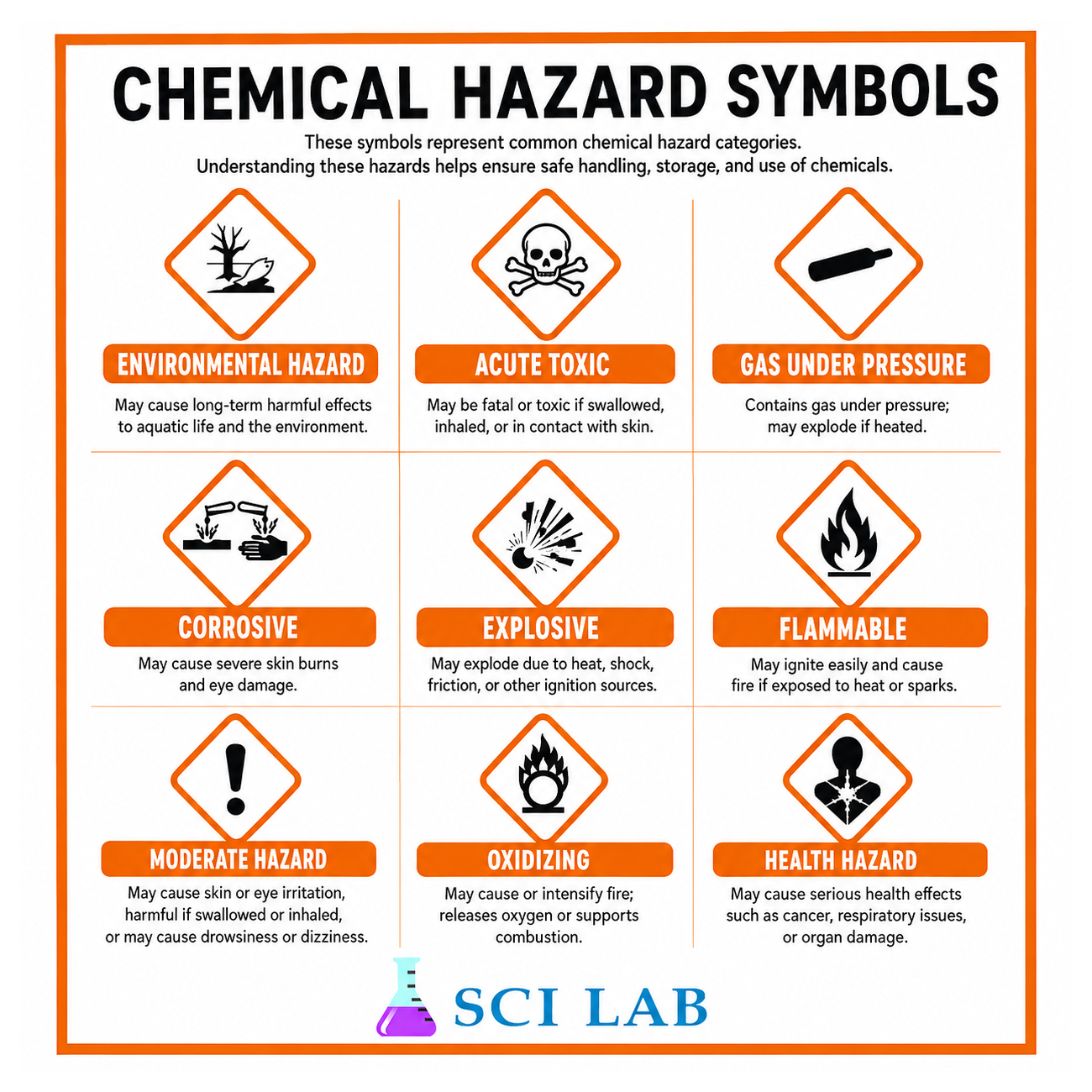
Signs of The Danger of Chemical Substances is a laminated wall chart, 70 x 100 cm, for teaching the danger signs used on chemical containers. It is wall mounted in the classroom or laboratory, so students can match a label to its meaning before they use a substance.
Specifications of the Danger Signs Chart
| Specification | Value |
|---|---|
| Size | 70 x 100 cm |
| Mounting | Wall mounted |
| Finish | Laminated |
| Use | Classrooms and laboratory |
| Supplied by | Science Lab Supplies, Ambala, India |
Teaching Hazard Signs with the Chart
Use the chart when students first meet the chemical store, and again whenever a new substance appears in a practical. Ask them to read the sign on the bottle before the name.
- Label matching: give groups empty, labelled Amber Glass Reagent Bottles with Stoppers and ask them to find each sign on the chart.
- Store layout: students decide which shelf each labelled colourless reagent bottle should go on, keeping flammables and oxidisers apart.
- Quick quiz: cover the meanings and ask students to name each sign.
Common error: treating the signs as decoration and not reading them on every container.
Frequently Asked Questions
What does a red diamond on a chemical label mean?
It is a hazard pictogram. A black symbol on a white background inside a red diamond warns of one type of hazard, such as flammable, corrosive or toxic.
What is the difference between Danger and Warning on a label?
Both are signal words. Danger is used for the more severe hazards and Warning for less severe ones. A label carries only one of them.
Why do some old bottles have orange square symbols?
Those come from older national systems used before the GHS pictograms. Students may still meet them on old stock, so it helps to recognise both sets.
What does the exclamation mark sign mean?
It warns of less severe health effects, such as skin or eye irritation, skin sensitisation or harm if swallowed. The skull and crossbones is different and marks acute toxicity.
How is the flame over a circle different from the flame?
The flame marks substances that catch fire easily. The flame over a circle marks oxidisers, which may not burn themselves but make other materials burn more fiercely.
Related Safety Charts and Equipment
- Safety Rules in The Laboratory: 70 x 100 cm laminated wall chart.
- Protective Gloves, White, Disposable: white, single-use disposable gloves.
- Protective Masks: mask with two carbon filters.
- Chemical-Physical Characteristics and Ways of Using Chemical Reagents at School: laminated wall chart in Albanian.
- Rubber Laboratory Apron, Size L: rubber apron, size L.
Find related stock in the Chemistry Lab category and under School Lab Equipments.
Orders can be shipped to Bangladesh, Zambia, Rwanda, South Africa, Qatar and Sri Lanka, as Science Lab Supplies holds an Importer-Exporter Code. To ask for a quotation, use the contact page or the enquiry cart.
Last updated: 14 November 2026