
Equipment for Vacuum Filtration
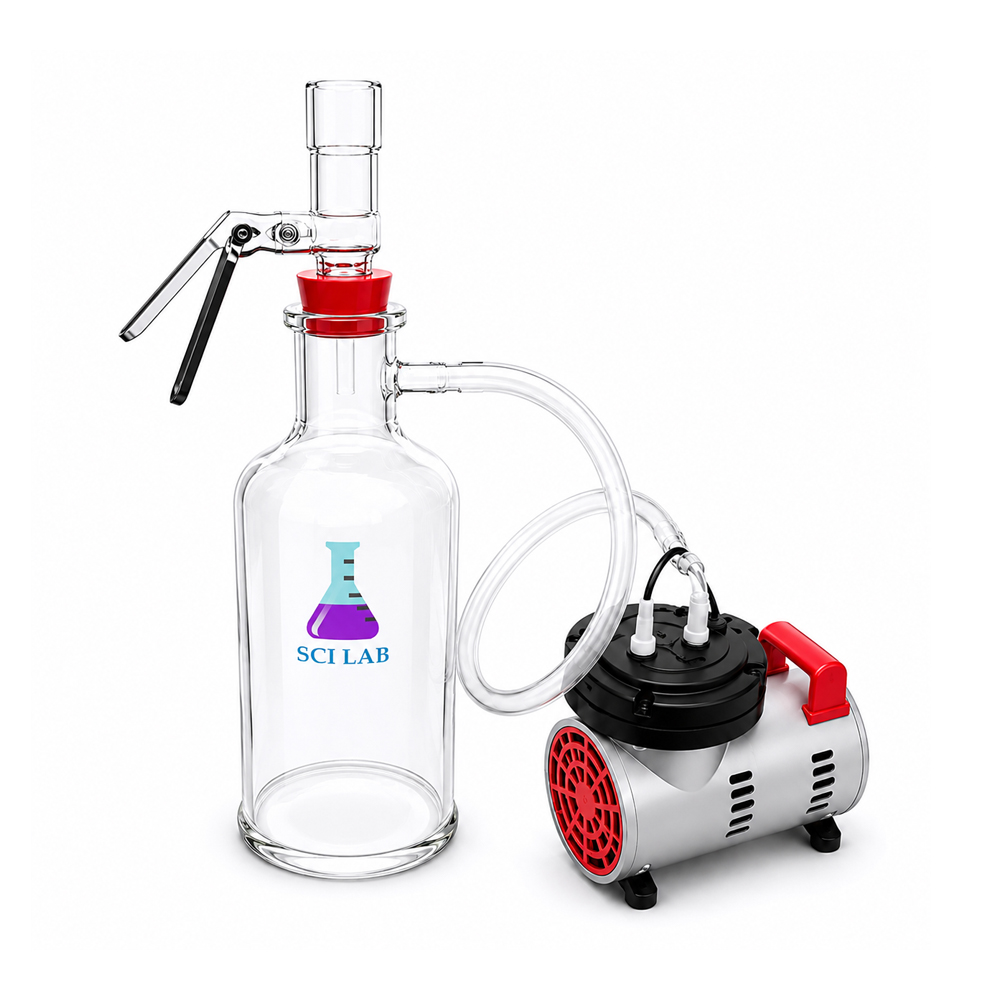
Product Code : SCL-CL-11457
This set is for fast filtration under suction. A porcelain Buchner funnel fits on a conical flask with a side arm, a water pump draws the vacuum, and a three-neck bottle sits between them as a trap. Rubber tubes, plastic tubes and rubber stoppers join the parts.
Specifications of the Vacuum Filtration Set
| Specification | Value |
|---|---|
| Filter flask | Conical flask with side arm |
| Funnel | Porcelain Buchner funnel |
| Vacuum source | Water pump |
| Trap bottle | Three-neck (Woulfe) bottle |
| Connections | Rubber tubes, plastic tubes, rubber stoppers |
| Supplied by | Science Lab Supplies, Ambala, India |
Running a Vacuum Filtration
Clamp the flask, fit the funnel through a stopper, and join the side arm to the trap bottle and the water pump. Lay a filter paper flat over all the holes, wet it with the solvent and turn on the water. Pour the mixture onto the centre of the paper.
- Collecting crystals (Class 11 to 12): filter recrystallised benzoic acid or copper sulfate on a Filter Paper disc cut to the funnel, then wash with a little cold solvent.
- Gravity against suction: filter the same precipitate through a 75 mm Glass Funnel and compare the times.
- Drying the solid: leave the suction on for a few minutes to pull air through the cake before spreading it out to dry.
Common errors: a paper larger than the funnel base, which folds and leaks, and a fine precipitate that clogs the paper. Use a finer paper grade for very fine solids.
Frequently Asked Questions
Why must the filter paper be wetted before filtering?
A dry paper can lift or slide when suction starts, letting solid pass underneath. Wetting it with a little of the same solvent and switching on the suction pulls it flat and seals it over the holes.
Why is the Buchner funnel flat instead of cone-shaped?
The flat perforated plate supports the paper over its whole area, so suction pulls liquid through quickly without tearing it. The solid forms an even layer that is easy to wash and dry.
What should be done at the end of filtration?
Pull the hose off the side arm or open the trap first, then turn off the water. Turning off the water first can draw tap water back towards the flask.
Why is a trap bottle placed between the flask and the pump?
It catches water that may flow back from the water pump when the water pressure drops. It also stops filtrate being drawn towards the pump if the flask overfills.
How should crystals be washed on the funnel?
Use a small amount of ice-cold solvent. Let it soak in briefly with the suction low, then pull it through. Cold solvent removes impurities while dissolving as little product as possible.
Why should the filter flask be clamped?
With the funnel fitted, the flask is top-heavy and the tubing can pull it over. Clamping it to a stand keeps it upright while it is under vacuum.
Related Filtration Glassware
- Buchner Funnel, Porcelain, 120 ml: porcelain funnel for vacuum filtration, 120 ml.
- Filter Flask (Buchner Flask) with Side Arm, 250 ml: 250 ml flask with a side arm for vacuum filtration.
- Filter Flask, Heavy Wall, 100-5000 ml: heavy-wall flask with a glass connector, 100 ml to 5000 ml.
- Buchner Funnel Fritted Disc: coarse, medium or fine porosity, 2 ml to 3000 ml.
- Rubber Tube (Laboratory): natural rubber hose, 9 mm outer and 6 mm inner diameter.
More separation and filtration items are in the Chemistry Lab list and under School Lab Equipments.
Science Lab Supplies is registered with an Importer-Exporter Code and can export to schools and colleges in Vietnam, Malaysia, Peru, Egypt, Iraq and Nigeria. For a quotation, write to us through the contact page or add the item to the enquiry cart.
Last updated: 14 November 2026
.jpg)

.png)

.jpg)