Atom and Molecule Classroom Kit
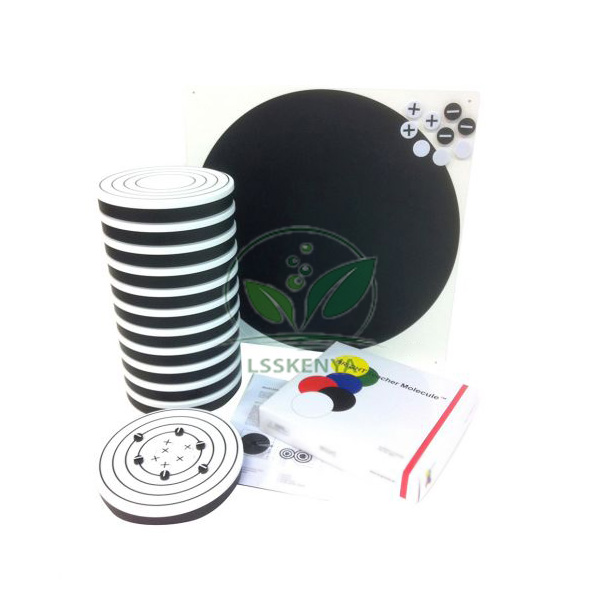
Product Code : LSK-CL-10269
This classroom kit brings together a full set of atom and molecule models for one class: twelve student atom models, one teacher atom model, one teacher molecule model and an instruction sheet. It is used to teach atomic structure, isotopes, ions, molecules and chemical bonding with hands-on models.
Specifications of the Classroom Atom and Molecule Kit
| Specification | Value |
|---|---|
| Student atom models | 12, for students to build their own atoms, isotopes and ions |
| Teacher atom model | 1, for showing atomic structure, isotopes and ions |
| Teacher molecule model | 1, for showing molecular concepts and chemical reactions |
| Instruction sheet | 1 |
| Topics covered | Atomic structure, molecules, chemical bonding |
| Supplied by | Science Lab Supplies, Ambala, India |
Teaching Atoms, Ions and Bonding with the Kit
The teacher shows each idea on the large models while students copy it on their own atom models. Students place protons, neutrons and electrons, then change one particle at a time to see what changes.
- Build the first 20 elements: students add particles shell by shell and check the arrangement against the wall chart Distribution of Electrons in Electronic Layers.
- Isotopes and ions: add a neutron to make an isotope, then remove or add an electron to make a positive or negative ion.
- Bonding and reactions: the teacher molecule model shows how atoms join, and the Molecular Models Demonstration Kit extends this to larger molecules.
Frequently Asked Questions
How do students show an isotope with the models?
They keep the number of protons the same and change only the number of neutrons. The element stays the same, but the mass number changes.
How is an ion shown?
Students take electrons off the outer shell to make a positive ion, or add electrons to make a negative ion. The protons in the nucleus stay unchanged.
Why is there one teacher model and twelve student models?
The teacher model is used at the front of the class to demonstrate. The twelve student models let pairs or small groups build the same atom at their benches.
Does the kit cover orbitals?
The atom models show the simple shell picture of protons, neutrons and electrons. Orbital shapes need a separate model, such as an atomic orbital set.
How do students work out the mass number from a model?
They add the protons and the neutrons in the nucleus. Electrons are not counted, because their mass is very small. A common mistake is to mix up the mass number with the atomic number, which counts protons only.
What can the models not show about a real atom?
They are not to scale. In a real atom the nucleus is tiny compared with the whole atom, and electrons do not move on fixed rings. Ask students to say what the model shows well and what it leaves out.
Related Atomic and Molecular Models
- Model of The Atom: board with 48 electron, 57 proton and 57 neutron spheres, 475 x 475 mm.
- Atom Activity Model: transparent plastic model for use on an overhead projector.
- Schrodinger Atomic Model: shows the shape of each orbital and its nodal planes.
- Atomic In/Organic Junior Model: molecular model set in a 24 x 20 x 5 cm box with a periodic chart in the lid.
- Sodium Chloride Crystal Model: 54 connectors with 13 black and 14 red jacks.
Find more teaching models in the Chemistry Lab range and across School Lab Equipments.
With an Importer-Exporter Code, Science Lab Supplies can send orders to schools in Vietnam, Malaysia, Peru, Egypt, Iraq and Nigeria. To request a quotation, use the contact page or the enquiry cart.
Last updated: 15 November 2026