Game - Understanding The Periodic Table
Product Code : LSK-CL-10060
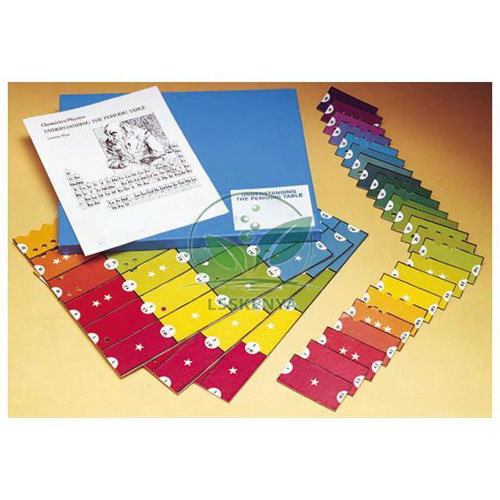
Game - Understanding The Periodic Table is a classroom puzzle in which students build their own periodic table. The kit holds enough material for 4 students or small groups to work at the same time, and it comes with complete instructions and guides for the teacher and the class.
Specifications of the Periodic Table Game
| Specification | Value |
|---|---|
| Format | Puzzle game: students build their own periodic table |
| Users | Material for 4 students or small groups working at the same time |
| Included | Complete instructions and guides |
| Supplied by | Science Lab Supplies, Ambala, India |
Using the Periodic Table Game in Class
Each group sorts the puzzle into a full periodic table, following the guide. The teacher then checks the layout and uses it to talk about groups, periods and trends.
- Starter lesson (Class 8–9): groups build the table, then check it against the wall-mounted Periodic Table of Chemical Elements chart.
- Symbols drill: after the build, students name ten elements from their symbols and compare with the Symbols of Chemical Elements chart.
- Families task: each group picks one column, such as the alkali metals or noble gases, and lists what the members share.
Common errors: mixing up rows (periods) and columns (groups), and placing elements by name instead of by atomic number.
Frequently Asked Questions
How many students can use one kit at a time?
The kit holds enough material for 4 students or 4 small groups to work at the same time. A larger class can rotate groups, or the teacher can run more than one kit side by side.
Which classes and syllabus topics does the game suit?
It suits lower secondary classes, such as Class 8 and 9, when the periodic table is first taught, and it works as revision later. It covers element symbols, ordering by atomic number, groups, periods and element families.
How does building the table link to Mendeleev's work?
Students sort elements by pattern, much as Mendeleev arranged known elements by repeating properties. A teacher can point out that he left gaps for elements not yet found and predicted their properties.
Why is the modern table ordered by atomic number and not atomic mass?
Ordering by mass puts a few pairs out of step with their families, such as tellurium and iodine. Ordering by atomic number, the number of protons, keeps every element in the group whose properties it shares.
Which ideas can the class discuss after the table is built?
Groups and periods, metals and non-metals, and families with shared properties, such as alkali metals, halogens and noble gases. Trends across a period and down a group follow on naturally.
What should a teacher do if a group gets stuck?
Give a small hint rather than the answer, for example the position of one family or the first few atomic numbers. Working through mistakes is part of how the puzzle builds understanding.
Related Periodic Table Charts and Atom Models
- Periodic Table of Chemical Elements (Short Version): laminated wall chart, 140 cm x 100 cm.
- Periodic Table of Chemical Elements (Long Version), Personal, 41.4 x 15.5 cm: laminated, 41.4 cm x 15.5 cm with a fold.
- Distribution of Electrons in Electronic Layers: laminated wall chart, 70 cm x 100 cm.
- Atom Activity Model: transparent plastic model for use with an overhead projector.
- Model of The Atom: atom model table, 475 x 475 mm, with coloured spheres for electrons, protons and neutrons.
Browse the Chemistry Lab range or the wider School Lab Equipments section.
Science Lab Supplies holds an Importer-Exporter Code and can ship to buyers in the UAE, Saudi Arabia, Oman, the Philippines, Nepal and Bangladesh. Teachers and distributors can ask for a quotation for the game on the contact page or add it to the enquiry cart.
Last updated: 15 November 2026