Plastic Wash Bottle, 500 ml
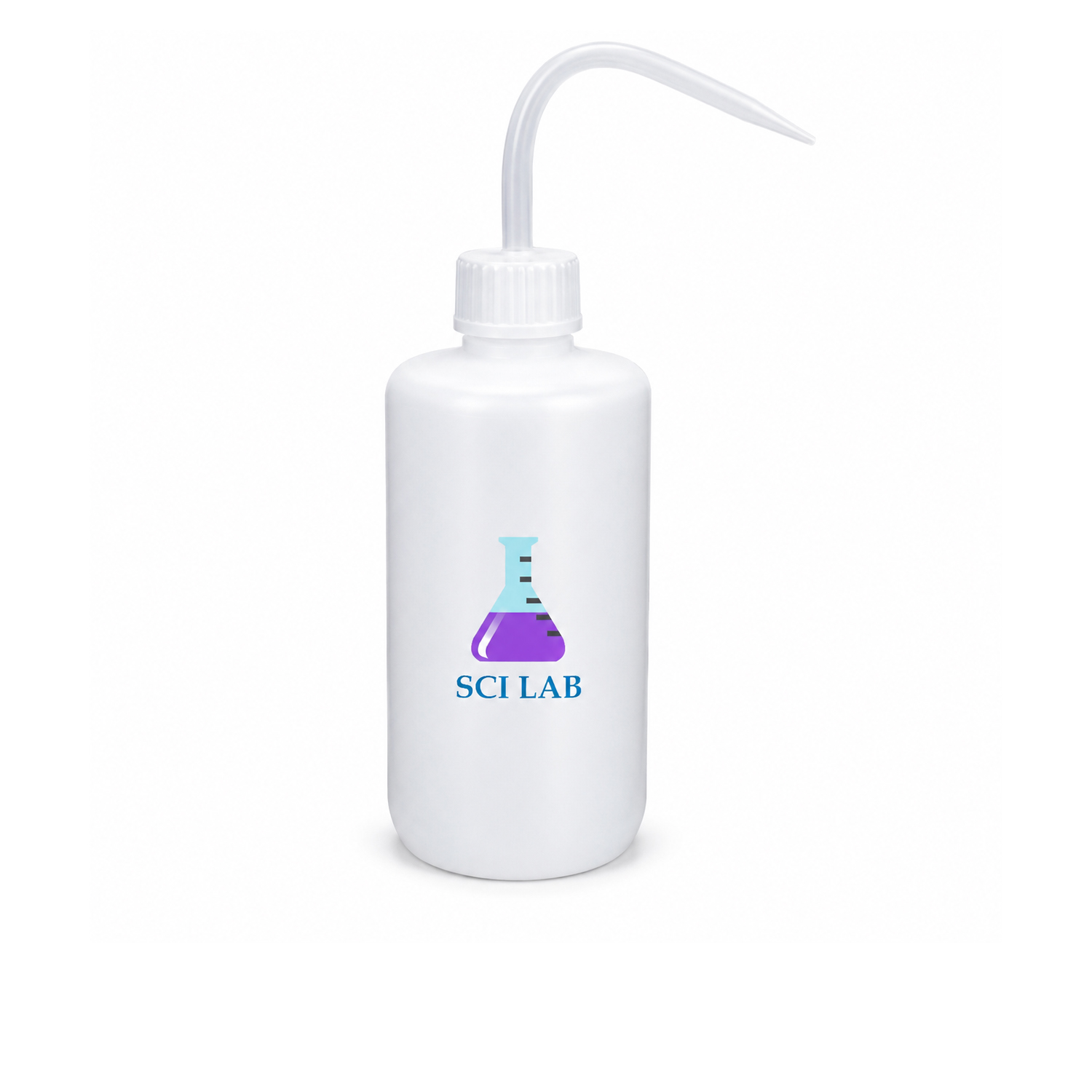
Product Code : SCL-CL-11545
The Plastic Wash Bottle is a 500 ml squeeze-and-spray bottle for rinsing glassware and moving solids with a controlled stream. Its nozzle has a 90° bend for spraying at different angles, and the screw-top seals to stop solvents evaporating.
Specifications of the Plastic Wash Bottle
| Specification | Value |
|---|---|
| Material | Plastic, chemical resistant |
| Capacity | 500 ml |
| Closure | Sealable screw-top that stops solvents evaporating |
| Nozzle | 90° bend for several spray angles |
| Action | Squeeze and spray |
| Supplied by | Science Lab Supplies, Ambala, India |
Rinsing and Transfer Work with the Wash Bottle
Squeezing the body forces liquid up the inner tube and out of the nozzle as a thin stream. The stream can be aimed at the wall of a beaker, the tip of a burette or the edge of a filter paper.
- Washing a precipitate: rinse the solid left in a beaker onto the filter paper in a 75 mm Glass Funnel, then wash it with small portions of water.
- Making up a standard solution: rinse every trace of solution from the beaker and stirring rod into the volumetric flask before filling to the mark.
- Final rinse of glassware: after washing, rinse with water from a Distiller for Distilled Water so tap-water salts do not stay on the glass.
Common errors: filling the bottle with a liquid other than the one it is labelled for, and touching the nozzle to dirty glass, which carries contamination back.
Frequently Asked Questions
How does a wash bottle push out liquid?
Squeezing the soft body raises the air pressure inside. That pressure drives the liquid up the inner tube and out through the nozzle. When you let go, air flows back in.
Should one wash bottle be kept for one liquid only?
Yes. Keep each bottle for a single liquid, usually distilled water, and label it clearly. Mixing uses carries traces from one liquid into the next and makes it easy to spray the wrong one.
Can organic solvents be kept in a plastic wash bottle?
This bottle is chemical resistant and its screw-top seals to cut evaporation. Still, check that the solvent suits the plastic, label the bottle, and keep flammable solvents away from flames when spraying.
Why is a precipitate washed with several small rinses?
Several small rinses remove more dissolved impurity than one large rinse of the same total volume. Let each portion drain through the filter before adding the next.
Related Water and Washing Supplies
- Wash Bottle, LDPE, 500 ml, Pack of 6: 500 mL flexible squeeze bottle for rinsing labware.
- Mariotte Bottle (Aspirator Bottle with Tap) for Distilled Water, 2.5 L: 2.5 l glass bottle with a tap.
- Reagent Bottle, Narrow Mouth, Clear Glass, 60 ml: 60 ml narrow-mouth bottle with a frosted stopper.
- Brush for Washing Dishes: 180 mm long brush, 30 mm in diameter.
- Laboratory Deioniser: runs from tap water with an output of up to 10 litres per hour.
Find more chemistry apparatus in the Chemistry Lab section, or browse Lab Glassware.
With an Importer-Exporter Code, Science Lab Supplies can export this item to Vietnam, Malaysia, Peru, Egypt, Iraq and Nigeria. For a quotation, write to us through the contact page or add the item to the enquiry cart.
Last updated: 14 November 2026