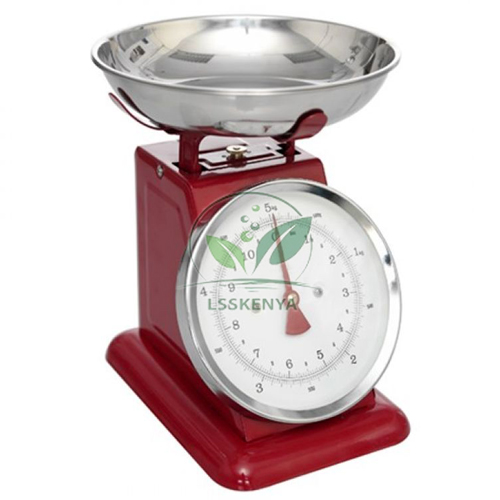
Dial Weighing Scale, Large Pan
Product Code : LSK-CL-10042
This dial weighing scale is for basic weighing in junior and intermediate science labs. A large pan takes bulky samples and containers, and a wide-view dial lets a group of pupils read the mass together. It suits first lessons on mass, where reading a scale matters more than fine precision.
Specifications of the Dial Weighing Scale
| Specification | Value |
|---|---|
| Display | Wide-view dial |
| Pan | Large pan |
| Use | Basic weighing in a junior or intermediate lab |
| Supplied by | Science Lab Supplies, Ambala, India |
Weighing Activities for Junior Classes
The scale stands on a flat table and the pointer is checked at zero with the pan empty. Pupils place the object gently in the centre of the pan, wait for the pointer to stop, and read the dial straight on.
- Reading a scale: weigh fruit, stones and books, then check the dial against known masses such as Weights with Hooks.
- Mass of water: weigh an empty Beaker Plastic, add measured volumes of water and record how the mass rises.
- Estimating: let pupils guess the mass of objects first, then weigh them and compare.
Common errors: forgetting to zero the scale, and reading the dial from the side.
Frequently Asked Questions
How does the dial scale differ from a digital balance a school may already have?
The dial scale shows a pointer moving round a wide dial as mass is added, so pupils practise reading scales and see the link between load and reading. A digital balance gives finer readings and extra functions, so it suits older pupils and chemistry work.
Which school subjects use the dial scale?
It serves early measures lessons in primary maths, where pupils read scale intervals and estimate masses, and first science lessons on mass in junior labs. The large pan takes fruit, books or a beaker of water, so the same scale covers both subjects.
How should the scale be looked after?
Do not drop heavy objects onto the pan or press on it with hands. Wipe it clean after use and store it on a flat shelf, not stacked under other items.
How do pupils read the dial between the numbered marks?
First work out what one small division is worth: divide the step between two numbered marks by the number of spaces between them. Then count the divisions on from the last number the pointer has passed.
Related Balances for School Labs
- Simple Beam Balance: plastic balance with a sliding compensator and detachable buckets.
- Rocker Bucket Balance: plastic and metal weights with a built-in storage compartment.
- Beranger Balance, 2 Pan, 2 kg: 2 kg capacity with removable 20 cm pans.
- Digital Scale 1500 g x 0.1 g, Mains or Battery: backlit LCD with one tare key.
- Mathematical balance: 8.5 in tall balance with twenty 10 g weights.
Browse the Chemistry Lab range or the Balances and Scales range.
The Importer-Exporter Code held by Science Lab Supplies covers shipments of this dial scale to Nepal, Bangladesh, Zambia, Rwanda, South Africa and Qatar. Quote requests for the dial scale go through the contact page or the enquiry cart.
Last updated: 15 November 2026