
Solubility of Chemical Substances in Water, Chart 140 x 100 cm
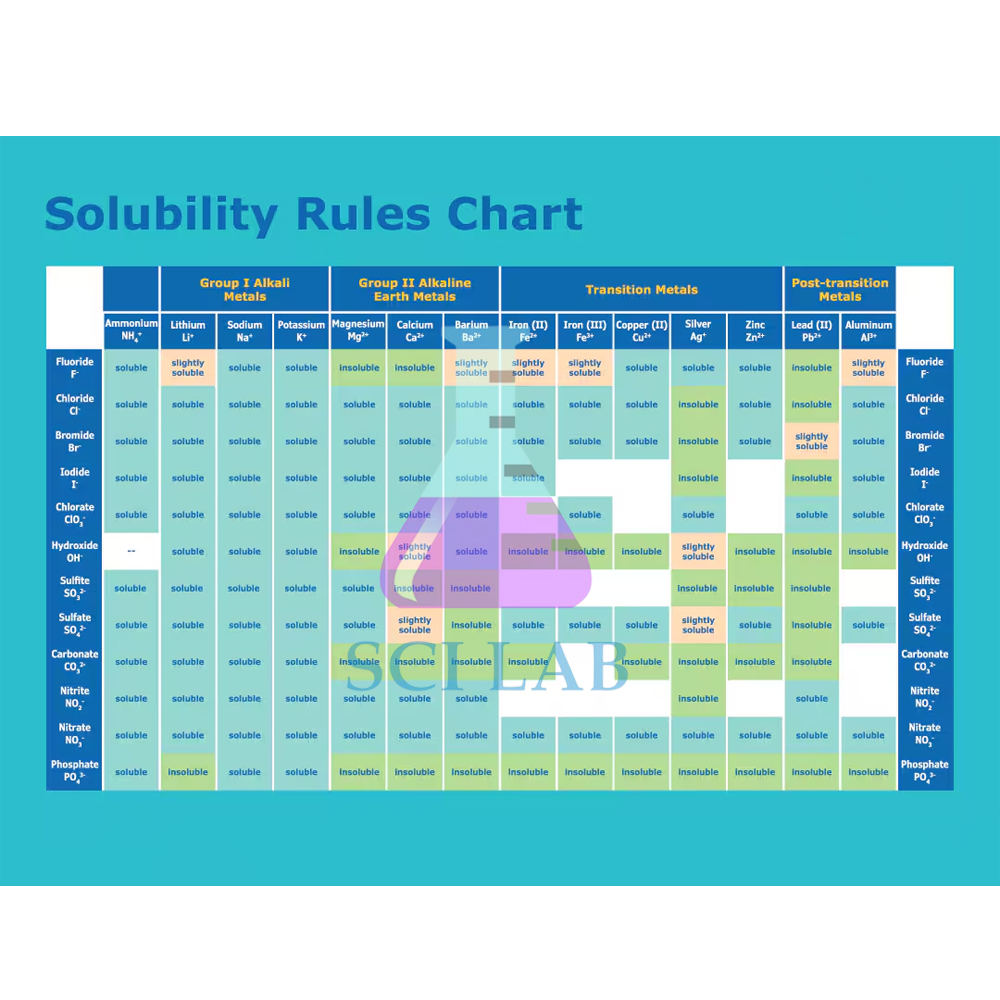
Product Code : SCL-CL-11590
Solubility of Chemical Substances in Water is a laminated wall chart, 140 cm x 100 cm, for teaching which acids, bases and salts dissolve in water and which do not. Students check it before mixing solutions, predicting precipitates or choosing a salt to crystallise.
Specifications of the Solubility Chart
| Specification | Value |
|---|---|
| Format | Laminated wall chart |
| Size | 140 cm x 100 cm |
| Mounting | Wall mounted |
| Use | Classrooms and laboratory |
| Supplied by | Science Lab Supplies, Ambala, India |
Dissolving and Precipitation Work with the Solubility Chart
Pupils look up each substance on the chart first, then test the prediction at the bench. A wrong prediction usually points to a misread row or column.
- Solubility tests: shake a small spatula of each solid with water in a 250 ml Glass Beaker and stir with a Glass Stirring Rod.
- Precipitation: mix two soluble salt solutions, predict the insoluble product from the chart and collect it on Filter Paper.
- Crystallisation: evaporate a saturated solution of a soluble salt slowly in a Glass Crystallizing Dish and compare crystal size with fast cooling.
Common errors: reading a slightly soluble salt as fully soluble, and adding too much solid so that undissolved grains are taken for a precipitate.
Frequently Asked Questions
What is the difference between solubility and how fast a solid dissolves?
Solubility is how much solute dissolves in a set amount of water at a given temperature. Speed of dissolving depends on grain size, stirring and temperature. Fine powder dissolves faster, but the final amount that can dissolve stays the same.
Why does stirring not raise the amount of salt that can dissolve?
Stirring only brings fresh water to the surface of the solid, so it dissolves sooner. Once the solution is saturated, more stirring adds nothing. Only a change of temperature or solvent changes the solubility.
Does hot water always dissolve more of a substance?
No. Most solid salts dissolve better in hot water, but calcium hydroxide is less soluble when hot, and gases such as oxygen and carbon dioxide dissolve less as water warms.
What does "insoluble" mean on a solubility chart?
It means very little dissolves, not that none does. When two soluble salts are mixed and an insoluble combination of ions can form, that substance comes out of solution as a precipitate.
Is silver chloride soluble in water?
No. Silver chloride is practically insoluble. That is why a few drops of silver nitrate solution give a white precipitate in a solution that contains chloride ions.
Related Solubility and Chemistry Charts
- Solubility Product: laminated wall chart, 70 cm x 100 cm.
- Table of Chemical Elements and Solubility of Substances for Personal Use: double-sided laminated card, 140 mm x 100 mm.
- Periodic Table of Chemical Elements (Short Version): wall chart, 140 cm x 100 cm, laminated.
- Methods of Separation of Substances Chart, 70 x 100 cm: laminated wall chart, 70 cm x 100 cm.
- Aggregate States of Water: wall-mounted laminated chart, 70 cm x 100 cm.
More charts and glassware are in the Chemistry Lab range, part of School Lab Equipments.
Science Lab Supplies holds an Importer-Exporter Code and can ship to buyers in Malaysia, Peru, Egypt, Iraq, Nigeria and Kenya. To ask for a quotation, use the contact page or the enquiry cart.
Last updated: 14 November 2026




.jpg)
.jpg)